Dichelostemma multiflorum
Wild hyacinth, Wild Hyacinth
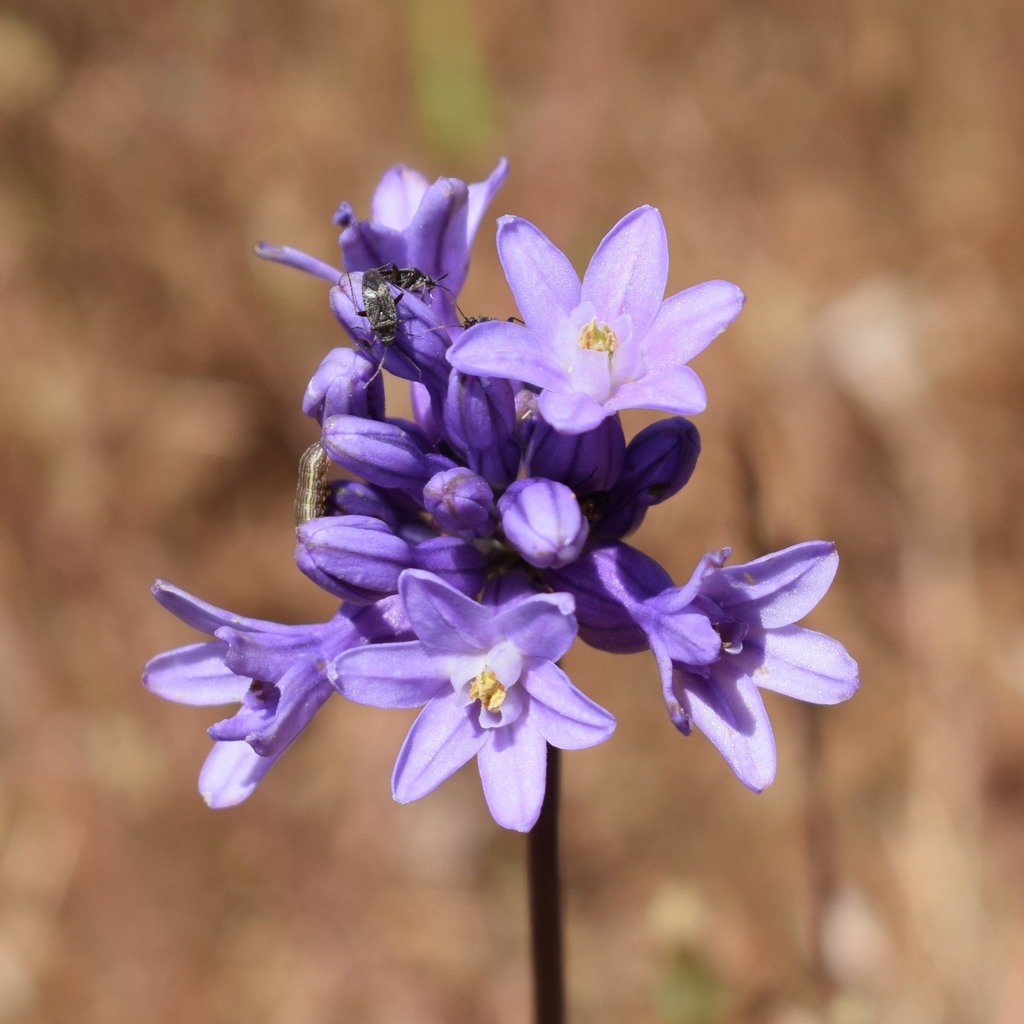
no rights reserved · CC0
Family: Themidaceae · Type: Herb · Native
Dichelostemma multiflorum (Wild hyacinth) is a native California herb in the Themidaceae family, recognized by . Key features: unkeeled leaves, crown arching toward anthers, umbel-like inflorescence.
Wild hyacinth is a California native perennial found in northwestern and northern Sierra Nevada, Sacramento Valley, San Francisco Bay Area, and Modoc Plateau in foothill grasslands, open woodlands, and scrub at elevations below 2,000 meters. Flowering from May to June, this plant produces pink to blue-purple flowers in dense umbel-like clusters with 6 to 35 erect blossoms, each featuring a cylindric perianth tube and spreading lobes. Growing with tall scapes 20 to 90 centimeters high and scabrous texture, it emerges from a cluster of 3 to 4 glaucous leaves reaching 30 to 85 centimeters long. Its leaves are unkeeled and distinctive, with an unusual white or pale purple crown that arches inward toward the anthers. The flower's pedicels are 3 to 15 millimeters long, adorned with ovate bracts 7 to 12 millimeters in length and streaked with purple.
Identification and appearance
Key characters: 3 sympatric species. Key features: unkeeled leaves, crown arching toward anthers, umbel-like inflorescence
Habitat and range
Habitat: Foothill grassland, open woodland, scrub
Elevation: < 2000 m
California counties: Amador, Plumas, Santa Clara, Shasta, Butte, Placer, Siskiyou, Tehama, Trinity, Mendocino, Tuolumne, Lassen, Calaveras, El Dorado, Modoc, Nevada, Sierra, Sacramento, Yuba, Humboldt, Alpine, Mono, Sutter, Mariposa, Glenn, Solano, San Joaquin, Sonoma, San Mateo, Yolo, Napa, Lake, Monterey, Santa Cruz
Outside California: southwestern Oregon
Bloom period
Dichelostemma multiflorum blooms May-Jun.
How to tell it apart
vs Dipterostemon: Dichelostemma stalks twist or twine dramatically; Dipterostemon stalks may curve but don't twine.; vs Allium: Dichelostemma lacks onion smell; Allium has strong onion/garlic odor when crushed.; vs Brodiaea: Dichelostemma stalks curve or twist; Brodiaea stalks stay straight and upright.; vs Triteleia: Dichelostemma stalks curve or twine; Triteleia stalks stay straight.; vs Tulbaghia: Dichelostemma lacks onion smell; Tulbaghia has garlic odor when damaged.
Frequently asked questions
Is Dichelostemma multiflorum native to California?
Yes. Dichelostemma multiflorum is native to California (recorded as native).
When does Dichelostemma multiflorum bloom?
Dichelostemma multiflorum blooms May-Jun.
Where in California does Dichelostemma multiflorum grow?
Dichelostemma multiflorum occurs in Amador, Plumas, Santa Clara, Shasta, Butte, Placer, Siskiyou, Tehama and other counties, at elevations of < 2000 m.
What plant family does Dichelostemma multiflorum belong to?
Dichelostemma multiflorum is in the Themidaceae family, genus Dichelostemma.
What habitat does Dichelostemma multiflorum grow in?
Dichelostemma multiflorum grows in Foothill grassland, open woodland, scrub.
Related species
Other California species in the same genus, family, or bioregion.
Sources: Jepson eFlora · Index of California Plant Names · CalPhotos
Last updated 2026-10-07
Data from The California Species Project — 14,000+ California species with verified data from CNPS, CDFW, USFWS, Cal-IPC, and more.