Dichelostemma volubile
Twining brodiaea, snake lily, Snake Lily
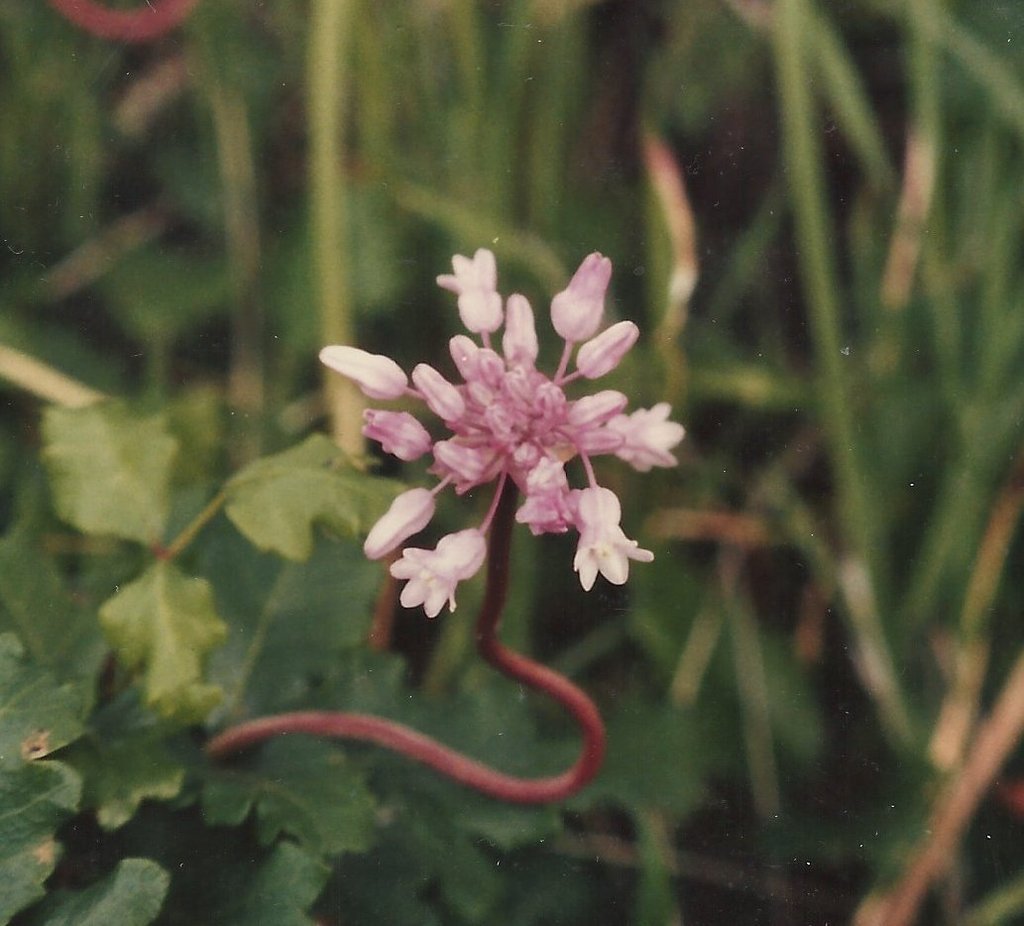
(c) 66dodge, some rights reserved (CC BY) · licence
Family: Themidaceae · Type: Vine · Native
Dichelostemma volubile (Twining brodiaea) is a native California vine in the Themidaceae family, recognized by . Key features: twining scape, presence of staminodes, climbing habit.
Twining brodiaea is a California native perennial found in northern California regions including the Coast Ranges, Cascade Range foothills, and Sierra Nevada foothills in woodland and chaparral habitats at elevations of 100 to 2,800 meters. Flowering from April to June, this plant produces pink to white flowers in dense umbel-like clusters with 6 to 30 blooms, featuring a distinctive spheric perianth tube and spreading floral lobes. Growing with an impressively long twining scape 40 to 150 centimeters tall that becomes scabrous, it develops a unique climbing habit unusual for a brodiaea. Its leaves are 3 to 4 in number, keeled and extending 30 to 70 centimeters long, with wide-ovate bracts approximately 12 to 15 millimeters long. The flower has an intricate white crown that folds inward, partially hiding the cream-white anthers and creating a delicate, complex floral structure.
Identification and appearance
Key characters: 3 sympatric species. Key features: twining scape, presence of staminodes, climbing habit
Habitat and range
Habitat: Foothill woodland, chaparral scrub
Elevation: 100-2800 m
California counties: Tulare, Lake, Yuba, Tehama, Placer, El Dorado, Madera, Mariposa, Yolo, Tuolumne, Napa, Kern, Solano, Calaveras, Amador, Nevada, Fresno, Colusa, Contra Costa, Butte, Mendocino, Glenn, San Bernardino, Stanislaus
Bloom period
Dichelostemma volubile blooms Apr-Jun.
How to tell it apart
vs Dipterostemon: Dichelostemma stalks twist or twine dramatically; Dipterostemon stalks may curve but don't twine.; vs Allium: Dichelostemma lacks onion smell; Allium has strong onion/garlic odor when crushed.; vs Brodiaea: Dichelostemma stalks curve or twist; Brodiaea stalks stay straight and upright.; vs Triteleia: Dichelostemma stalks curve or twine; Triteleia stalks stay straight.; vs Tulbaghia: Dichelostemma lacks onion smell; Tulbaghia has garlic odor when damaged.
Frequently asked questions
Is Dichelostemma volubile native to California?
Yes. Dichelostemma volubile is native to California (recorded as native).
When does Dichelostemma volubile bloom?
Dichelostemma volubile blooms Apr-Jun.
Where in California does Dichelostemma volubile grow?
Dichelostemma volubile occurs in Tulare, Lake, Yuba, Tehama, Placer, El Dorado, Madera, Mariposa and other counties, at elevations of 100-2800 m.
What plant family does Dichelostemma volubile belong to?
Dichelostemma volubile is in the Themidaceae family, genus Dichelostemma.
What habitat does Dichelostemma volubile grow in?
Dichelostemma volubile grows in Foothill woodland, chaparral scrub.
Related species
Other California species in the same genus, family, or bioregion.
- Dichelostemma congestum — Fork-toothed ookow
- Dichelostemma ida-maia — Firecracker flower
- Dichelostemma multiflorum — Wild hyacinth
- Dichelostemma sp.
- Dipterostemon capitatus — Blue dicks
- Dipterostemon capitatus subsp. capitatus
- Dipterostemon capitatus subsp. lacuna-vernalis — Vernal pool blue dicks
- Dipterostemon capitatus subsp. pauciflorus
Sources: Jepson eFlora · Index of California Plant Names · CalPhotos
Last updated 2026-10-07
Data from The California Species Project — 14,000+ California species with verified data from CNPS, CDFW, USFWS, Cal-IPC, and more.