Digitalis purpurea
Purple foxglove
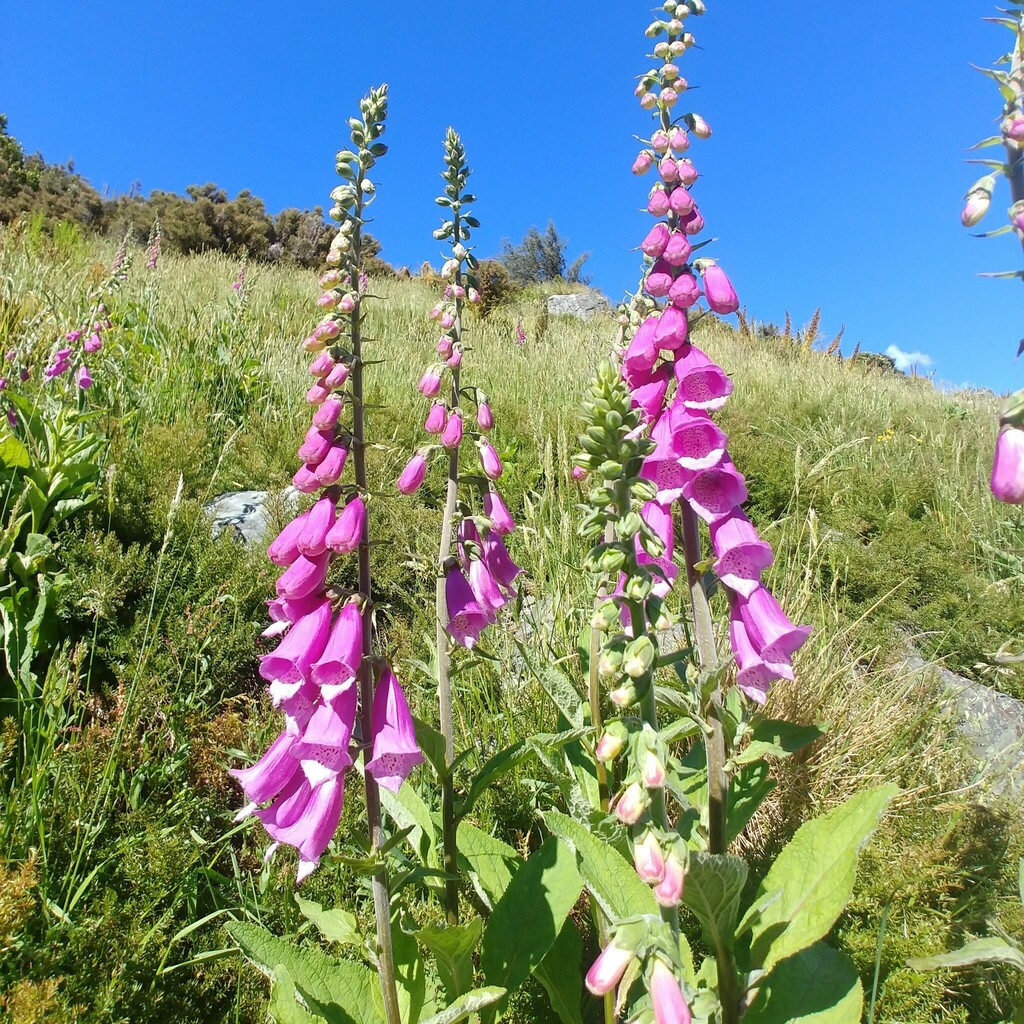
(c) nbasargin, some rights reserved (CC BY) · licence
Family: Plantaginaceae · Type: Herb · Not Native
Conservation status: Cal-IPC Yes
Digitalis purpurea (Purple foxglove) is a non-native California herb in the Plantaginaceae family, recognized by European medicinal plant naturalized in cool, moist forest habitats; only Digitalis species established in California.
Purple foxglove is a naturalized biennial found in northern California coastal, Klamath Ranges, northern Coast Ranges, Sierra Nevada, southern Sierra Nevada, central Coast, San Francisco Bay, Transverse Ranges, and Peninsular Ranges in acid soil of open woodlands and disturbed areas at elevations below 1,700 meters. Flowering from May to July, this plant produces white to pink-purple flowers 40 to 60 millimeters long with darker spots on the lower inside surface, arranged in dense terminal spikes. Growing up to 1.8 meters tall with simple stems covered in gray tomentose and glandular hairs, especially toward the top of the plant. Its large leaves are 10 to 30 centimeters long with winged petioles, lanceolate to ovate in shape, with green upper surfaces and soft hairs and gray-tomentose undersides. The fruit is approximately 12 millimeters long, containing numerous small seeds less than 0.5 millimeters in size.
Identification and appearance
Key characters: European medicinal plant naturalized in cool, moist forest habitats; only Digitalis species established in California
Habitat and range
Habitat: Acid soil in open woodland, disturbed areas
Elevation: < 1700 m
California counties: Tulare, Humboldt, Mendocino, Marin, Santa Cruz, San Diego, Orange, Mariposa, Nevada, El Dorado, Fresno, Sonoma, Siskiyou, Sacramento, Butte, San Mateo, Alameda, Napa, San Joaquin, Placer, Del Norte, Sierra, Trinity, San Luis Obispo, Santa Barbara, Santa Clara, Yolo, Monterey, Tuolumne
Outside California: to British Columbia, native to western Europe, northwestern Africa
Bloom period
Digitalis purpurea blooms May-Jul.
Conservation status
Cal-IPC Yes
How to tell it apart
vs Verbascum: Digitalis has one-sided flower spikes with bells; Verbascum has flowers all around a woolly spike.; vs Salvia: Digitalis has bell-shaped flowers with 4 stamens inside; Salvia has hooded flowers with 2 protruding stamens.; vs Campanula: Digitalis flowers have irregular two-lipped openings; Campanula bells are perfectly symmetrical with 5 equal lobes.; vs Penstemon: Digitalis has smooth bell interiors with spots; Penstemon has hairy lower lips and throat guides.; vs Antirrhinum: Digitalis has open bell throats 40-60mm long; Antirrhinum has closed snapdragon mouths under 30mm.
Frequently asked questions
Is Digitalis purpurea native to California?
No. Digitalis purpurea is not native to California (recorded as not native).
When does Digitalis purpurea bloom?
Digitalis purpurea blooms May-Jul.
Where in California does Digitalis purpurea grow?
Digitalis purpurea occurs in Tulare, Humboldt, Mendocino, Marin, Santa Cruz, San Diego, Orange, Mariposa and other counties, at elevations of < 1700 m.
What plant family does Digitalis purpurea belong to?
Digitalis purpurea is in the Plantaginaceae family, genus Digitalis.
Is Digitalis purpurea invasive in California?
Digitalis purpurea is listed by Cal-IPC with an invasiveness rating of Yes.
Related species
Other California species in the same genus, family, or bioregion.
Sources: Jepson eFlora · Index of California Plant Names · CalPhotos
Last updated 2026-10-07
Data from The California Species Project — 14,000+ California species with verified data from CNPS, CDFW, USFWS, Cal-IPC, and more.