Digitaria sanguinalis
Hairy crab grass
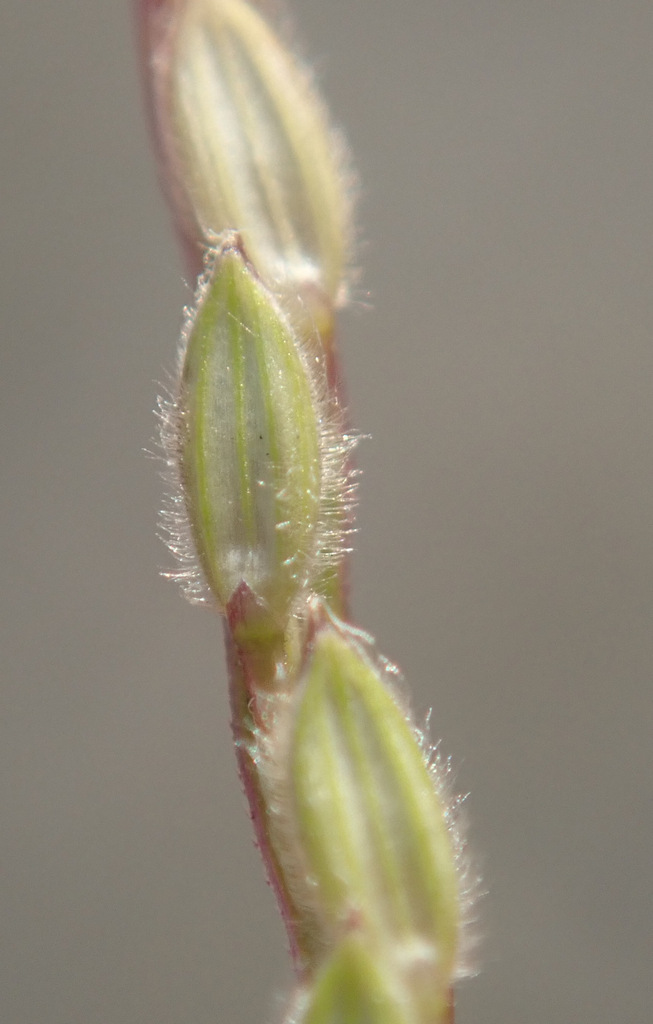
(c) Thomas Gyselinck, some rights reserved (CC BY), uploaded by Thomas Gyselinck · licence
Family: Poaceae · Type: Grass · Not Native
Digitaria sanguinalis (Hairy crab grass) is a non-native California grass in the Poaceae family, recognized by swollen-based hairs on both leaf surfaces and purple stems.
Hairy crab grass is a naturalized annual grass found in California's lowland and coastal regions in disturbed areas at elevations below 1,250 meters. Flowering from June to September, this grass produces purple-tinged spikelets with delicate white to green flowers. Growing with decumbent stems 20 to 70 centimeters long that often root at lower nodes and have a purplish cast, it spreads readily in disturbed landscapes. Its leaf blades are 3 to 10 centimeters long, covered with swollen-based hairs on both surfaces, and typically 3 to 8 millimeters wide. The plant forms branching, digitate flower clusters with spikelets generally occurring two per node.
Identification and appearance
Key characters: 3 sympatric species; distinguished by swollen-based hairs on both leaf surfaces and purple stems
Habitat and range
Habitat: Disturbed areas
Elevation: < 1250 m
California counties: El Dorado, Los Angeles, Alameda, Butte, Colusa, Del Norte, Fresno, Humboldt, Marin, Orange, Riverside, Sacramento, San Bernardino, San Diego, San Joaquin, San Luis Obispo, Santa Barbara, Santa Clara, Santa Cruz, Shasta, Stanislaus, Tulare, Ventura, Inyo, Kern, Lake, Mariposa, San Mateo, Sonoma, Tuolumne, Yolo, Merced, Amador, Nevada, Calaveras, Placer, Lassen, Mendocino, Plumas, Siskiyou, Trinity, Monterey, San Francisco, Sutter, Solano, Napa, Contra Costa, Imperial, Yuba, Glenn, Tehama, Madera, Kings
Outside California: to Canada, widespread in United States, native to Europe
Bloom period
Digitaria sanguinalis blooms Jun-Sep.
How to tell it apart
vs Eleusine: Digitaria has flexible mature seeds; goosegrass has flattened hard seeds and often grows in a perfect rosette.; vs Cynodon: Digitaria has 3-10 finger-like branches; bermudagrass has 3-7 branches and spreads by aggressive stolons.; vs Ehrharta: Digitaria has finger-like branches with flexible seeds; veldtgrass has a pyramidal panicle with hardened lemmas.; vs Stenotaphrum: Digitaria has thin finger-like branches; St. Augustine grass has thick, flattened stems and embedded spikelets.; vs Cenchrus: Digitaria has open finger-like branches; sandbur has spikelets enclosed in spiny burs.
Frequently asked questions
Is Digitaria sanguinalis native to California?
No. Digitaria sanguinalis is not native to California (recorded as not native).
When does Digitaria sanguinalis bloom?
Digitaria sanguinalis blooms Jun-Sep.
Where in California does Digitaria sanguinalis grow?
Digitaria sanguinalis occurs in El Dorado, Los Angeles, Alameda, Butte, Colusa, Del Norte, Fresno, Humboldt and other counties, at elevations of < 1250 m.
What plant family does Digitaria sanguinalis belong to?
Digitaria sanguinalis is in the Poaceae family, genus Digitaria.
What habitat does Digitaria sanguinalis grow in?
Digitaria sanguinalis grows in Disturbed areas.
Related species
Other California species in the same genus, family, or bioregion.
Sources: Jepson eFlora · Index of California Plant Names · CalPhotos
Last updated 2026-10-07
Data from The California Species Project — 14,000+ California species with verified data from CNPS, CDFW, USFWS, Cal-IPC, and more.