Dimorphotheca ecklonis
Blue & white daisybush
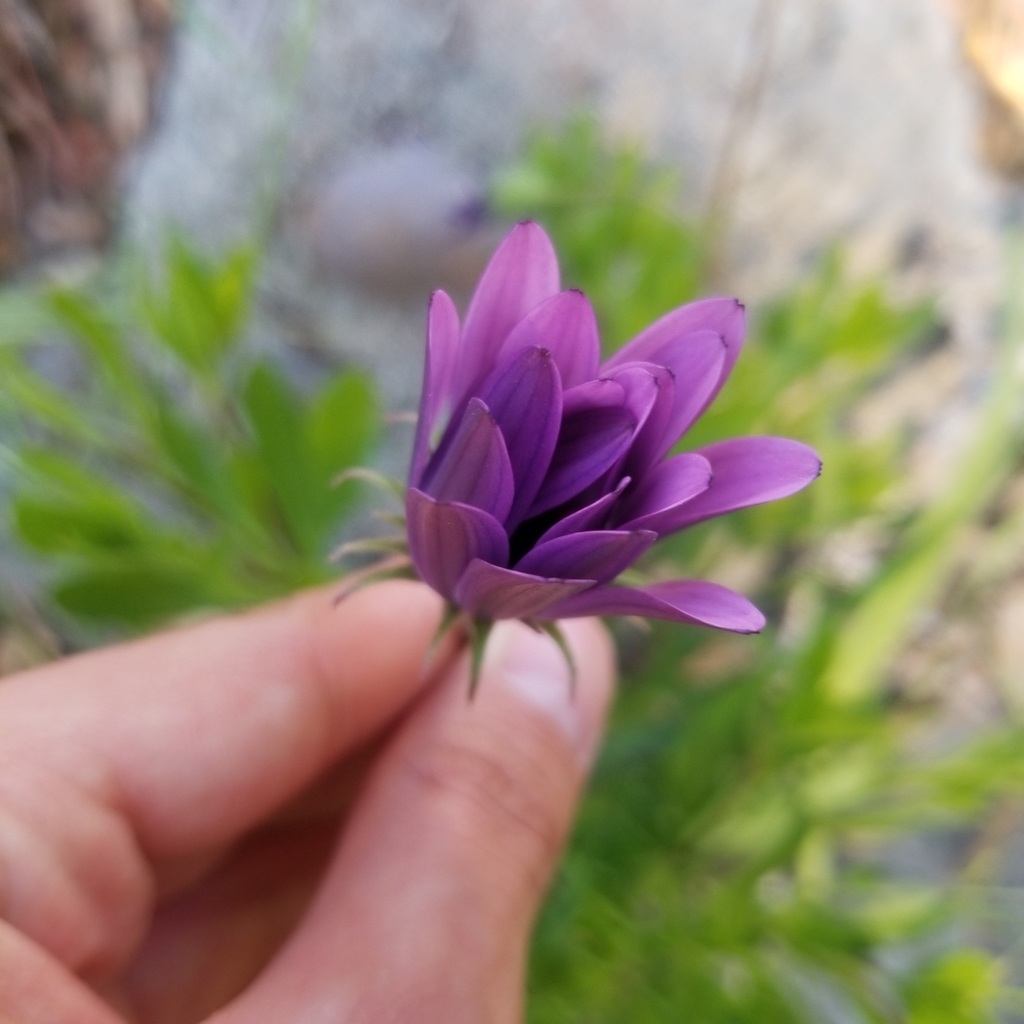
(c) James C. Davis, some rights reserved (CC BY-SA) · licence
Family: Asteraceae · Type: Subshrub · Not Native
Dimorphotheca ecklonis (Blue & white daisybush) is a non-native California subshrub in the Asteraceae family, recognized by differentiated by woody shrub habit vs. trailing perennial vs. small annual, plus distinct flower colors.
Blue and white daisybush is a naturalized shrub found in coastal California regions including the Central Coast, Southern Coast, and Peninsular Ranges in disturbed places and beaches at elevations below 200 meters. Flowering from March to July (and potentially year-round in cultivation), this plant produces distinctive ray flowers that are white adaxially and blue-purple abaxially, creating a striking two-toned appearance in flower heads 4 to 7 centimeters wide. Growing up to 1 meter tall with erect or ascending branches, the shrub has a puberulent texture with stems that branch distally or throughout. Its leaves range from 3 to 6 centimeters long, varying from linear-oblong to obovate, with proximal leaves wing-petioled and distal leaves nearly sessile, and are slightly fleshy with entire or sparingly dentate edges. The flower heads feature lance-linear phyllaries 12 to 15 millimeters long with narrowly scarious margins, creating a distinctive bell-shaped involucre.
Identification and appearance
Key characters: 2 sympatric species; differentiated by woody shrub habit vs. trailing perennial vs. small annual, plus distinct flower colors
Habitat and range
Habitat: Uncommon. Disturbed places, beaches; escape from cultivation
Elevation: < 200 m
California counties: Los Angeles, Orange, Riverside, Santa Barbara, Ventura, San Luis Obispo, San Diego
Outside California: native to southern Africa
Bloom period
Dimorphotheca ecklonis blooms Generally Mar-Jul(+- all year in cultivation).
How to tell it apart
vs Anemone: Anemone has no true petals (just colorful sepals) and never has a yellow disk center like Dimorphotheca.; vs Osteospermum: Osteospermum has spoon-shaped disk fruits with a hardened center, while Dimorphotheca disk fruits are flat.; vs Arctotis: Arctotis plants are coarse perennials or subshrubs with inch-long rays; Dimorphotheca is a delicate annual with half-inch heads.; vs Encelia: Encelia has no ray flowers on most heads (disk-only), while Dimorphotheca always has showy rays.; vs Gazania: Gazania leaves are white-woolly underneath and clustered at the base; Dimorphotheca has green puberulent leaves along stems.
Frequently asked questions
Is Dimorphotheca ecklonis native to California?
No. Dimorphotheca ecklonis is not native to California (recorded as not native).
When does Dimorphotheca ecklonis bloom?
Dimorphotheca ecklonis blooms Generally Mar-Jul(+- all year in cultivation).
Where in California does Dimorphotheca ecklonis grow?
Dimorphotheca ecklonis occurs in Los Angeles, Orange, Riverside, Santa Barbara, Ventura, San Luis Obispo, San Diego, at elevations of < 200 m.
What plant family does Dimorphotheca ecklonis belong to?
Dimorphotheca ecklonis is in the Asteraceae family, genus Dimorphotheca.
What habitat does Dimorphotheca ecklonis grow in?
Dimorphotheca ecklonis grows in Uncommon. Disturbed places, beaches; escape from cultivation.
Related species
Other California species in the same genus, family, or bioregion.
Sources: Jepson eFlora · Index of California Plant Names · CalPhotos
Last updated 2026-10-07
Data from The California Species Project — 14,000+ California species with verified data from CNPS, CDFW, USFWS, Cal-IPC, and more.