Diplacus jepsonii
Jepson's monkeyflower
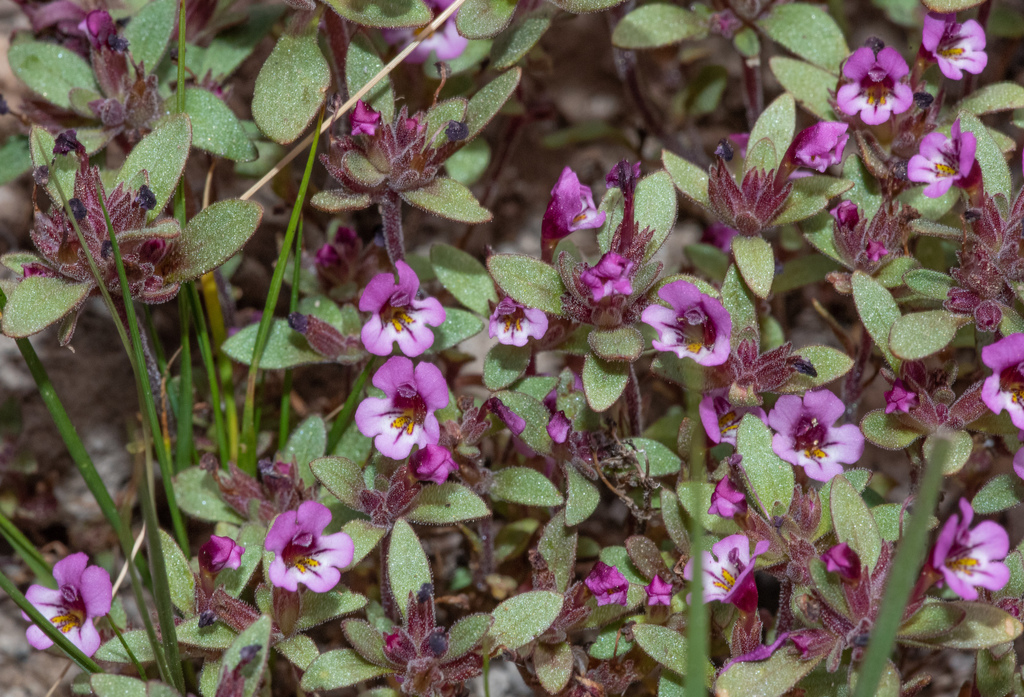
(c) Don Loarie, some rights reserved (CC BY) · licence
Family: Phrymaceae · Type: Annual · Native
Diplacus jepsonii (Jepson's monkeyflower) is a native California annual in the Phrymaceae family, recognized by small flowers and congested fruit nodes.
Jepson's monkeyflower is a California native annual found in eastern Klamath Ranges, northeastern California mountains, northern Sierra Nevada, and western Modoc Plateau in shallow drainage areas of pine forest openings at elevations of 1,200 to 2,380 meters. Flowering from May to August, this plant produces lavender to rose-purple flowers with wide petals 5 to 10 millimeters across. Growing 1 to 15 centimeters tall with stems where lower internodes are notably longer than upper ones, it develops a dominant primary axis that is minutely glandular-hairy. Its leaves are delicately puberulent, with lower stem sections showing more distinctive growth characteristics. The plant produces fruits 3.5 to 6 millimeters long, typically clustered at stem tips.
Identification and appearance
Key characters: 13 sympatric species; small flowers and congested fruit nodes
Habitat and range
Habitat: Shallow drainage areas in pine forest openings
Elevation: 1220-2380 m
Outside California: southern Oregon, western Nevada (Mount Rose, Washoe Co.)
Bloom period
Diplacus jepsonii blooms May-Aug.
How to tell it apart
vs Erythranthe: Diplacus has a corolla that withers and stays attached and typically grows in dry, rocky places; Erythranthe drops its corolla cleanly and favors wet seeps and streambanks.; vs Mimulus: Diplacus covers the shrubby and small annual western monkeyflowers with ribbed, inflating calyces; Mimulus (in the strict sense) is a fleshy-stemmed perennial with squarish 4-angled stems.; vs Mimetanthe: Diplacus is puberulent to glandular with a distinctly 2-lipped flower; Mimetanthe is densely long-soft-wavy-hairy with tiny yellow flowers and a nearly regular calyx.; vs Collinsia: Diplacus has an open funnel-throated corolla and a 5-ribbed calyx; Collinsia has a sharply 2-lipped flower with the middle lower lobe folded into a keel that hides the stamens.; vs Antirrhinum: Diplacus has an open-throated corolla and free calyx lobes; Antirrhinum (snapdragon) has a closed, pouched throat sealed by a palate and a spurless sac at the base.
Frequently asked questions
Is Diplacus jepsonii native to California?
Yes. Diplacus jepsonii is native to California (recorded as native).
When does Diplacus jepsonii bloom?
Diplacus jepsonii blooms May-Aug.
What plant family does Diplacus jepsonii belong to?
Diplacus jepsonii is in the Phrymaceae family, genus Diplacus.
What habitat does Diplacus jepsonii grow in?
Diplacus jepsonii grows in Shallow drainage areas in pine forest openings.
Related species
Other California species in the same genus, family, or bioregion.
Sources: Jepson eFlora · CalPhotos
Last updated 2026-09-30
Data from The California Species Project — 14,000+ California species with verified data from CNPS, CDFW, USFWS, Cal-IPC, and more.