Diplacus leptaleus
Least flowered monkeyflower
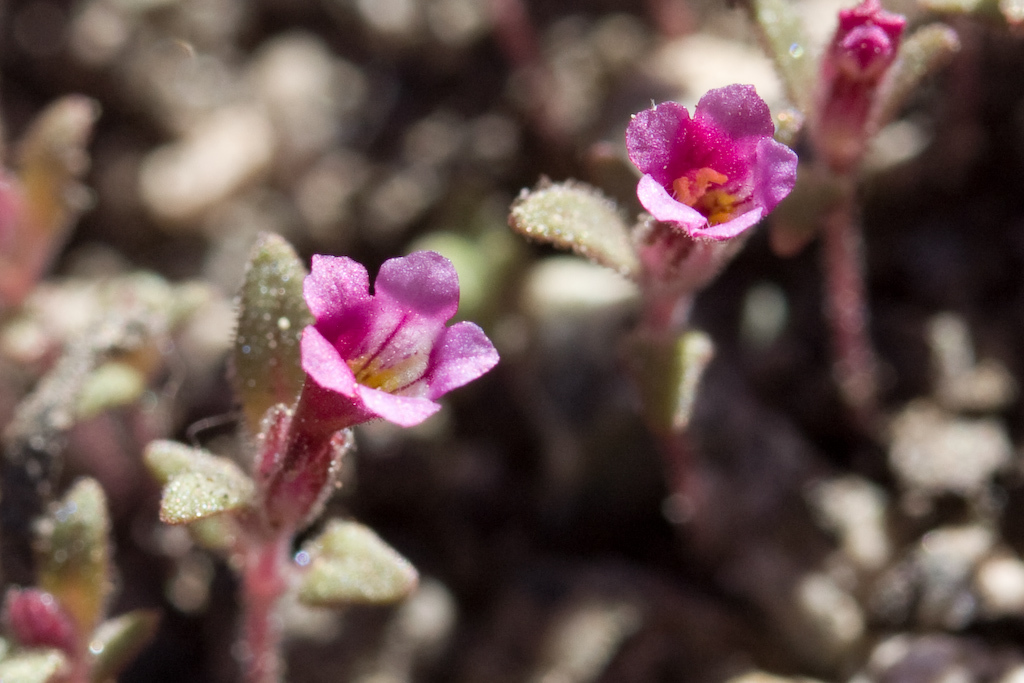
(c) Ken-ichi Ueda, some rights reserved (CC BY) · licence
Family: Phrymaceae · Type: Herb · Native
Diplacus leptaleus (Least flowered monkeyflower) is a native California herb in the Phrymaceae family, recognized by size, elevation, and flower characteristics.
Least flowered monkeyflower is a California native annual found in the Klamath Ranges, High Cascade Range, and Sierra Nevada in granitic soil and disturbed areas near rocky outcrops at elevations of 2,000 to 3,400 meters. Flowering from June to August, this plant produces magenta or white flowers with distinctive white throats marked with dark dots, creating delicate 3 to 5 millimeters wide blooms. Growing as a diminutive plant reaching 0.5 to 14 centimeters tall with soft puberulent stems, it displays a compact and understated form. Its leaves are slender, ranging 5 to 25 millimeters long, varying from linear to oblanceolate in shape and contributing to its subtle botanical character. The small flowers emerge on extremely short pedicels of 0.5 to 1 millimeter, with a puberulent calyx featuring nearly equal lobes 0.8 to 2 millimeters long.
Identification and appearance
Key characters: 18 sympatric species; distinguished by size, elevation, and flower characteristics
Habitat and range
Habitat: Granitic soils or sand near outcrops, disturbed areas
Elevation: 2000-3400 m
Outside California: western Nevada (Mount Rose, Washoe Co.)
Bloom period
Diplacus leptaleus blooms Jun-Aug.
How to tell it apart
vs Erythranthe: Diplacus has a corolla that withers and stays attached and typically grows in dry, rocky places; Erythranthe drops its corolla cleanly and favors wet seeps and streambanks.; vs Mimulus: Diplacus covers the shrubby and small annual western monkeyflowers with ribbed, inflating calyces; Mimulus (in the strict sense) is a fleshy-stemmed perennial with squarish 4-angled stems.; vs Mimetanthe: Diplacus is puberulent to glandular with a distinctly 2-lipped flower; Mimetanthe is densely long-soft-wavy-hairy with tiny yellow flowers and a nearly regular calyx.; vs Collinsia: Diplacus has an open funnel-throated corolla and a 5-ribbed calyx; Collinsia has a sharply 2-lipped flower with the middle lower lobe folded into a keel that hides the stamens.; vs Antirrhinum: Diplacus has an open-throated corolla and free calyx lobes; Antirrhinum (snapdragon) has a closed, pouched throat sealed by a palate and a spurless sac at the base.
Frequently asked questions
Is Diplacus leptaleus native to California?
Yes. Diplacus leptaleus is native to California (recorded as native).
When does Diplacus leptaleus bloom?
Diplacus leptaleus blooms Jun-Aug.
What plant family does Diplacus leptaleus belong to?
Diplacus leptaleus is in the Phrymaceae family, genus Diplacus.
What habitat does Diplacus leptaleus grow in?
Diplacus leptaleus grows in Granitic soils or sand near outcrops, disturbed areas.
Related species
Other California species in the same genus, family, or bioregion.
Sources: Jepson eFlora · CalPhotos
Last updated 2026-10-07
Data from The California Species Project — 14,000+ California species with verified data from CNPS, CDFW, USFWS, Cal-IPC, and more.