Dipsacus sativus
Fuller's teasel
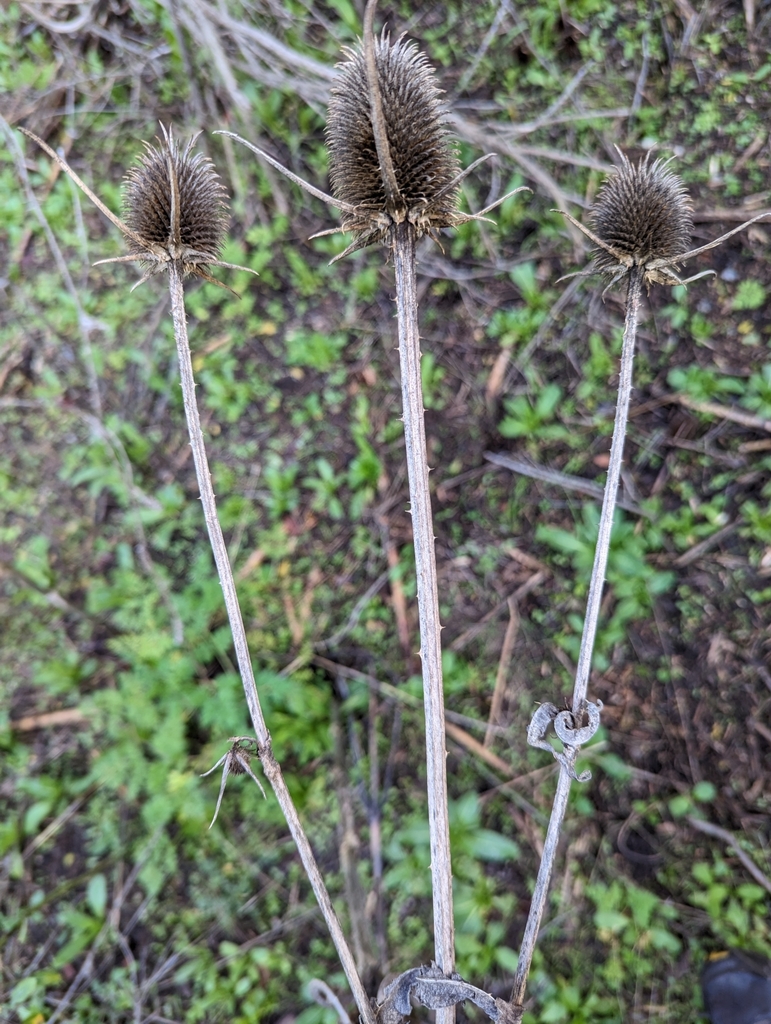
(c) Alan Rockefeller, some rights reserved (CC BY) · licence
Family: Dipsacaceae · Type: Herb · Not Native
Conservation status: Cal-IPC Yes
Dipsacus sativus (Fuller's teasel) is a non-native California herb in the Dipsacaceae family, recognized by key difference in leaf fusion width around stem.
Fuller's teasel is a naturalized biennial found in northern coastal, northern coastal-rocky, central western California, and Peninsular Ranges in disturbed areas, fields, vacant lots, and pastures at elevations below 800 meters. Flowering from May to July, this plant produces pale lavender to white flowers in dense, ovoid to cylindrical heads 5 to 10 centimeters long. Growing with robust, branching stems that can reach up to one meter tall, it develops distinctive leaf pairs that fuse widely around the stem. Its large leaves are connected at the base, forming a cup-like structure around the stem that can collect water. The fruit is approximately 6 to 8 millimeters long, contributing to its characteristic bristly appearance.
Identification and appearance
Key characters: 1 sympatric species; key difference in leaf fusion width around stem
Habitat and range
Habitat: Disturbed areas, fields, vacant lots, pastures
Elevation: < 800 m
California counties: San Mateo, Santa Clara, Santa Barbara, San Bernardino, San Diego, San Luis Obispo, Sonoma, Riverside, Calaveras, Marin, Glenn, Humboldt, Alameda, Napa, Solano, Siskiyou, Santa Cruz, Contra Costa, Los Angeles
Outside California: native to Europe
Bloom period
Dipsacus sativus blooms May-Jul.
Conservation status
Cal-IPC Yes
How to tell it apart
vs Cirsium: Dipsacus has egg-shaped heads with protruding bracts; Cirsium has round thistle heads.; vs Helminthotheca: Dipsacus has dense cylindrical heads; Helminthotheca has typical dandelion-like composite flowers.; vs Eryngium: Dipsacus has soft tubular flowers in heads; Eryngium has hard, ball-like flower heads.; vs Verbascum: Dipsacus has spiny stems and bracts; Verbascum is soft-fuzzy with no spines.; vs Plantago: Dipsacus has armed stems and egg-shaped heads; Plantago is unarmed with spike-like heads.
Frequently asked questions
Is Dipsacus sativus native to California?
No. Dipsacus sativus is not native to California (recorded as not native).
When does Dipsacus sativus bloom?
Dipsacus sativus blooms May-Jul.
Where in California does Dipsacus sativus grow?
Dipsacus sativus occurs in San Mateo, Santa Clara, Santa Barbara, San Bernardino, San Diego, San Luis Obispo, Sonoma, Riverside and other counties, at elevations of < 800 m.
What plant family does Dipsacus sativus belong to?
Dipsacus sativus is in the Dipsacaceae family, genus Dipsacus.
Is Dipsacus sativus invasive in California?
Dipsacus sativus is listed by Cal-IPC with an invasiveness rating of Yes.
Related species
Other California species in the same genus, family, or bioregion.
Sources: Jepson eFlora · Index of California Plant Names · CalPhotos
Last updated 2026-10-07
Data from The California Species Project — 14,000+ California species with verified data from CNPS, CDFW, USFWS, Cal-IPC, and more.