Dipterostemon capitatus subsp. lacuna-vernalis
Vernal pool blue dicks
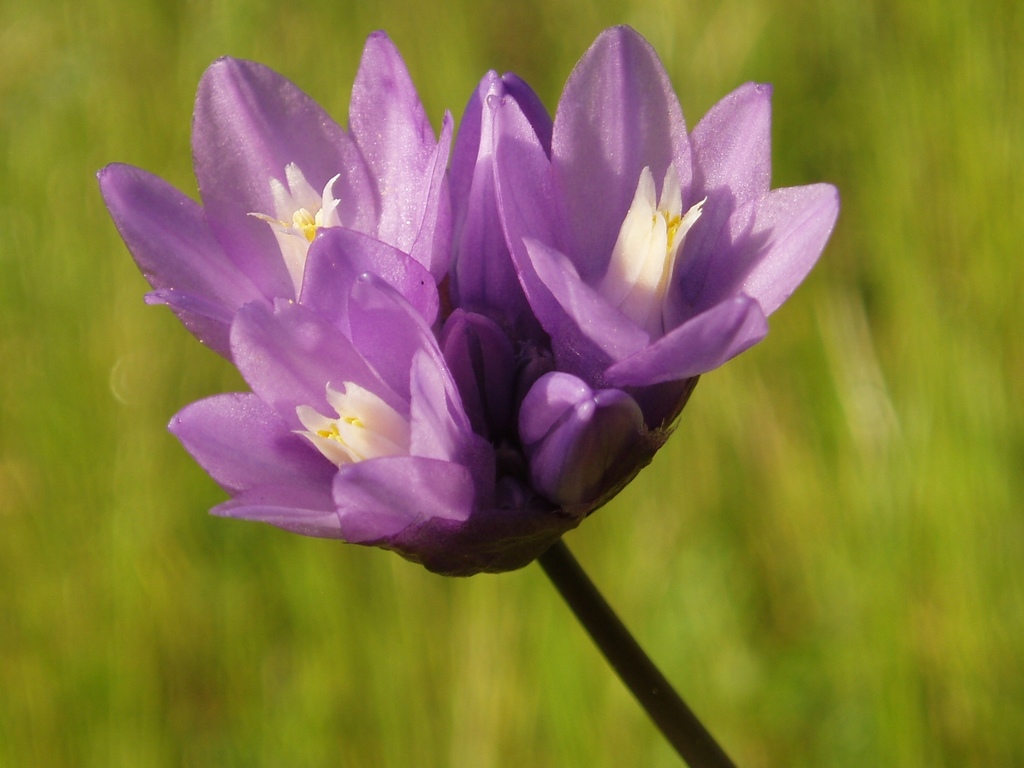
(c) Tom Hilton, some rights reserved (CC BY) · licence
Family: Themidaceae · Type: Perennial · Native
Dipterostemon capitatus subsp. lacuna-vernalis (Vernal pool blue dicks) is a native California perennial in the Themidaceae family, recognized by 3 sympatric subspecies; key features are short scape (6-20 cm), very few flowers (1-3), short pedicels (<4.5 mm), and low elevation habitat.
Vernal pool blue dicks is a California native perennial found in grasslands and grassy openings in oak woodland in central California at elevations of 30 to 270 meters. Flowering from February to April, this plant produces purple flowers in compact clusters with 1 to 3 blooms per scape. Growing with slender stems 6 to 20 centimeters tall, it emerges from a small underground corm. Its flowers feature distinctive ovate perianth lobes that are 9 to 14 millimeters long, with outer lobes cordate at the base and inner lobes oblong in shape. Each delicate flower has small appendages 3.4 to 6 millimeters long, creating an intricate floral structure characteristic of this vernal pool indicator species.
Identification and appearance
Key characters: 3 sympatric subspecies; key features are short scape (6-20 cm), very few flowers (1-3), short pedicels (<4.5 mm), and low elevation habitat
Habitat and range
Habitat: Grassland, grassy openings in oak woodland
Elevation: 30-270 m
Bloom period
Dipterostemon capitatus subsp. lacuna-vernalis blooms Feb-Apr.
How to tell it apart
vs Dichelostemma: Dipterostemon has 6 fertile stamens (all with anthers) and 2 broad papery bracts under a tight head; Dichelostemma has only 3 fertile stamens alternating with 3 forked, sterile staminodes.; vs Brodiaea: Dipterostemon crowds its flowers into a dense head on very short pedicels with 6 stamens; Brodiaea has an open umbel of long-pedicelled flowers with 3 stamens plus 3 flat petal-like staminodes.; vs Triteleia: Dipterostemon flowers are packed into a bracted head; Triteleia holds its 6-stamened flowers in an open umbel on spreading pedicels.; vs Bloomeria: Dipterostemon has a fused perianth tube and a congested head; Bloomeria has yellow tepals nearly free to the base in an open, star-like umbel.; vs Allium: Dipterostemon has no onion smell and a dense purple head under leafy bracts; Allium (wild onion) reeks of onion and opens from a papery spathe.
Frequently asked questions
Is Dipterostemon capitatus subsp. lacuna-vernalis native to California?
Yes. Dipterostemon capitatus subsp. lacuna-vernalis is native to California (recorded as native).
When does Dipterostemon capitatus subsp. lacuna-vernalis bloom?
Dipterostemon capitatus subsp. lacuna-vernalis blooms Feb-Apr.
What plant family does Dipterostemon capitatus subsp. lacuna-vernalis belong to?
Dipterostemon capitatus subsp. lacuna-vernalis is in the Themidaceae family, genus Dipterostemon.
What habitat does Dipterostemon capitatus subsp. lacuna-vernalis grow in?
Dipterostemon capitatus subsp. lacuna-vernalis grows in Grassland, grassy openings in oak woodland.
Related species
Other California species in the same genus, family, or bioregion.
Sources: Jepson eFlora · CalPhotos
Last updated 2026-09-30
Data from The California Species Project — 14,000+ California species with verified data from CNPS, CDFW, USFWS, Cal-IPC, and more.