Dittrichia graveolens
Stinkwort
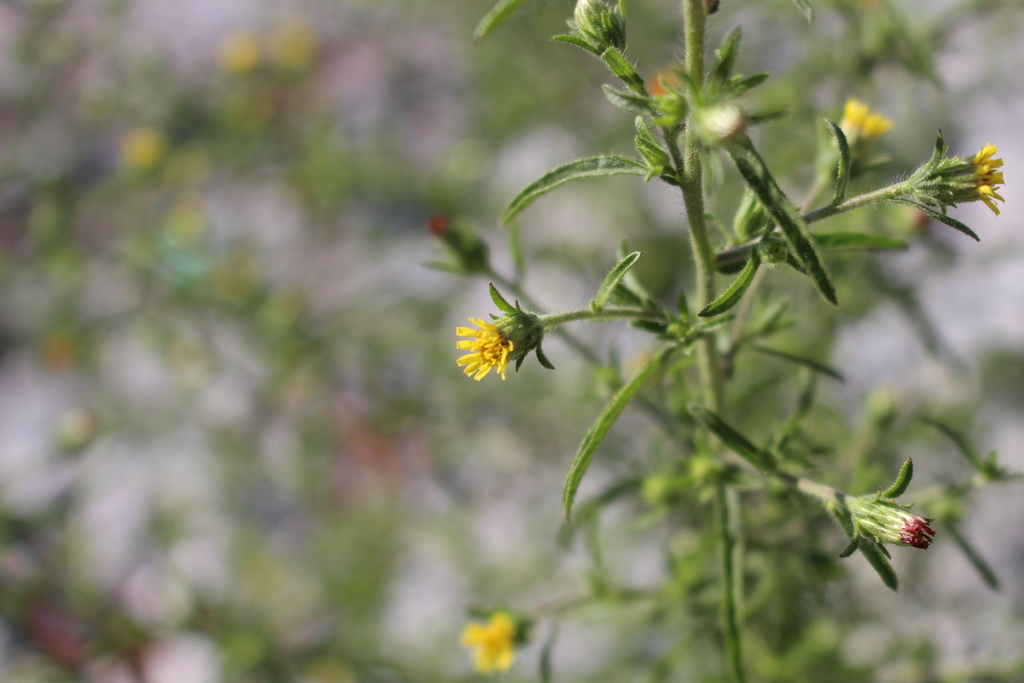
(c) Fabien Piednoir, some rights reserved (CC BY-SA), uploaded by Fabien Piednoir · licence
Family: Asteraceae · Type: Herb · Not Native
Conservation status: Cal-IPC Yes
Dittrichia graveolens (Stinkwort) is a non-native California herb in the Asteraceae family, recognized by annual herb 2-10 dm tall with narrow linear leaves.
Stinkwort is a naturalized annual found in the Klamath Ranges, northern Sierra Nevada, Central Valley, Central Coast, San Francisco Bay Area, and southern California coastal regions in disturbed areas at elevations below 700 meters. Flowering from September to November, this plant produces yellow ray flowers with small white disk flowers in compact heads. Growing with a single, much-branched erect stem reaching 20 to 100 centimeters tall, it develops a robust and spreading habit. Its narrow linear leaves are 1 to 5 centimeters long, typically 1 to 4 millimeters wide, with minimal to no serration along the edges. The plant produces small fruits with 25 to 30 feathery pappus bristles, contributing to its widespread dispersal in disturbed landscapes.
Identification and appearance
Key characters: 0 sympatric species - geographically isolated; annual herb 2-10 dm tall with narrow linear leaves
Habitat and range
Habitat: Disturbed areas
Elevation: < 700 m
Outside California: native to western Europe, Mediterranean, southwestern Asia, introduced, possibly naturalized in New York, Connecticut, New Jersey, Europe, Asia, Africa, South America, Australia
Bloom period
Dittrichia graveolens blooms Sep-Nov.
Conservation status
Cal-IPC Yes
How to tell it apart
vs Solidago: Dittrichia is intensely sticky-glandular and camphor-scented, a bushy plant with small spreading heads; goldenrods are non-sticky, scentless, with heads massed in dense one-sided plume-like sprays.; vs Grindelia: Dittrichia has narrow, few-toothed leaves and small heads with short rays; Grindelia (gumweed) has broad clasping toothed leaves and large heads with a gummy white-exuding involucre and hooked phyllaries.; vs Baccharis: Dittrichia has short yellow ray flowers and glandular, ill-smelling foliage; Baccharis is dioecious with rayless heads and no glandular stink.; vs Erigeron: Dittrichia has distinct short yellow rays and sticky aromatic herbage; horseweed-type Erigeron/Conyza has minute, barely visible rays and is not sticky.; vs Pulicaria: Dittrichia is strongly resinous-sticky with a woody base and a foul smell; Pulicaria (false fleabane) is softer, less glandular and not woody-based.
Frequently asked questions
Is Dittrichia graveolens native to California?
No. Dittrichia graveolens is not native to California (recorded as not native).
When does Dittrichia graveolens bloom?
Dittrichia graveolens blooms Sep-Nov.
What plant family does Dittrichia graveolens belong to?
Dittrichia graveolens is in the Asteraceae family, genus Dittrichia.
Is Dittrichia graveolens invasive in California?
Dittrichia graveolens is listed by Cal-IPC with an invasiveness rating of Yes.
What habitat does Dittrichia graveolens grow in?
Dittrichia graveolens grows in Disturbed areas.
Related species
Other California species in the same genus, family, or bioregion.
Sources: Jepson eFlora · Index of California Plant Names · CalPhotos
Last updated 2026-10-07
Data from The California Species Project — 14,000+ California species with verified data from CNPS, CDFW, USFWS, Cal-IPC, and more.