Dodecahema leptoceras
Slender-horned spineflower
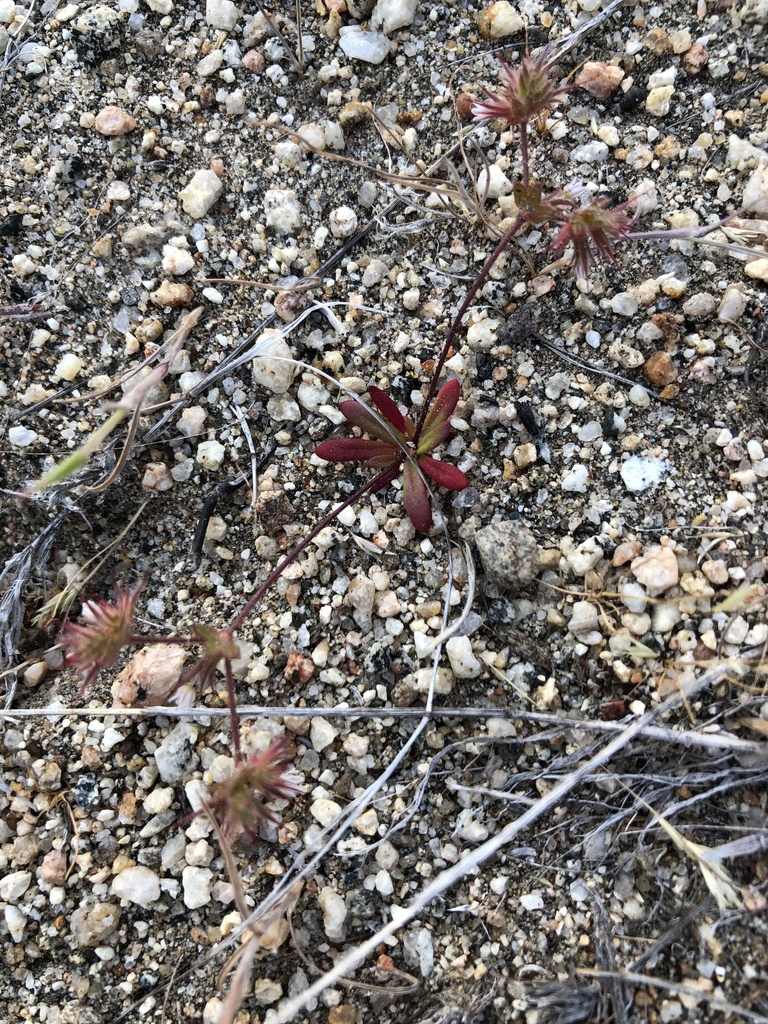
(c) nmoorhatch, some rights reserved (CC BY) · licence
Family: Polygonaceae · Type: Herb · Native
Conservation status: CNPS 1B.1 · Endangered
Dodecahema leptoceras (Slender-horned spineflower) is a native California herb in the Polygonaceae family, recognized by Monotypic genus endemic to southern California, representing a specialized evolutionary line within Polygonaceae.
Slender-horned spineflower is a rare (CNPS 1B.1) California native annual found in central and southern California coastal areas, including the Transverse and Peninsular Ranges, in sandy or gravelly habitats at elevations of 200 to 700 meters. Flowering from May to June, this plant produces white to pink flowers tiny and delicate, with distinct six-angled involucres bearing six basal awns. Growing 3 to 8 centimeters tall with an erect, sparsely glandular habit, it forms slender upright stems with minimal branching. Its basal leaves are glabrous, measuring 1.5 to 4 centimeters long and quite narrow, ranging from 0.2 to 0.4 centimeters wide. The fruit is dark brown to black, obconic, and approximately 1.7 to 2 millimeters long with a distinctively curved embryo.
Identification and appearance
Key characters: Monotypic genus endemic to southern California, representing a specialized evolutionary line within Polygonaceae
Habitat and range
Habitat: Sand or gravel
Elevation: 200-700 m
California counties: Los Angeles, Riverside, San Bernardino, San Diego
Bloom period
Dodecahema leptoceras blooms May-Jun.
Conservation status
CNPS 1B.1 · Endangered
How to tell it apart
vs Chorizanthe: Dodecahema has 6-angled cups with 12 total spines (6 basal + 6 rim); Chorizanthe varies widely but never this exact pattern.; vs Centrostegia: Dodecahema cups are 6-angled with 6 basal spines; Centrostegia cups are 3-angled with only 3 basal spines.; vs Systenotheca: Dodecahema has prominent spines at both base and rim; Systenotheca has no basal spines at all.; vs Mucronea: Dodecahema has 6 basal spines projecting from the cup base; Mucronea has no basal spines.; vs Aristocapsa: Dodecahema has 6 basal spines plus 6 rim spines; Aristocapsa has only 5 rim spines with no basal spines.
Frequently asked questions
Is Dodecahema leptoceras native to California?
Yes. Dodecahema leptoceras is native to California (recorded as native).
When does Dodecahema leptoceras bloom?
Dodecahema leptoceras blooms May-Jun.
Where in California does Dodecahema leptoceras grow?
Dodecahema leptoceras occurs in Los Angeles, Riverside, San Bernardino, San Diego, at elevations of 200-700 m.
What plant family does Dodecahema leptoceras belong to?
Dodecahema leptoceras is in the Polygonaceae family, genus Dodecahema.
Is Dodecahema leptoceras rare or endangered?
Dodecahema leptoceras carries California Rare Plant Rank 1B.1, state rank S1.
Related species
Other California species in the same genus, family, or bioregion.
Sources: Jepson eFlora · CNPS Rare Plant Inventory · Index of California Plant Names · CalPhotos · CDFW CNDDB
Last updated 2026-10-07
Data from The California Species Project — 14,000+ California species with verified data from CNPS, CDFW, USFWS, Cal-IPC, and more.