Downingia bicornuta var. bicornuta
Bristled downingia
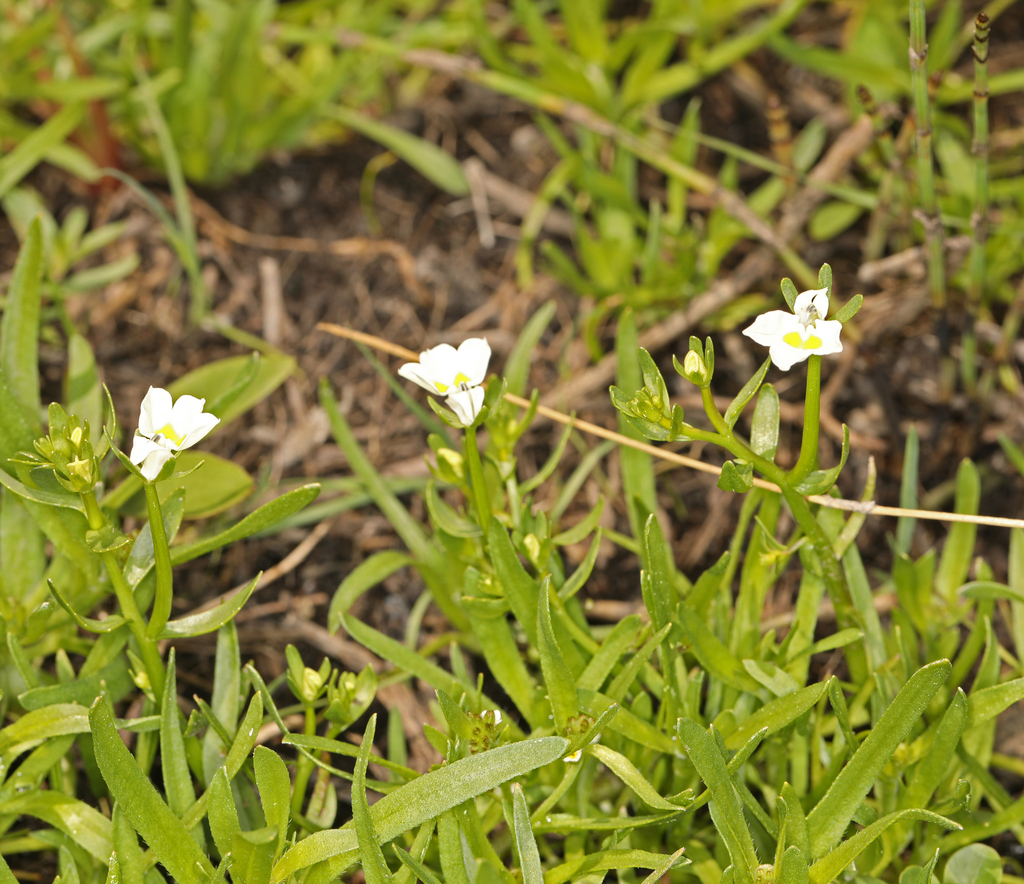
Photo: parent species Downingia bicornuta · (c) Steve Matson, some rights reserved (CC BY) · licence
Family: Campanulaceae · Type: Herb · Native
Downingia bicornuta var. bicornuta (Bristled downingia) is a native California herb in the Campanulaceae family, recognized by white-hairy tube, knob-like projections, and twisted anther bristles.
Bristled downingia is a California native annual found in northern California bioregions including the northern Coast Ranges, southern Cascade Range, northern Sierra Nevada, central Sierra Nevada Forest, Sacramento Valley, northern San Joaquin Valley, and Modoc Plateau in vernal pools, roadside ditches, and lake margins at elevations below 1,700 meters. Flowering from April to July, this plant produces blue flowers with a distinctive corolla 9 to 19 millimeters long, featuring two upper lobes that are erect or slightly recurved. Growing with delicate stems, it typically reaches low heights characteristic of annual vernal pool species. Its flowers have unique features, with two lower lobes having prominent bristles at their tips and small anthers measuring 0.6 to 1.5 millimeters long. The flower's blue coloration and distinctive lower lip make it a notable species in seasonal wetland habitats.
Identification and appearance
Key characters: 15 sympatric species; distinguished by white-hairy tube, knob-like projections, and twisted anther bristles
Habitat and range
Habitat: Vernal pools, roadside ditches, lake margins
Elevation: < 1700 m
California counties: Lassen, Placer, Lake, Amador, Modoc, Sacramento, Tehama, Butte, Shasta, Plumas, Sierra, Sutter, Yuba, Napa, Solano, Stanislaus, Madera, Merced, Fresno, Yolo, Sonoma
Outside California: to southern Oregon, southwestern Idaho, western Nevada
Bloom period
Downingia bicornuta var. bicornuta blooms Apr-Jul.
How to tell it apart
vs Porterella: Downingia flowers lack yellow ridges; Porterella has two distinctive yellow ridges on the lower lip.; vs Nemacladus: Downingia has showy blue flowers sitting on stem; Nemacladus has threadlike flowers on long stalks.; vs Legenere: Downingia has blue two-lipped flowers; Legenere has small white flowers with nearly equal petals.; vs Lobelia: Downingia is a vernal pool annual; Lobelia is perennial with spherical seed pods.; vs Howellia: Downingia flowers have no stalk; Howellia has short but visible flower stalks 1-8mm long.
Frequently asked questions
Is Downingia bicornuta var. bicornuta native to California?
Yes. Downingia bicornuta var. bicornuta is native to California (recorded as native).
When does Downingia bicornuta var. bicornuta bloom?
Downingia bicornuta var. bicornuta blooms Apr-Jul.
Where in California does Downingia bicornuta var. bicornuta grow?
Downingia bicornuta var. bicornuta occurs in Lassen, Placer, Lake, Amador, Modoc, Sacramento, Tehama, Butte and other counties, at elevations of < 1700 m.
What plant family does Downingia bicornuta var. bicornuta belong to?
Downingia bicornuta var. bicornuta is in the Campanulaceae family, genus Downingia.
What habitat does Downingia bicornuta var. bicornuta grow in?
Downingia bicornuta var. bicornuta grows in Vernal pools, roadside ditches, lake margins.
Related species
Other California species in the same genus, family, or bioregion.
Sources: Jepson eFlora · Index of California Plant Names · CalPhotos
Last updated 2026-10-07
Data from The California Species Project — 14,000+ California species with verified data from CNPS, CDFW, USFWS, Cal-IPC, and more.