Downingia willamettensis
Cascade downingia
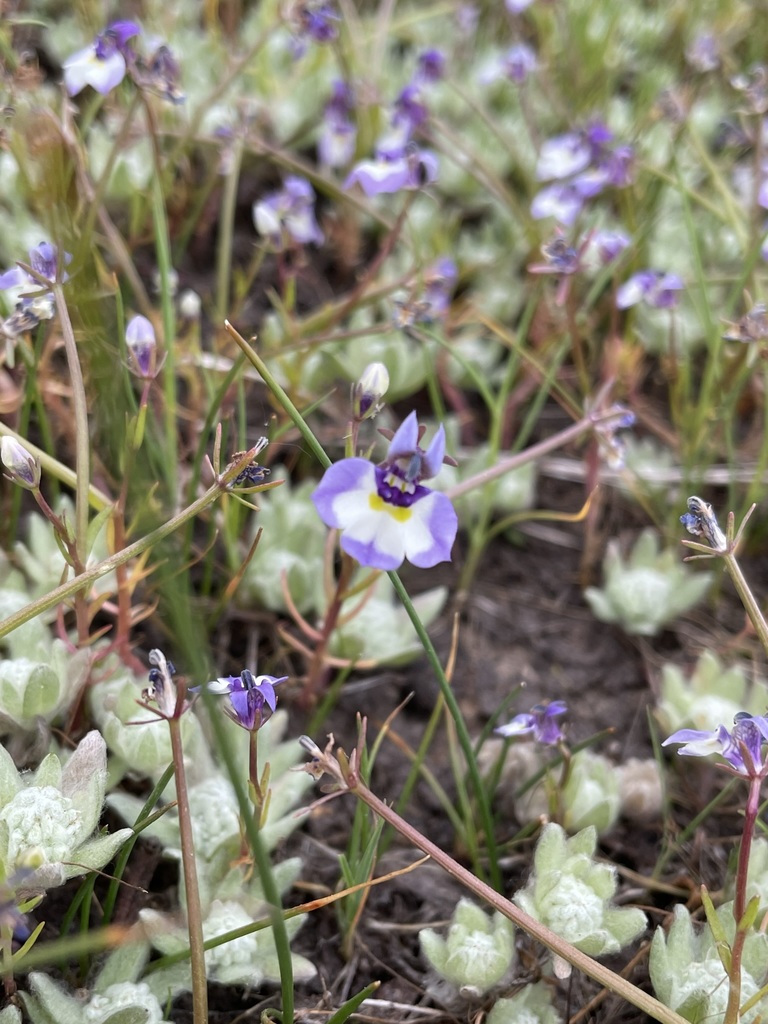
(c) Matt Berger, some rights reserved (CC BY), uploaded by Matt Berger · licence
Family: Campanulaceae · Type: Annual · Native
Conservation status: CNPS 2B.2
Downingia willamettensis (Cascade downingia) is a native California annual in the Campanulaceae family, recognized by unequal sepals and thin easily fractured fruit walls.
Cascade downingia is a rare (CNPS 2B.2) California native annual found in northwestern California, typically at elevations below 200 meters in edges of lakes, ponds, and vernal pools. Flowering from June to July, this plant produces blue and white flowers with distinctive lower lips featuring a central white area with two yellow spots surrounded by three purple spots. Growing with delicate stems typically 10 to 30 centimeters tall, the plant forms small compact clusters in seasonal wetland environments. Its leaves are relatively small and narrow, arranged alternately along the slender stems. The flower's unique color pattern, with blue petals and intricate white and yellow markings, makes it a striking inhabitant of ephemeral wetland habitats.
Identification and appearance
Key characters: 10 sympatric species; key features are unequal sepals and thin easily fractured fruit walls
Habitat and range
Habitat: Edges of lakes, ponds, vernal pools
Elevation: generally < 200 m (650 m, Lake Co.)
Outside California: to Washington, western of Cascade Range
Bloom period
Downingia willamettensis blooms Jun-Jul.
Conservation status
CNPS 2B.2
How to tell it apart
vs Porterella: Downingia flowers lack yellow ridges; Porterella has two distinctive yellow ridges on the lower lip.; vs Nemacladus: Downingia has showy blue flowers sitting on stem; Nemacladus has threadlike flowers on long stalks.; vs Legenere: Downingia has blue two-lipped flowers; Legenere has small white flowers with nearly equal petals.; vs Lobelia: Downingia is a vernal pool annual; Lobelia is perennial with spherical seed pods.; vs Howellia: Downingia flowers have no stalk; Howellia has short but visible flower stalks 1-8mm long.
Frequently asked questions
Is Downingia willamettensis native to California?
Yes. Downingia willamettensis is native to California (recorded as native).
When does Downingia willamettensis bloom?
Downingia willamettensis blooms Jun-Jul.
What plant family does Downingia willamettensis belong to?
Downingia willamettensis is in the Campanulaceae family, genus Downingia.
Is Downingia willamettensis rare or endangered?
Downingia willamettensis carries California Rare Plant Rank 2B.2, state rank S2.
What habitat does Downingia willamettensis grow in?
Downingia willamettensis grows in Edges of lakes, ponds, vernal pools.
Related species
Other California species in the same genus, family, or bioregion.
- Downingia yina — Cascade calicoflower
- Downingia bacigalupii — Bach's calicoflower
- Downingia bella — Hoover's calicoflower
- Downingia bicornuta — Bristled downingia
- Downingia bicornuta var. bicornuta — Bristled downingia
- Downingia bicornuta var. picta — Doublehorn calicoflower
- Eastwoodiella californica — Swamp harebell
- Eastwoodiella sp. — Harebell
- Githopsis diffusa — San Gabriel bluecup
Sources: Jepson eFlora · CalPhotos · CDFW CNDDB
Last updated 2026-10-06
Data from The California Species Project — 14,000+ California species with verified data from CNPS, CDFW, USFWS, Cal-IPC, and more.