Drosera anglica
English sundew
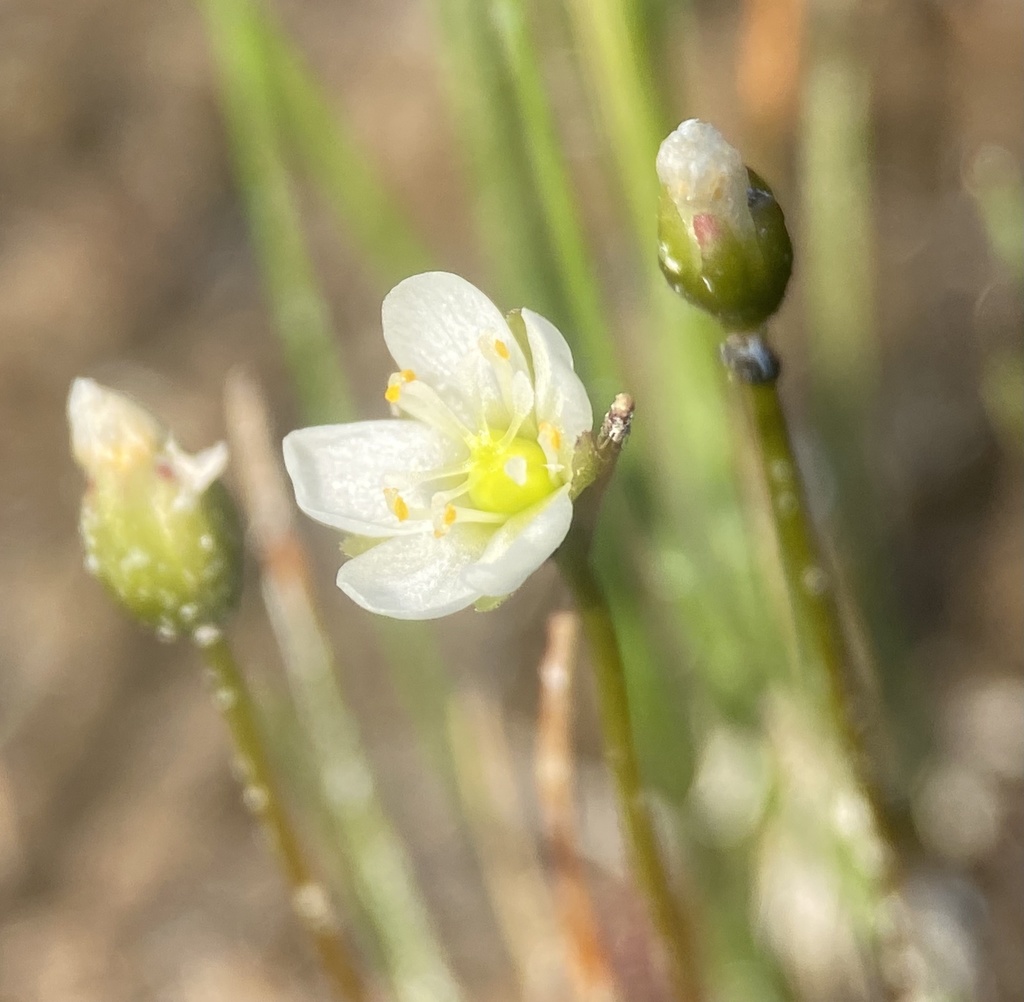
(c) Matt Berger, some rights reserved (CC BY), uploaded by Matt Berger · licence
Family: Droseraceae · Type: Herb · Native
Conservation status: CNPS 2B.3
Drosera anglica (English sundew) is a native California herb in the Droseraceae family, recognized by (D. rotundifolia). Clear leaf size and shape differences.
English sundew is a rare (CNPS 2B.3) California native perennial found in the Klamath Ranges, northern California Ranges, northern Sierra Nevada, and southern Warner Mountains in swamps and peatlands at elevations of 1,300 to 2,000 meters. Flowering from June to August, this plant produces white flowers with delicate petals 8 to 12 millimeters long. Growing with thin, erect stems 6 to 25 centimeters tall, it forms a distinctive rosette of leaves close to the ground. Its leaves have slender blades 15 to 50 millimeters long and 2 to 7 millimeters wide, characteristic of the carnivorous sundew family with sticky glandular surfaces for trapping insects. The small seed is 1 to 1.5 millimeters long with a distinctive longitudinally striate-netted texture.
Identification and appearance
Key characters: 1 sympatric species (D. rotundifolia). Clear leaf size and shape differences.
Habitat and range
Habitat: Swamps, peatlands, often with
Elevation: 1300-2000 m
California counties: Modoc, Siskiyou, Nevada, Plumas, Shasta, Lassen
Outside California: circumboreal
Bloom period
Drosera anglica blooms Jun-Aug.
Conservation status
CNPS 2B.3
How to tell it apart
vs Parnassia: Sundew has sticky insect-trapping hairs on leaves; Parnassia has smooth leaves.; vs Limonium: Sundew has sticky-haired leaves that trap insects; sea lavender has smooth leaves.; vs Linum: Sundew has sticky-haired leaves in basal rosettes; flax has smooth narrow leaves on upright stems.; vs Ayenia: Sundew has sticky gland-tipped hairs on leaves; Ayenia has smooth leaves.; vs Armeria: Sundew has sticky-haired leaves that trap insects; thrift has smooth grass-like leaves.
Frequently asked questions
Is Drosera anglica native to California?
Yes. Drosera anglica is native to California (recorded as native).
When does Drosera anglica bloom?
Drosera anglica blooms Jun-Aug.
Where in California does Drosera anglica grow?
Drosera anglica occurs in Modoc, Siskiyou, Nevada, Plumas, Shasta, Lassen, at elevations of 1300-2000 m.
What plant family does Drosera anglica belong to?
Drosera anglica is in the Droseraceae family, genus Drosera.
Is Drosera anglica rare or endangered?
Drosera anglica carries California Rare Plant Rank 2B.3, state rank S2.
Related species
Other California species in the same genus, family, or bioregion.
Sources: Jepson eFlora · CNPS Rare Plant Inventory · Index of California Plant Names · CalPhotos · CDFW CNDDB
Last updated 2026-10-07
Data from The California Species Project — 14,000+ California species with verified data from CNPS, CDFW, USFWS, Cal-IPC, and more.