Drymocallis glandulosa var. glandulosa
Sticky cinquefoil
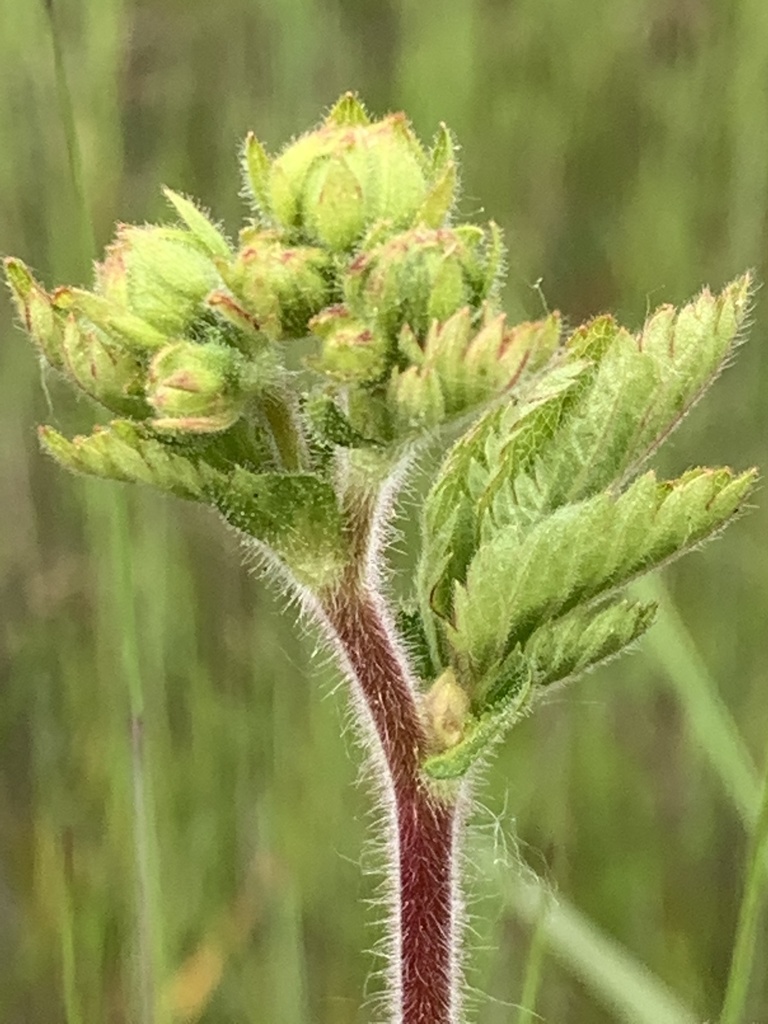
no rights reserved, uploaded by Tom Erler · CC0
Family: Rosaceae · Type: Subshrub · Native
Drymocallis glandulosa var. glandulosa (Sticky cinquefoil) is a native California subshrub in the Rosaceae family, recognized by leafy inflorescence and large double-toothed leaflets.
Sticky cinquefoil is a California native perennial found in the Klamath Ranges, northern Coast Ranges, Cascade Range, Sierra Nevada, Sutter Buttes, Transverse Ranges, Peninsular Ranges, and Modoc Plateau in generally shady or moist areas at elevations of 400 to 2,000 meters. Flowering from May to July, this plant produces pale yellow to cream flowers in small clusters with petals 3.5 to 5 millimeters wide. Growing with stems 20 to 60 centimeters tall, it forms an open, spreading growth pattern with branch angles between 30 and 55 degrees. Its compound basal leaves have 2 to 3 pairs of lateral leaflets and a terminal leaflet 25 to 55 millimeters long, with double-toothed edges featuring 7 to 15 teeth on each side. The flower hypanthium has small bractlets 2.5 to 6 millimeters long, with sepals spreading and widely obtuse.
Identification and appearance
Key characters: 15 sympatric species; key features are leafy inflorescence and large double-toothed leaflets
Habitat and range
Habitat: Generally +- shady or moist areas
Elevation: generally 400-2000 m
California counties: Tulare, Napa, Los Angeles, Siskiyou, Trinity, Modoc, Butte, San Diego, Riverside, Del Norte, San Bernardino, Solano, Plumas, Sutter, Nevada, Mono, Lake, Madera, Alpine, Colusa, Glenn, Mariposa, Placer, Sierra, Tehama, Tuolumne, Alameda, Contra Costa, El Dorado, Fresno, Humboldt, Kern, San Francisco, San Luis Obispo, San Mateo, Santa Barbara, Santa Clara, Santa Cruz, Shasta, Sonoma, Marin, Mendocino, Monterey, Ventura, Lassen, Orange, Yuba
Outside California: to British Columbia, Montana, Arizona
Bloom period
Drymocallis glandulosa var. glandulosa blooms May-Jul.
How to tell it apart
vs Potentilla: Drymocallis has club-shaped styles thickest in the middle; Potentilla has slender styles throughout.; vs Fragaria: Drymocallis has yellow-white flowers and dry achenes; Fragaria has white flowers and red fleshy fruits.; vs Horkelia: Drymocallis has swollen fusiform styles; Horkelia has flattened filaments forming a tube around pistils.; vs Rubus: Drymocallis has simple yellow flowers and herbaceous stems; Rubus has aggregate white-pink flowers and woody stems.; vs Dasiphora: Drymocallis has herbaceous stems and fusiform styles; Dasiphora is a woody shrub with slender styles.
Frequently asked questions
Is Drymocallis glandulosa var. glandulosa native to California?
Yes. Drymocallis glandulosa var. glandulosa is native to California (recorded as native).
When does Drymocallis glandulosa var. glandulosa bloom?
Drymocallis glandulosa var. glandulosa blooms May-Jul.
Where in California does Drymocallis glandulosa var. glandulosa grow?
Drymocallis glandulosa var. glandulosa occurs in Tulare, Napa, Los Angeles, Siskiyou, Trinity, Modoc, Butte, San Diego and other counties, at elevations of generally 400-2000 m.
What plant family does Drymocallis glandulosa var. glandulosa belong to?
Drymocallis glandulosa var. glandulosa is in the Rosaceae family, genus Drymocallis.
What habitat does Drymocallis glandulosa var. glandulosa grow in?
Drymocallis glandulosa var. glandulosa grows in Generally +- shady or moist areas.
Related species
Other California species in the same genus, family, or bioregion.
Sources: Jepson eFlora · Index of California Plant Names · CalPhotos
Last updated 2026-10-07
Data from The California Species Project — 14,000+ California species with verified data from CNPS, CDFW, USFWS, Cal-IPC, and more.