Drymocallis lactea var. austiniae
Austin's woodbeauty
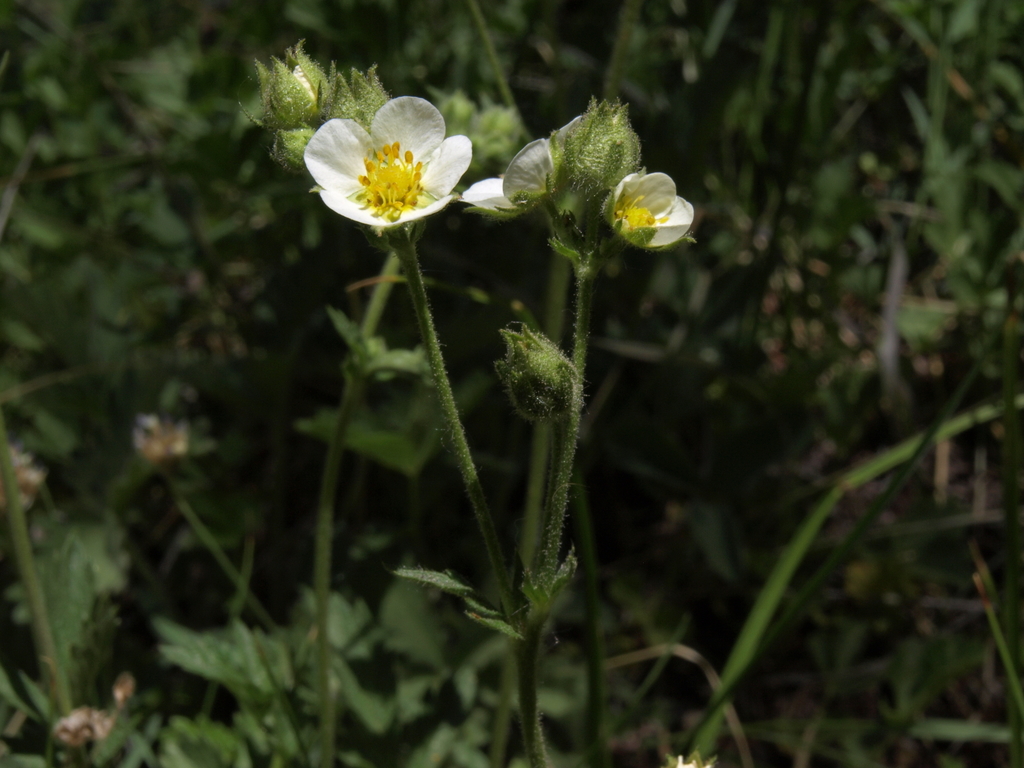
(c) Jim Morefield, some rights reserved (CC BY) · licence
Family: Rosaceae · Type: Subshrub · Native
Drymocallis lactea var. austiniae (Austin's woodbeauty) is a native California subshrub in the Rosaceae family, recognized by spreading inflorescence and yellow petals.
Austin's woodbeauty is a California native perennial found in northwestern California, the Cascade Range, northern Sierra Nevada, and Modoc Plateau in generally moist, often rocky places at elevations of 900 to 2,600 meters. Flowering from May to September, this plant produces pale yellow flowers in open, spreading inflorescences with branch angles between 20 to 40 degrees. Growing with stems that may have glandular hairs near the base, reaching moderate heights in rocky montane environments. Its leaves are complex, typically divided with multiple leaflets characteristic of the Drymocallis genus. The plant thrives in varied rocky and moist habitats, demonstrating adaptability across several California mountain ecosystems.
Identification and appearance
Key characters: 11 sympatric species; distinguished by spreading inflorescence and yellow petals
Habitat and range
Habitat: Generally +- moist, often rocky places
Elevation: 900-2600 m
Outside California: southwestern Oregon
Bloom period
Drymocallis lactea var. austiniae blooms May-Sep.
How to tell it apart
vs Potentilla: Drymocallis has club-shaped styles thickest in the middle; Potentilla has slender styles throughout.; vs Fragaria: Drymocallis has yellow-white flowers and dry achenes; Fragaria has white flowers and red fleshy fruits.; vs Horkelia: Drymocallis has swollen fusiform styles; Horkelia has flattened filaments forming a tube around pistils.; vs Rubus: Drymocallis has simple yellow flowers and herbaceous stems; Rubus has aggregate white-pink flowers and woody stems.; vs Dasiphora: Drymocallis has herbaceous stems and fusiform styles; Dasiphora is a woody shrub with slender styles.
Frequently asked questions
Is Drymocallis lactea var. austiniae native to California?
Yes. Drymocallis lactea var. austiniae is native to California (recorded as native).
When does Drymocallis lactea var. austiniae bloom?
Drymocallis lactea var. austiniae blooms May-Sep.
What plant family does Drymocallis lactea var. austiniae belong to?
Drymocallis lactea var. austiniae is in the Rosaceae family, genus Drymocallis.
What habitat does Drymocallis lactea var. austiniae grow in?
Drymocallis lactea var. austiniae grows in Generally +- moist, often rocky places.
Related species
Other California species in the same genus, family, or bioregion.
Sources: Jepson eFlora · CalPhotos
Last updated 2026-10-07
Data from The California Species Project — 14,000+ California species with verified data from CNPS, CDFW, USFWS, Cal-IPC, and more.