Drymocallis lactea var. lactea
Sierran woodbeauty
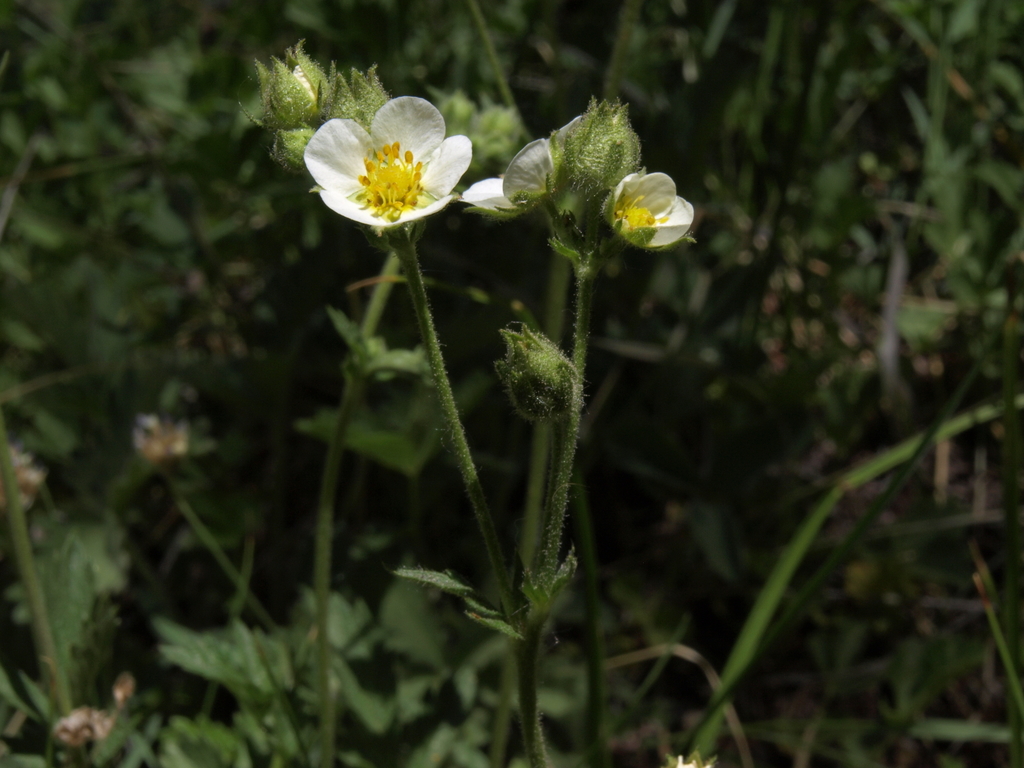
(c) Jim Morefield, some rights reserved (CC BY) · licence
Family: Rosaceae · Type: Subshrub · Native
Drymocallis lactea var. lactea (Sierran woodbeauty) is a native California subshrub in the Rosaceae family, recognized by narrow inflorescence, cream petals, and sparse glandular hairs.
Sierran woodbeauty is a California native perennial found in the Sierra Nevada, Transverse Ranges, San Jacinto Mountains, and eastern Sierra Nevada in generally moist, often rocky places at elevations of 1,800 to 3,700 meters. Flowering from June to September, this plant produces cream-colored flowers in narrow inflorescences with branch angles typically 10 to 20 degrees. Growing with slender stems that have sparse glandular hairs near the base, it forms delicate clumps 15 to 45 centimeters tall. Its leaves are compound, typically with multiple leaflets arranged in a pinnate pattern, providing a lacy, intricate texture to the plant's overall appearance. In rocky alpine and subalpine habitats, this woodbeauty adds a subtle, elegant touch to mountain landscapes with its cream-colored blooms and finely textured foliage.
Identification and appearance
Key characters: 13 sympatric species; key features are narrow inflorescence, cream petals, and sparse glandular hairs
Habitat and range
Habitat: Generally +- moist, often rocky places
Elevation: 1800-3700 m
California counties: Fresno, Tulare, Los Angeles, San Bernardino, Riverside, Kern, Mono, Modoc, Alpine, Plumas, Amador, Butte, Humboldt, Lassen, Sierra, Tehama, Ventura, El Dorado, Glenn, Mariposa, Inyo, Mendocino, Madera, Nevada, Placer, Shasta, Siskiyou, Trinity, Tuolumne, Del Norte, Santa Barbara, Calaveras
Outside California: Oregon, Nevada
Bloom period
Drymocallis lactea var. lactea blooms Jun-Sep.
How to tell it apart
vs Potentilla: Drymocallis has club-shaped styles thickest in the middle; Potentilla has slender styles throughout.; vs Fragaria: Drymocallis has yellow-white flowers and dry achenes; Fragaria has white flowers and red fleshy fruits.; vs Horkelia: Drymocallis has swollen fusiform styles; Horkelia has flattened filaments forming a tube around pistils.; vs Rubus: Drymocallis has simple yellow flowers and herbaceous stems; Rubus has aggregate white-pink flowers and woody stems.; vs Dasiphora: Drymocallis has herbaceous stems and fusiform styles; Dasiphora is a woody shrub with slender styles.
Frequently asked questions
Is Drymocallis lactea var. lactea native to California?
Yes. Drymocallis lactea var. lactea is native to California (recorded as native).
When does Drymocallis lactea var. lactea bloom?
Drymocallis lactea var. lactea blooms Jun-Sep.
Where in California does Drymocallis lactea var. lactea grow?
Drymocallis lactea var. lactea occurs in Fresno, Tulare, Los Angeles, San Bernardino, Riverside, Kern, Mono, Modoc and other counties, at elevations of 1800-3700 m.
What plant family does Drymocallis lactea var. lactea belong to?
Drymocallis lactea var. lactea is in the Rosaceae family, genus Drymocallis.
What habitat does Drymocallis lactea var. lactea grow in?
Drymocallis lactea var. lactea grows in Generally +- moist, often rocky places.
Related species
Other California species in the same genus, family, or bioregion.
Sources: Jepson eFlora · Index of California Plant Names · CalPhotos
Last updated 2026-10-07
Data from The California Species Project — 14,000+ California species with verified data from CNPS, CDFW, USFWS, Cal-IPC, and more.