Dudleya cespitosa
Coast dudleya
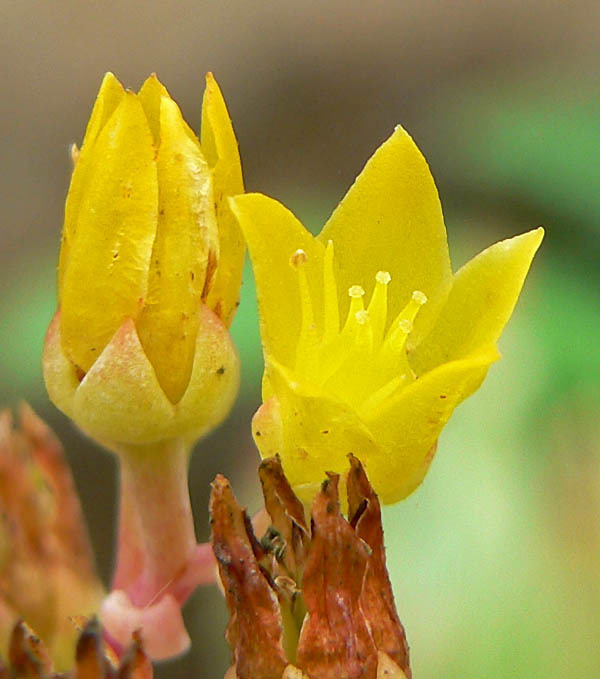
(c) Stan Shebs, some rights reserved (CC BY-SA) · licence
Family: Crassulaceae · Type: Herb · Native
Dudleya cespitosa (Coast dudleya) is a native California herb in the Crassulaceae family, recognized by large coastal rosettes and yellow flowers diagnostic.
Coast dudleya is a California native perennial found in southern Northern Coast Ranges, Central Coast, Southern Coast, and northern Channel Islands in coastal rock and sand habitats at elevations generally below 100 meters. Flowering from April to August, this succulent produces bright yellow flowers in clusters with 3 to 15 blooms on tall peduncles 10 to 60 centimeters high. Growing in rosettes 8 to 32 centimeters wide with exposed stems from older plants, it develops multiple clusters of succulent leaves. Its evergreen leaves are lance-oblong, 15 to 30 in number, measuring 5 to 20 centimeters long and 1 to 2 centimeters wide, with bases that may have a distinctive purple-red coloration. The plant forms loose rosettes with thick, glaucous leaves that have acute tips and vary significantly in shape and appearance.
Identification and appearance
Key characters: 28 sympatric species, large coastal rosettes and yellow flowers diagnostic
Habitat and range
Habitat: Common. Coastal, rock, sand
Elevation: generally < 100 m
California counties: San Bernardino, Santa Barbara, San Luis Obispo, Ventura, San Francisco, Los Angeles, Orange, Santa Cruz, Monterey, San Mateo, Santa Clara, San Benito, Sonoma, Humboldt, Kern, Lake, San Diego, Solano, Marin, Mendocino, Napa, Contra Costa
Bloom period
Dudleya cespitosa blooms Apr-Aug.
How to tell it apart
vs Curio: Dudleya has thick succulent leaves in rosettes; Curio has thin, cylindrical or string-like leaves.; vs Echeveria: Dudleya flower stalks emerge from leaf axils; Echeveria flowers emerge from rosette center.; vs Sedum: Dudleya forms distinct basal rosettes; Sedum grows as spreading mats or upright stems without rosettes.; vs Aeonium: Dudleya has smooth leaf edges; Aeonium has tiny hairs along leaf margins.; vs Carpobrotus: Dudleya has rosettes under 30cm; Carpobrotus has sprawling succulent stems over 1m long.
Frequently asked questions
Is Dudleya cespitosa native to California?
Yes. Dudleya cespitosa is native to California (recorded as native).
When does Dudleya cespitosa bloom?
Dudleya cespitosa blooms Apr-Aug.
Where in California does Dudleya cespitosa grow?
Dudleya cespitosa occurs in San Bernardino, Santa Barbara, San Luis Obispo, Ventura, San Francisco, Los Angeles, Orange, Santa Cruz and other counties, at elevations of generally < 100 m.
What plant family does Dudleya cespitosa belong to?
Dudleya cespitosa is in the Crassulaceae family, genus Dudleya.
What habitat does Dudleya cespitosa grow in?
Dudleya cespitosa grows in Common. Coastal, rock, sand.
Related species
Other California species in the same genus, family, or bioregion.
Sources: Jepson eFlora · Index of California Plant Names · CalPhotos
Last updated 2026-10-07
Data from The California Species Project — 14,000+ California species with verified data from CNPS, CDFW, USFWS, Cal-IPC, and more.