Dudleya farinosa
Bluff lettuce
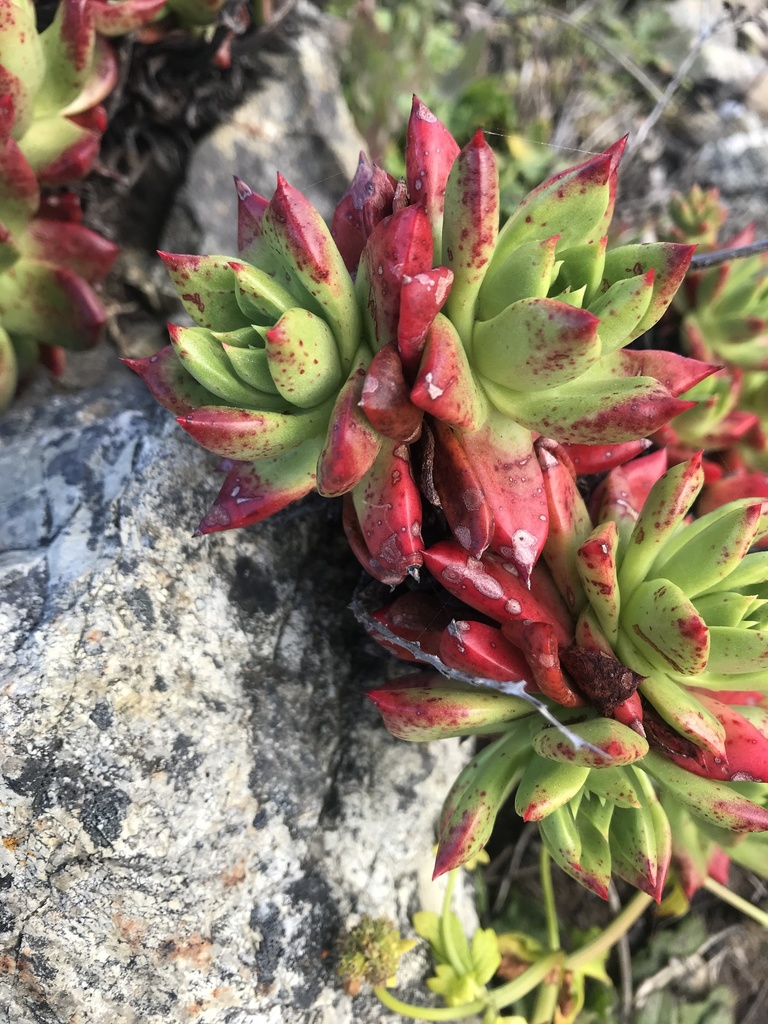
(c) Karen (with occasional help from Mike), some rights reserved (CC BY) · licence
Family: Crassulaceae · Type: Herb · Native
Dudleya farinosa (Bluff lettuce) is a native California herb in the Crassulaceae family, recognized by differs by flower color and rosette size.
Bluff lettuce is a California native perennial found in the northern Coast and central Coast ranges, growing on coastal soils and cliffs at elevations generally below 100 meters. Flowering from June to August, this succulent produces pale yellow flowers in clusters with petals 10 to 14 millimeters long. Growing in dense rosettes 4 to 25 centimeters wide, with stems 1 to 3 centimeters wide that can become elongated with age. Its evergreen leaves are thick and glaucous, oblong-ovate, 2.5 to 6 centimeters long with bases 1 to 2.5 centimeters wide and generally obtuse tips. The plant forms multiple rosettes, creating distinctive clusters along coastal bluffs and rocky outcrops.
Identification and appearance
Key characters: 1 sympatric species - differs by flower color and rosette size
Habitat and range
Habitat: Common: Coastal soils and cliffs
Elevation: generally < 100 m (< 600 m in San Mateo Co.)
California counties: Mendocino, Los Angeles, Monterey, Del Norte, San Mateo, Marin, San Luis Obispo, Trinity, Humboldt, San Francisco, Santa Cruz, Sonoma, Solano, Alameda, Contra Costa, Santa Barbara, Sierra, Mariposa, Lake, Tehama, Santa Clara
Outside California: southwestern Oregon
Bloom period
Dudleya farinosa blooms Jun-Aug.
How to tell it apart
vs Curio: Dudleya has thick succulent leaves in rosettes; Curio has thin, cylindrical or string-like leaves.; vs Echeveria: Dudleya flower stalks emerge from leaf axils; Echeveria flowers emerge from rosette center.; vs Sedum: Dudleya forms distinct basal rosettes; Sedum grows as spreading mats or upright stems without rosettes.; vs Aeonium: Dudleya has smooth leaf edges; Aeonium has tiny hairs along leaf margins.; vs Carpobrotus: Dudleya has rosettes under 30cm; Carpobrotus has sprawling succulent stems over 1m long.
Frequently asked questions
Is Dudleya farinosa native to California?
Yes. Dudleya farinosa is native to California (recorded as native).
When does Dudleya farinosa bloom?
Dudleya farinosa blooms Jun-Aug.
Where in California does Dudleya farinosa grow?
Dudleya farinosa occurs in Mendocino, Los Angeles, Monterey, Del Norte, San Mateo, Marin, San Luis Obispo, Trinity and other counties, at elevations of generally < 100 m (< 600 m in San Mateo Co.).
What plant family does Dudleya farinosa belong to?
Dudleya farinosa is in the Crassulaceae family, genus Dudleya.
What habitat does Dudleya farinosa grow in?
Dudleya farinosa grows in Common: Coastal soils and cliffs.
Related species
Other California species in the same genus, family, or bioregion.
Sources: Jepson eFlora · Index of California Plant Names · CalPhotos
Last updated 2026-10-07
Data from The California Species Project — 14,000+ California species with verified data from CNPS, CDFW, USFWS, Cal-IPC, and more.