Dysphania ambrosioides
Mexican tea
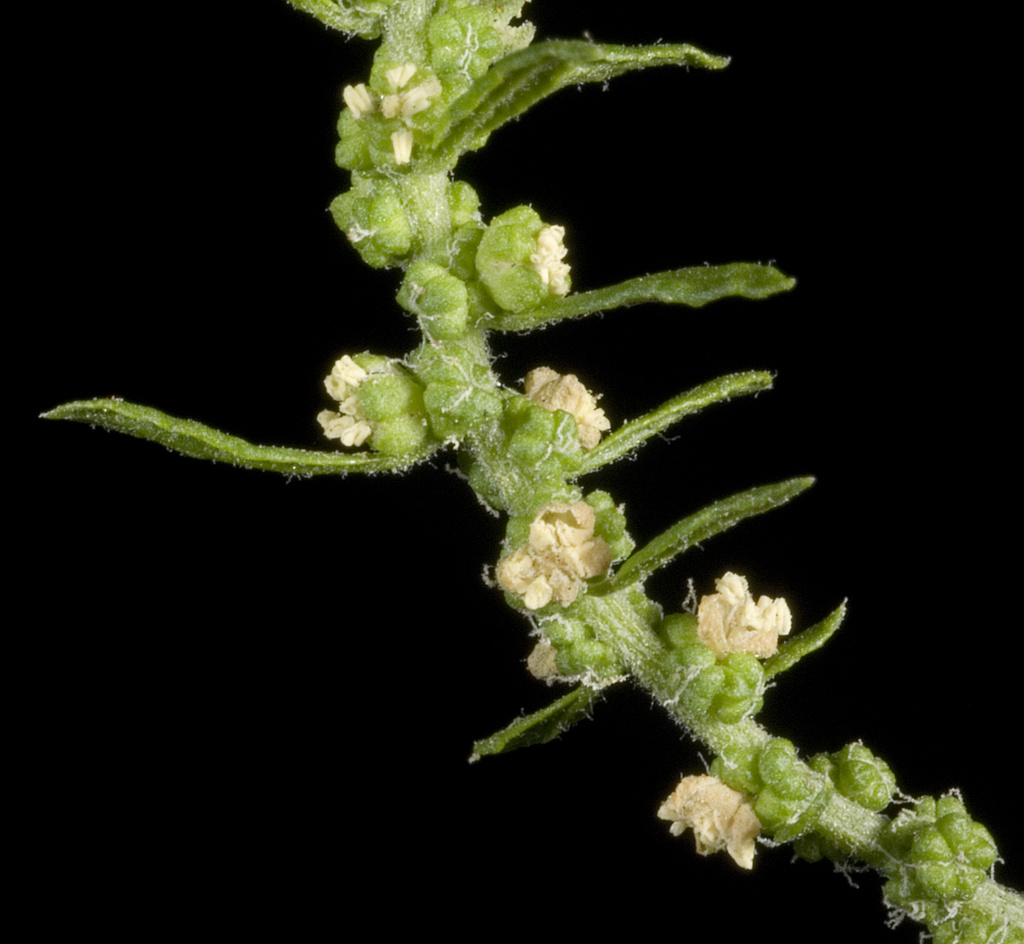
(c) Kevin Thiele, some rights reserved (CC BY) · licence
Family: Chenopodiaceae · Type: Subshrub · Not Native
Dysphania ambrosioides (Mexican tea) is a non-native California subshrub in the Chenopodiaceae family, recognized by size and leaf morphology.
Mexican tea is a naturalized perennial found in the California Floristic Province in disturbed places at elevations below 1,400 meters. Flowering from July to September, this plant produces tiny green flowers clustered in spheric terminal and axillary spikes. Growing with erect stems 25 to 130 centimeters tall that are glabrous or gland-dotted, it develops a robust and spreading habit. Its leaves are distinctively glandular, with blades 15 to 100 millimeters long, ranging from ovate to lance-oblong and featuring entire to coarsely dentate edges. The fruit is small, approximately 0.5 millimeters in diameter, with a glandular wall and containing smooth, red-brown seeds.
Identification and appearance
Key characters: 5 sympatric species; distinguished by size and leaf morphology
Habitat and range
Habitat: Disturbed places
Elevation: < 1400 m
California counties: Kern, Los Angeles, Ventura, Santa Barbara, San Bernardino, San Joaquin, San Diego, Riverside, Marin, San Luis Obispo, Butte, Monterey, Plumas, Glenn, Tehama, Colusa, Yuba, Modoc, Merced, Mendocino, Contra Costa, Yolo, Trinity, Del Norte, Humboldt, Sutter, Lassen, San Mateo, Madera, Alameda, Sonoma, Sacramento, Santa Clara, Siskiyou, Stanislaus, Tuolumne, Fresno, Napa, San Francisco, Orange, Santa Cruz
Outside California: to Canada, eastern United States, native to tropical America
Bloom period
Dysphania ambrosioides blooms Jul-Sep.
How to tell it apart
vs Artemisia: Dysphania has sticky glandular hairs; Artemisia has fine silky or woolly hairs.; vs Amaranthus: Dysphania is sticky-glandular; Amaranthus is smooth with dense flower spikes.; vs Erigeron: Dysphania has tiny greenish clustered flowers; Erigeron has obvious ray flowers.; vs Baccharis: Dysphania is herbaceous annual; Baccharis is woody shrub.; vs Ambrosia: Dysphania has sticky leaves; Ambrosia has divided leaves without sticky glands.
Frequently asked questions
Is Dysphania ambrosioides native to California?
No. Dysphania ambrosioides is not native to California (recorded as not native).
When does Dysphania ambrosioides bloom?
Dysphania ambrosioides blooms Jul-Sep.
Where in California does Dysphania ambrosioides grow?
Dysphania ambrosioides occurs in Kern, Los Angeles, Ventura, Santa Barbara, San Bernardino, San Joaquin, San Diego, Riverside and other counties, at elevations of < 1400 m.
What plant family does Dysphania ambrosioides belong to?
Dysphania ambrosioides is in the Chenopodiaceae family, genus Dysphania.
What habitat does Dysphania ambrosioides grow in?
Dysphania ambrosioides grows in Disturbed places.
Related species
Other California species in the same genus, family, or bioregion.
Sources: Jepson eFlora · Index of California Plant Names · CalPhotos
Last updated 2026-10-07
Data from The California Species Project — 14,000+ California species with verified data from CNPS, CDFW, USFWS, Cal-IPC, and more.