Dysphania pumilio
Tasmanian goosefoot
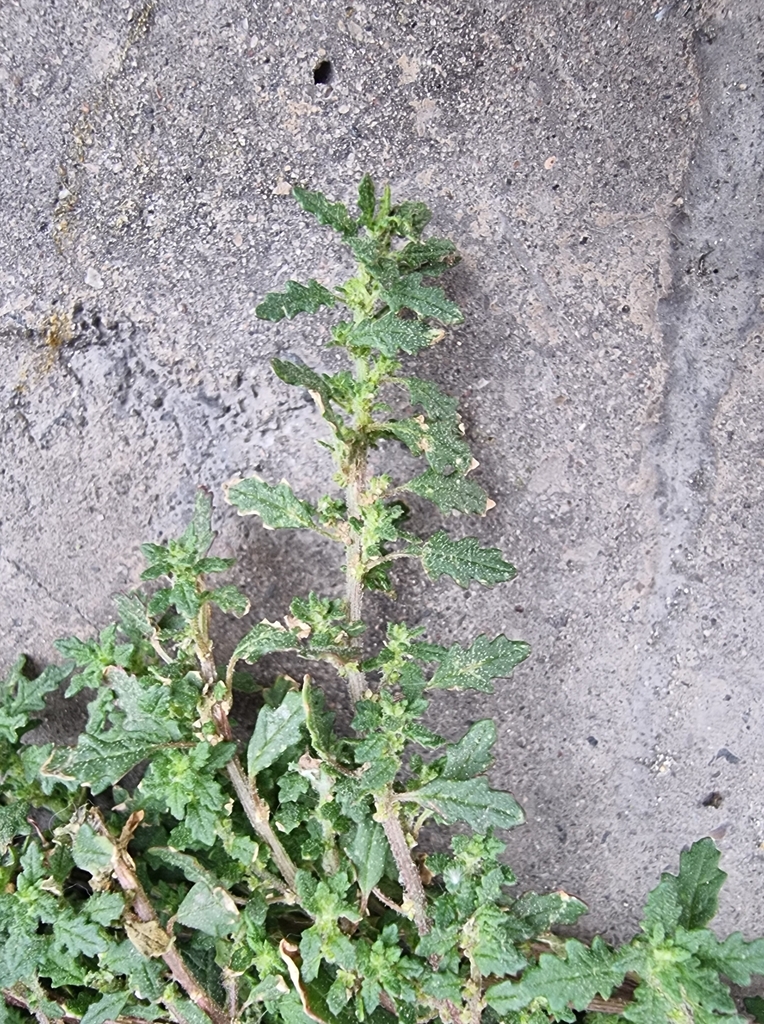
(c) Daniel Cahen, some rights reserved (CC BY) · licence
Family: Chenopodiaceae · Type: Herb · Not Native
Dysphania pumilio (Tasmanian goosefoot) is a non-native California herb in the Chenopodiaceae family, recognized by prostrate habit, small size, and compact flower clusters.
Tasmanian goosefoot is a naturalized annual found in the Klamath Ranges, northern Coast Ranges, Cascades, Sierra Nevada, Central Valley, San Francisco Bay Area, southern California coastal areas, Transverse Ranges, western Peninsular Ranges, and Modoc Plateau in disturbed areas at elevations below 3,000 meters. Flowering from July to August, this plant produces small, dense spherical flower clusters approximately 3 to 6 millimeters in diameter. Growing prostrate to ascending with glandular stems 12 to 45 centimeters long, it spreads in low, sprawling patches. Its leaves are elliptic to lanceolate, 4 to 25 millimeters long, with coarsely wavy-toothed edges and glandular undersides. The tiny fruits are less than 0.5 millimeters in diameter with smooth walls that adhere closely to the seed.
Identification and appearance
Key characters: 5 sympatric species; distinguished by prostrate habit, small size, and compact flower clusters
Habitat and range
Habitat: Disturbed areas
Elevation: < 3000 m
California counties: Riverside, Los Angeles, San Bernardino, El Dorado, Orange, Marin, Trinity, Plumas, Butte, Sierra, Tehama, Shasta, Placer, Yuba, Lake, Napa, Colusa, Glenn, Fresno, Calaveras, Tuolumne, Lassen, Humboldt, Mendocino, Santa Barbara, Ventura, Inyo, San Diego, Sonoma, Santa Cruz, Sacramento, San Joaquin, Siskiyou, Alpine, Monterey
Outside California: to eastern United States, northern Mexico, native to Australia
Bloom period
Dysphania pumilio blooms Jul-Aug.
How to tell it apart
vs Artemisia: Dysphania has sticky glandular hairs; Artemisia has fine silky or woolly hairs.; vs Amaranthus: Dysphania is sticky-glandular; Amaranthus is smooth with dense flower spikes.; vs Erigeron: Dysphania has tiny greenish clustered flowers; Erigeron has obvious ray flowers.; vs Baccharis: Dysphania is herbaceous annual; Baccharis is woody shrub.; vs Ambrosia: Dysphania has sticky leaves; Ambrosia has divided leaves without sticky glands.
Frequently asked questions
Is Dysphania pumilio native to California?
No. Dysphania pumilio is not native to California (recorded as not native).
When does Dysphania pumilio bloom?
Dysphania pumilio blooms Jul-Aug.
Where in California does Dysphania pumilio grow?
Dysphania pumilio occurs in Riverside, Los Angeles, San Bernardino, El Dorado, Orange, Marin, Trinity, Plumas and other counties, at elevations of < 3000 m.
What plant family does Dysphania pumilio belong to?
Dysphania pumilio is in the Chenopodiaceae family, genus Dysphania.
What habitat does Dysphania pumilio grow in?
Dysphania pumilio grows in Disturbed areas.
Related species
Other California species in the same genus, family, or bioregion.
- Dysphania sp. — Mexican tea
- Dysphania ambrosioides — Mexican tea
- Dysphania anthelmintica — Wormseed
- Dysphania atriplicifolia — Winged pigweed, tumble ringwing
- Dysphania botrys — Jerusalem oak
- Dysphania chilensis
- Extriplex californica — California orach
- Extriplex joaquinana — San joaquin spearscale
- Extriplex sp.
Sources: Jepson eFlora · Index of California Plant Names · CalPhotos
Last updated 2026-10-07
Data from The California Species Project — 14,000+ California species with verified data from CNPS, CDFW, USFWS, Cal-IPC, and more.