Dyssodia papposa
Dogweed, Dogweed
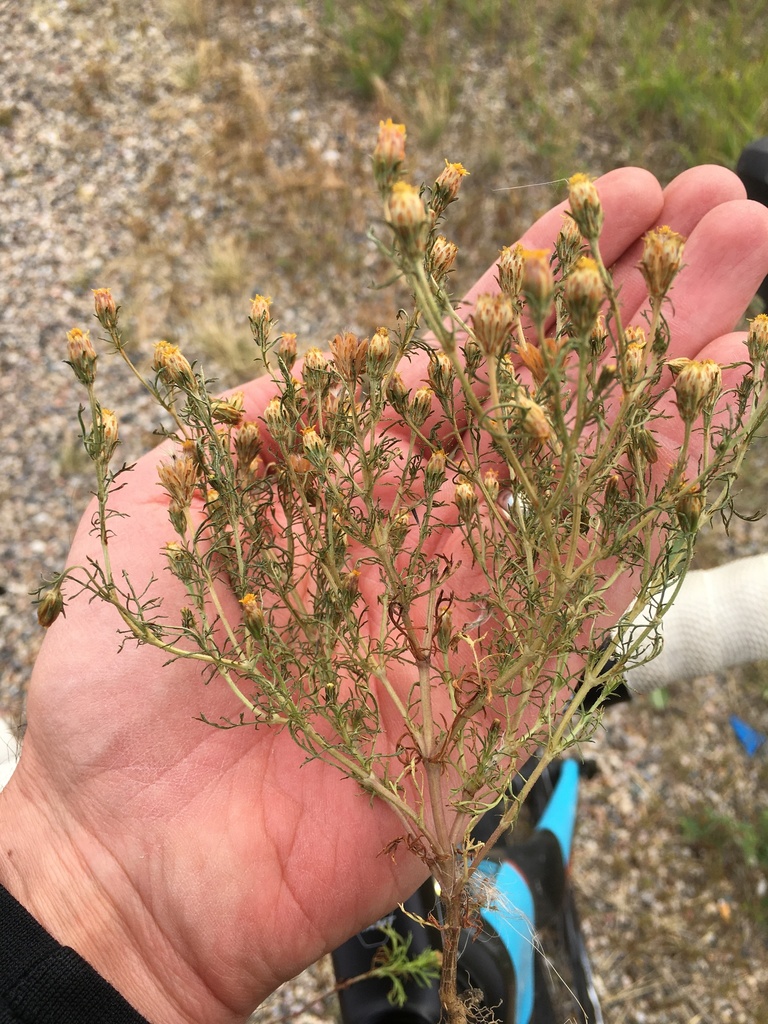
(c) Eric Lamb, some rights reserved (CC BY) · licence
Family: Asteraceae · Type: Herb · Not Native
Dyssodia papposa (Dogweed) is a non-native California herb in the Asteraceae family, recognized by Central/eastern North American species, probably extirpated from California; waif status indicates non-persistent introduction.
Dogweed is a naturalized annual found in eastern Southern California, specifically in southwestern San Bernardino County, on roadsides and disturbed fields at elevations below 350 meters. Flowering from May to October, this plant produces yellow ray flowers with narrow petals 1.5 to 2.5 millimeters long, surrounded by an unpleasant-smelling inflorescence. Growing with finely divided stems up to 50 centimeters tall, it has a distinctive branching habit. Its leaves are deeply lobed with 11 to 15 narrow segments, each 5 to 20 millimeters long, dotted with embedded oil glands that contribute to its distinctive odor. The plant produces small fruits 3 to 3.5 millimeters long, typical of its daisy family heritage.
Identification and appearance
Key characters: Central/eastern North American species, probably extirpated from California; waif status indicates non-persistent introduction
Habitat and range
Habitat: Roadsides, disturbed fields
Elevation: < 350 m
Outside California: widespread weed in America, native to central and eastern North America, Mexico, also in western South America
Bloom period
Dyssodia papposa blooms May-Oct.
How to tell it apart
vs Thymophylla: Dyssodia is annual dying after one season; Thymophylla is a woody perennial subshrub.; vs Adenophyllum: Dyssodia has tiny 1-5mm flower stalks; Adenophyllum has longer 2-15cm stalks.; vs Pectis: Dyssodia flower heads appear nearly stemless (1-5mm stalks); Pectis has longer visible stalks.; vs Tagetes: Dyssodia bracts are separate in 2 rows; Tagetes bracts are fused into a tube.; vs Nicolletia: Dyssodia has both ray and disk flowers; Nicolletia has only disk flowers (no rays).
Frequently asked questions
Is Dyssodia papposa native to California?
No. Dyssodia papposa is not native to California (recorded as not native).
When does Dyssodia papposa bloom?
Dyssodia papposa blooms May-Oct.
What plant family does Dyssodia papposa belong to?
Dyssodia papposa is in the Asteraceae family, genus Dyssodia.
What habitat does Dyssodia papposa grow in?
Dyssodia papposa grows in Roadsides, disturbed fields.
Related species
Other California species in the same genus, family, or bioregion.
Sources: Jepson eFlora · Index of California Plant Names · CalPhotos
Last updated 2026-10-07
Data from The California Species Project — 14,000+ California species with verified data from CNPS, CDFW, USFWS, Cal-IPC, and more.