Eastwoodiella californica
Swamp harebell
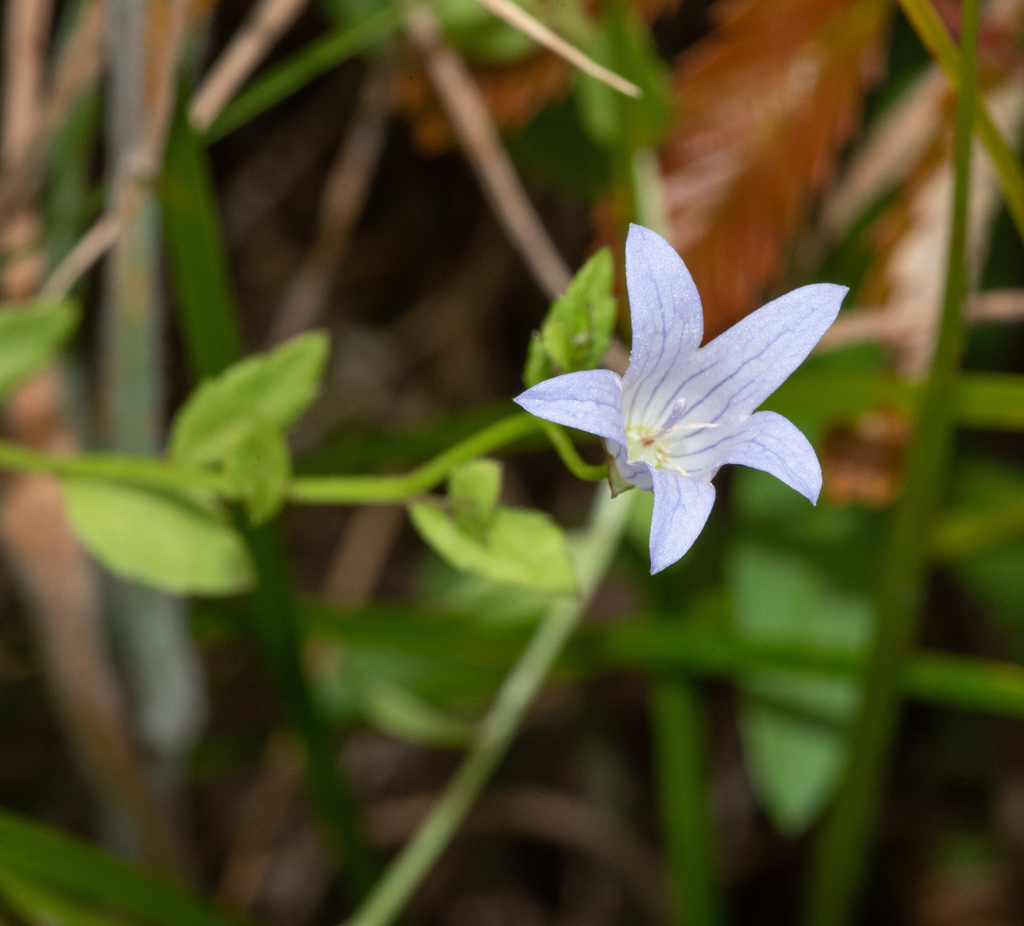
(c) Don Loarie, some rights reserved (CC BY) · licence
Family: Campanulaceae · Type: Herb · Native
Conservation status: CNPS 1B.2
Eastwoodiella californica (Swamp harebell) is a native California herb in the Campanulaceae family, recognized by Monotypic genus endemic to coastal northern California marshes.
Swamp harebell is a rare (CNPS 1B.2) California native perennial found in southern Northern Coast and northern Central Coast bioregions in marshy areas at elevations up to 400 meters. Flowering from June to September, this plant produces pale blue flowers in bell-shaped corollas 8 to 15 millimeters long with reflexed lobes. Growing with clambering stems 10 to 30 centimeters tall that have stiff, recurved hairs along stem angles, it develops thin, elliptic to ovate leaves 10 to 20 millimeters long with crenate or irregularly serrate margins. Its leaves are arranged with short or absent petioles, and individual flowers emerge singly at each node. The fruit is spheric and weakly ribbed, with basal pores containing small elliptic seeds less than one millimeter long.
Identification and appearance
Key characters: Monotypic genus endemic to coastal northern California marshes
Habitat and range
Habitat: Marshy areas
Elevation: <= 400 m
California counties: Mendocino, Sonoma, Marin, Santa Cruz
Bloom period
Eastwoodiella californica blooms Jun-Sep.
Conservation status
CNPS 1B.2
How to tell it apart
vs Campanula: Eastwoodiella is a slender clambering bog plant with stiff, backward-hooked (recurved) hairs along the stem angles, leaf margins and ovary ribs; true Campanula is mostly erect and either glabrous or evenly soft-hairy without hooked bristles.; vs Githopsis: Eastwoodiella has a bell-shaped corolla with reflexed lobes and a many-seeded capsule; Githopsis (bluecup) has a narrow, sharply angled calyx tube and a small erect blue flower.; vs Heterocodon: Eastwoodiella is a perennial with true open bell flowers; Heterocodon is a tiny annual with round clasping toothed leaves and mostly closed (cleistogamous) flowers.; vs Triodanis: Eastwoodiella flowers are pedicelled bells; Triodanis (Venus's looking-glass) has sessile flowers crowded in the leaf axils, the lower ones closed.; vs Wahlenbergia: Eastwoodiella has recurved bristly hairs and weak clambering stems; Wahlenbergia is a rhizomatous plant with erect glabrous stems and a top-opening capsule.
Frequently asked questions
Is Eastwoodiella californica native to California?
Yes. Eastwoodiella californica is native to California (recorded as native).
When does Eastwoodiella californica bloom?
Eastwoodiella californica blooms Jun-Sep.
Where in California does Eastwoodiella californica grow?
Eastwoodiella californica occurs in Mendocino, Sonoma, Marin, Santa Cruz, at elevations of <= 400 m.
What plant family does Eastwoodiella californica belong to?
Eastwoodiella californica is in the Campanulaceae family, genus Eastwoodiella.
Is Eastwoodiella californica rare or endangered?
Eastwoodiella californica carries California Rare Plant Rank 1B.2, state rank S3.
Related species
Other California species in the same genus, family, or bioregion.
Sources: Jepson eFlora · CNPS Rare Plant Inventory · Index of California Plant Names · CalPhotos · CDFW CNDDB
Last updated 2026-10-07
Data from The California Species Project — 14,000+ California species with verified data from CNPS, CDFW, USFWS, Cal-IPC, and more.