Echinochloa crus-galli
Barnyard grass
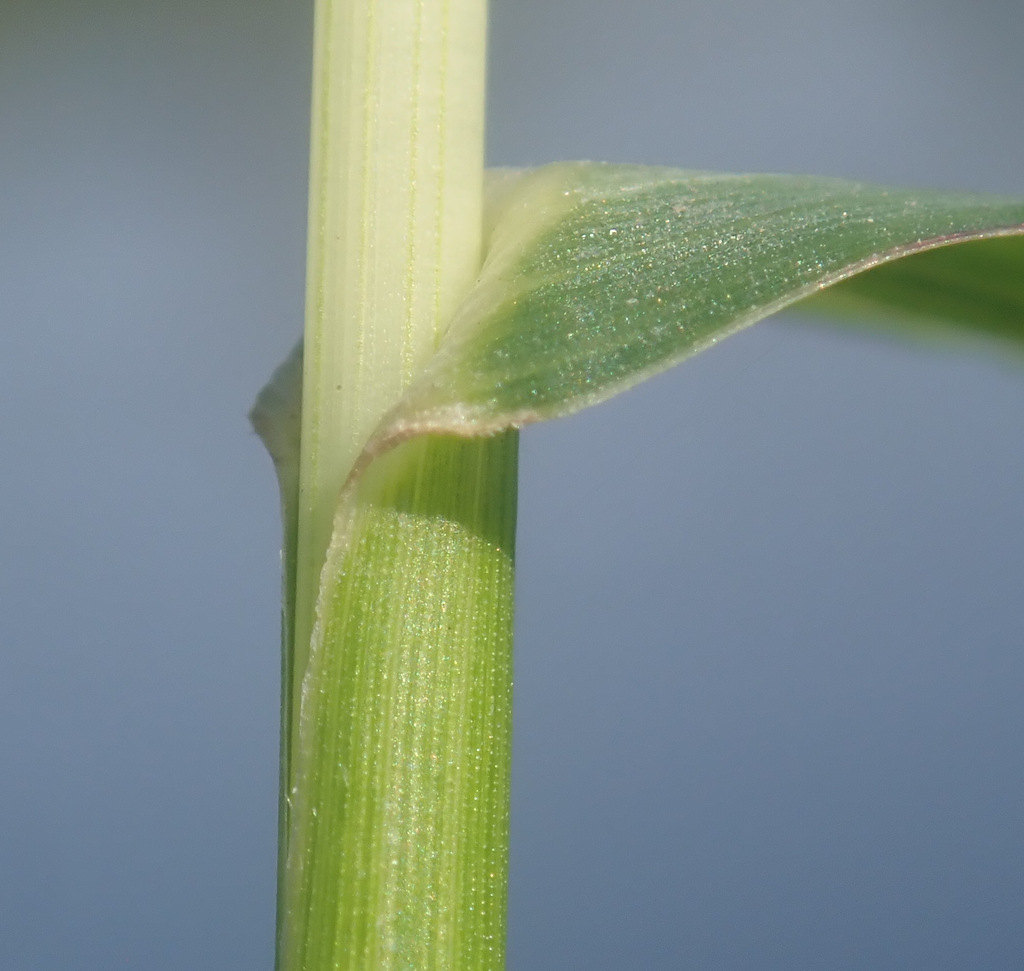
(c) Thomas Gyselinck, some rights reserved (CC BY), uploaded by Thomas Gyselinck · licence
Family: Poaceae · Type: Grass · Not Native
Echinochloa crus-galli (Barnyard grass) is a non-native California grass in the Poaceae family, recognized by large size, variable awns, and leathery lemma texture.
Barnyard grass is a naturalized annual grass found throughout California's Central Valley and foothill regions in wet, disturbed sites, fields, and roadsides at elevations below 2,000 meters. Flowering from June to October, this grass produces pale green to purplish spikelets with distinctive awned branches 5 to 25 centimeters long. Growing with spreading or erect stems 30 to 200 centimeters tall, it forms dense, adaptable clumps in agricultural and disturbed landscapes. Its long leaves measure up to 65 centimeters in length and 5 to 30 millimeters wide, with smooth leaf sheaths 3 to 7 centimeters long. The fruit is approximately brown, with upper lemmas that have a distinctive early-withering, acuminate tip marked by a line of minute hairs.
Identification and appearance
Key characters: 6 sympatric species; key features are large size, variable awns, and leathery lemma texture
Habitat and range
Habitat: Generally wet, disturbed sites, fields, roadsides
Elevation: < 2000 m
California counties: Humboldt, Riverside, Glenn, Orange, Merced, Fresno, Los Angeles, Kern, Butte, Mendocino, San Diego, Ventura, Nevada, San Bernardino, Imperial, Santa Clara, San Luis Obispo, Inyo, Madera, Alameda, Yuba, Monterey, Tulare, Colusa, San Mateo, Contra Costa, Lake, Napa, Sierra, Sonoma, Tehama, Tuolumne, El Dorado, Yolo, Modoc, Solano, Santa Barbara, Stanislaus, Sutter, Amador, San Joaquin, Calaveras, Sacramento, Kings, Plumas, Trinity, Marin, San Francisco, Santa Cruz, Lassen, Shasta, Siskiyou, Mariposa, Del Norte, Placer
Outside California: worldwide, native to Eurasia
Bloom period
Echinochloa crus-galli blooms Jun-Oct.
How to tell it apart
vs Sorghum: Echinochloa has no ligule and bristly inflorescence; sorghum has a ligule and smooth three-spikelet clusters.; vs Digitaria: Echinochloa lacks a ligule and has bristly branches; crabgrass has a ligule and finger-like smooth branches.; vs Paspalum: Echinochloa has no ligule and bristly flowers; dallisgrass has a ligule and smooth leathery spikelets.; vs Panicum: Echinochloa completely lacks a ligule on upper leaves; panicgrass has a membranous ligule present.; vs Eriochloa: Echinochloa has bristly spikelets without cups; cupgrass has each spikelet sitting in a distinctive cup.
Frequently asked questions
Is Echinochloa crus-galli native to California?
No. Echinochloa crus-galli is not native to California (recorded as not native).
When does Echinochloa crus-galli bloom?
Echinochloa crus-galli blooms Jun-Oct.
Where in California does Echinochloa crus-galli grow?
Echinochloa crus-galli occurs in Humboldt, Riverside, Glenn, Orange, Merced, Fresno, Los Angeles, Kern and other counties, at elevations of < 2000 m.
What plant family does Echinochloa crus-galli belong to?
Echinochloa crus-galli is in the Poaceae family, genus Echinochloa.
What habitat does Echinochloa crus-galli grow in?
Echinochloa crus-galli grows in Generally wet, disturbed sites, fields, roadsides.
Related species
Other California species in the same genus, family, or bioregion.
Sources: Jepson eFlora · Index of California Plant Names · CalPhotos
Last updated 2026-10-07
Data from The California Species Project — 14,000+ California species with verified data from CNPS, CDFW, USFWS, Cal-IPC, and more.