Echinochloa muricata var. microstachya
Rough barnyardgrass
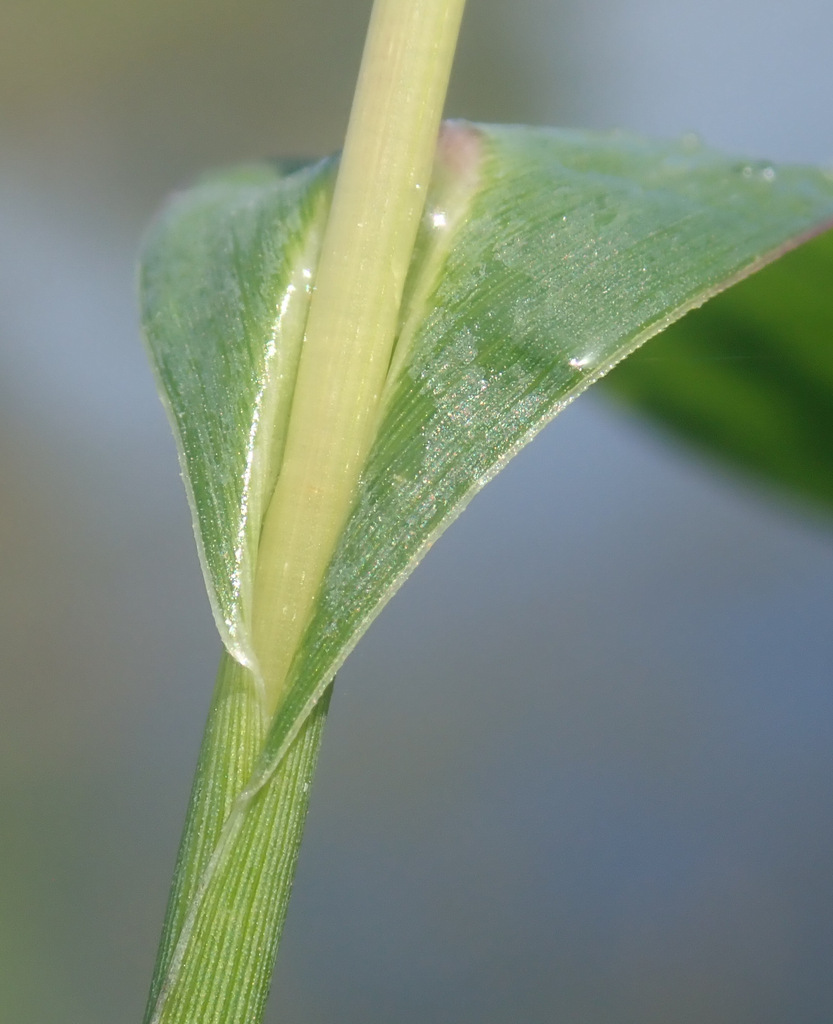
(c) Thomas Gyselinck, some rights reserved (CC BY), uploaded by Thomas Gyselinck · licence
Family: Poaceae · Type: Grass · Native
Echinochloa muricata var. microstachya (Rough barnyardgrass) is a native California grass in the Poaceae family, recognized by native status, open inflorescence, and undifferentiated lemma tip.
Rough barnyardgrass is a native annual grass found in northwestern California, northern Sierra Nevada foothills, Great Valley, southern California coastal areas, San Bernardino Mountains, Peninsular Ranges, and Great Basin at elevations below 1,800 meters in moist, often disturbed sites. Flowering from July to September, this grass produces yellow-tinted spikelets that are 2.5 to 3.8 millimeters long with spreading branches. Growing 80 to 160 centimeters tall with erect stems that occasionally root at lower nodes, it forms open, upright inflorescences up to 35 centimeters long. Its leaf blades measure 1 to 27 centimeters long and 4 to 11 millimeters wide, with smooth sheaths extending 6 to 20 centimeters. The upper lemma is leathery with an acute tip, creating a distinctive appearance in moist habitats.
Identification and appearance
Key characters: 6 sympatric species; key features are native status, open inflorescence, and undifferentiated lemma tip
Habitat and range
Habitat: Moist, often disturbed sites (rarely in rice fields)
Elevation: < 1800 m
Outside California: western North America, Mexico
Bloom period
Echinochloa muricata var. microstachya blooms Jul-Sept.
How to tell it apart
vs Sorghum: Echinochloa has no ligule and bristly inflorescence; sorghum has a ligule and smooth three-spikelet clusters.; vs Digitaria: Echinochloa lacks a ligule and has bristly branches; crabgrass has a ligule and finger-like smooth branches.; vs Paspalum: Echinochloa has no ligule and bristly flowers; dallisgrass has a ligule and smooth leathery spikelets.; vs Panicum: Echinochloa completely lacks a ligule on upper leaves; panicgrass has a membranous ligule present.; vs Eriochloa: Echinochloa has bristly spikelets without cups; cupgrass has each spikelet sitting in a distinctive cup.
Frequently asked questions
Is Echinochloa muricata var. microstachya native to California?
Yes. Echinochloa muricata var. microstachya is native to California (recorded as native).
When does Echinochloa muricata var. microstachya bloom?
Echinochloa muricata var. microstachya blooms Jul-Sept.
What plant family does Echinochloa muricata var. microstachya belong to?
Echinochloa muricata var. microstachya is in the Poaceae family, genus Echinochloa.
What habitat does Echinochloa muricata var. microstachya grow in?
Echinochloa muricata var. microstachya grows in Moist, often disturbed sites (rarely in rice fields).
Related species
Other California species in the same genus, family, or bioregion.
Sources: Jepson eFlora · CalPhotos
Last updated 2026-10-07
Data from The California Species Project — 14,000+ California species with verified data from CNPS, CDFW, USFWS, Cal-IPC, and more.