Echium candicans
Pride of madeira
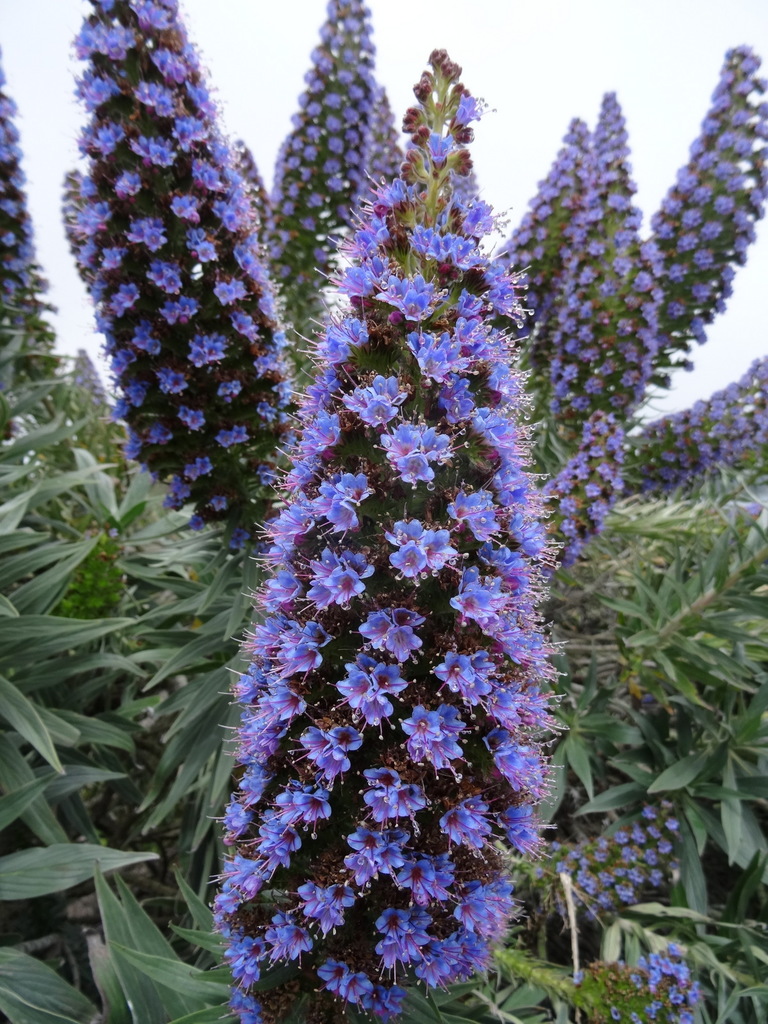
(c) Thomas Koffel, some rights reserved (CC BY) · licence
Family: Boraginaceae · Type: Shrub · Not Native
Conservation status: Cal-IPC Yes
Echium candicans (Pride of madeira) is a non-native California shrub in the Boraginaceae family, recognized by . Distinguished by shrubby perennial habit vs annual herb or tall monocarpic shrub.
Pride of Madeira is a naturalized shrub found in coastal regions including central California Coast, San Francisco Bay Area, southern California Coast, and southern Channel Islands on open, dry slopes and bluffs at elevations below 500 meters. Flowering from February to October, this plant produces stunning blue to violet flowers in dense elliptic clusters 15 to 40 centimeters long. Growing as a long-lived, many-branched shrub 1 to 2 meters tall with spreading stems, it forms a robust and distinctive landscape presence. Its persistent leaves are narrow-elliptic, 6 to 25 centimeters long, covered in dense strigose hairs with some bulbous-based follicles. The fruit is characterized by black, rough surfaces with fine tubercles.
Identification and appearance
Key characters: 2 sympatric species. Distinguished by shrubby perennial habit vs annual herb or tall monocarpic shrub.
Habitat and range
Habitat: Open, dry slopes, bluffs
Elevation: < 500 m
California counties: Ventura, Los Angeles, Orange, San Diego, Marin, San Luis Obispo, Monterey, Contra Costa, Alameda, Santa Barbara, Santa Cruz
Outside California: native to Madeira, Macaronesia
Bloom period
Echium candicans blooms Feb-Oct.
Conservation status
Cal-IPC Yes
How to tell it apart
vs Phacelia: Echium grows as a woody shrub; Phacelia is herbaceous (soft-stemmed) and much smaller.; vs Salvia: Echium flowers are lopsided but tubular; Salvia has distinctly 2-lipped mint-family flowers.; vs Euphorbia: Echium has blue-purple tubular flowers; Euphorbia has tiny flowers with milky sap.; vs Lupinus: Echium has tubular lopsided flowers; Lupinus has pea-shaped flowers with banner petal.; vs Veronica: Echium forms tall tower-like spikes; Veronica has small 4-lobed flowers in loose clusters.
Frequently asked questions
Is Echium candicans native to California?
No. Echium candicans is not native to California (recorded as not native).
When does Echium candicans bloom?
Echium candicans blooms Feb-Oct.
Where in California does Echium candicans grow?
Echium candicans occurs in Ventura, Los Angeles, Orange, San Diego, Marin, San Luis Obispo, Monterey, Contra Costa and other counties, at elevations of < 500 m.
What plant family does Echium candicans belong to?
Echium candicans is in the Boraginaceae family, genus Echium.
Is Echium candicans invasive in California?
Echium candicans is listed by Cal-IPC with an invasiveness rating of Yes.
Related species
Other California species in the same genus, family, or bioregion.
Sources: Jepson eFlora · Index of California Plant Names · CalPhotos
Last updated 2026-10-07
Data from The California Species Project — 14,000+ California species with verified data from CNPS, CDFW, USFWS, Cal-IPC, and more.