Eichhornia crassipes
Common water hyacinth
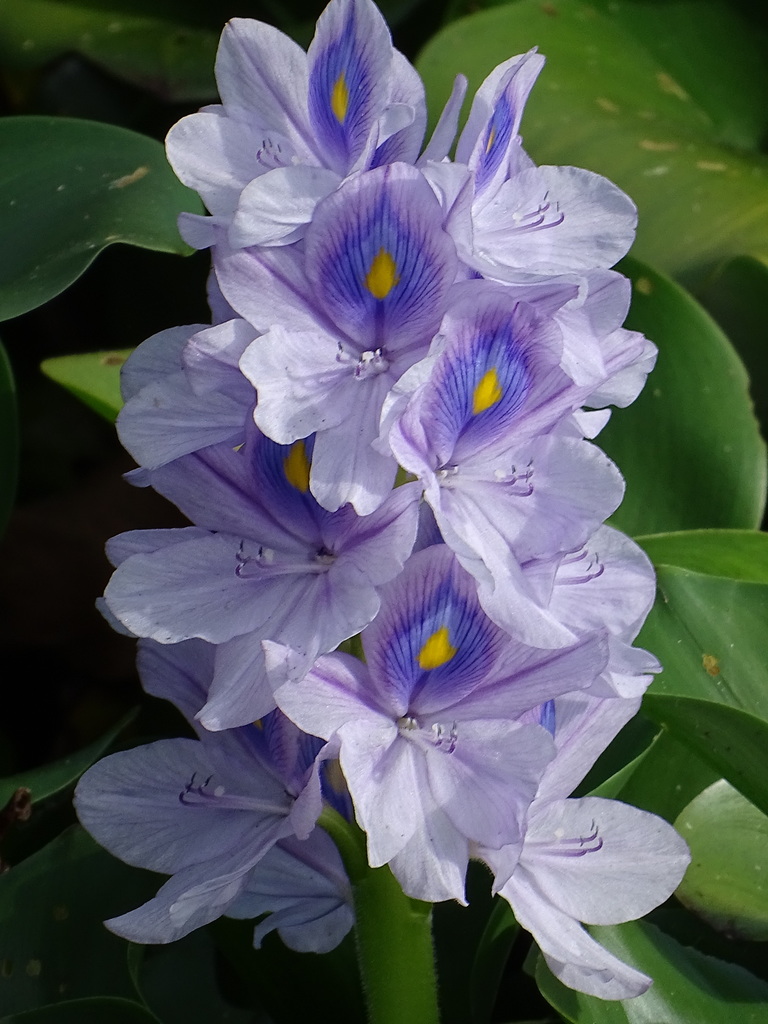
no rights reserved, uploaded by 葉子 · CC0
Family: Pontederiaceae · Type: Herb · Not Native
Conservation status: Cal-IPC Yes
Eichhornia crassipes (Common water hyacinth) is a non-native California herb in the Pontederiaceae family, recognized by Tropical American genus adapted for free-floating lifestyle; represents unique evolutionary solution to aquatic existence.
Common water hyacinth is a naturalized perennial found in the Great Valley, San Francisco Bay, southern California coastal areas, and Peninsular Ranges in ponds, sloughs, and waterways at elevations below 200 meters. Flowering from June to October, this invasive plant produces lilac, pale blue, or white flowers in compact clusters 5 to 15 centimeters long. Growing with floating stems over 30 centimeters in length, it forms dense mats across water surfaces. Its broad leaves are less than 10 centimeters wide, creating thick floating vegetation. This aggressive aquatic plant rapidly spreads and can completely cover water surfaces, disrupting local ecosystems.
Identification and appearance
Key characters: Tropical American genus adapted for free-floating lifestyle; represents unique evolutionary solution to aquatic existence
Habitat and range
Habitat: Locally abundant. Ponds, sloughs, waterways
Elevation: < 200 m
California counties: San Joaquin, Orange, San Diego, Riverside, Kern, San Bernardino, Los Angeles, Contra Costa, Sacramento, Lake, Yuba, Placer, Stanislaus, Merced, Madera, Santa Cruz, Santa Barbara, Solano, Butte, Fresno, Tulare, San Luis Obispo, Monterey
Outside California: widely naturalized, native to tropical America
Bloom period
Eichhornia crassipes blooms Jun-Oct.
Conservation status
Cal-IPC Yes
How to tell it apart
vs Heteranthera: Eichhornia has swollen balloon-like leaf stalks and many-flowered clusters; Heteranthera has thin petioles and single flowers.; vs Monochoria: Eichhornia floats freely with inflated stems; Monochoria is rooted with non-inflated stems.; vs Azolla: Eichhornia is large with showy flower spikes; Azolla is tiny floating fern without flowers.; vs Pistia: Eichhornia has balloon-like leaf stalks; Pistia has wedge-shaped velvety leaves in rosettes.; vs Salvinia: Eichhornia has large glossy leaves with inflated stalks; Salvinia has tiny paired leaves without inflation.
Frequently asked questions
Is Eichhornia crassipes native to California?
No. Eichhornia crassipes is not native to California (recorded as not native).
When does Eichhornia crassipes bloom?
Eichhornia crassipes blooms Jun-Oct.
Where in California does Eichhornia crassipes grow?
Eichhornia crassipes occurs in San Joaquin, Orange, San Diego, Riverside, Kern, San Bernardino, Los Angeles, Contra Costa and other counties, at elevations of < 200 m.
What plant family does Eichhornia crassipes belong to?
Eichhornia crassipes is in the Pontederiaceae family, genus Eichhornia.
Is Eichhornia crassipes invasive in California?
Eichhornia crassipes is listed by Cal-IPC with an invasiveness rating of Yes.
Related species
Other California species in the same genus, family, or bioregion.
Sources: Jepson eFlora · Index of California Plant Names · CalPhotos
Last updated 2026-10-07
Data from The California Species Project — 14,000+ California species with verified data from CNPS, CDFW, USFWS, Cal-IPC, and more.