Elaeagnus angustifolia
Russian olive, Russian Olive
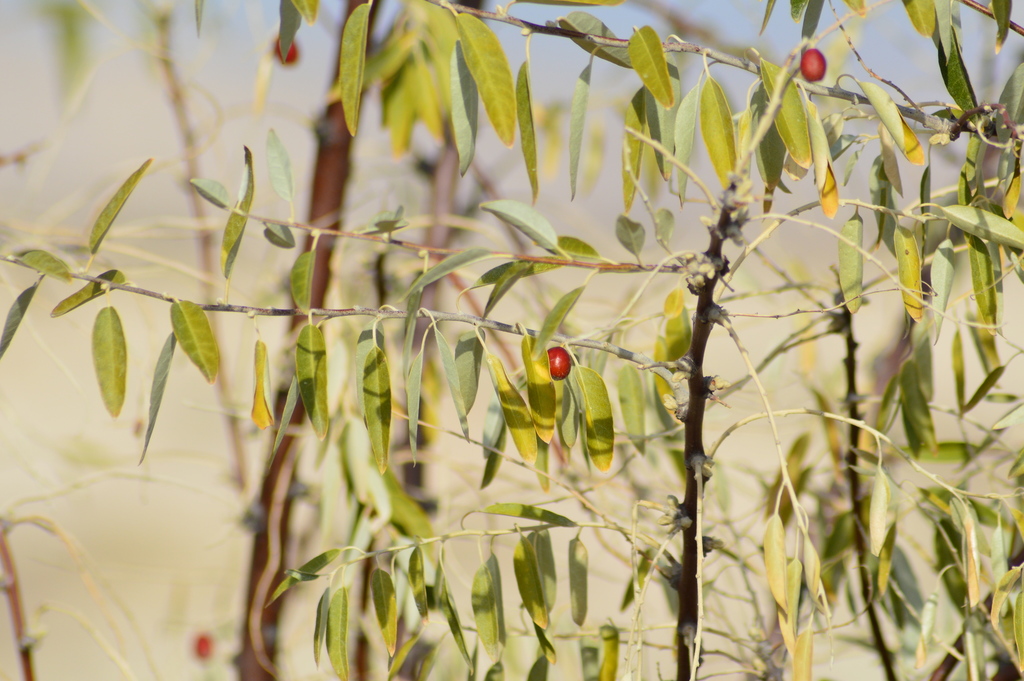
(c) Olena V. Vakarenko, some rights reserved (CC BY) · licence
Family: Elaeagnaceae · Type: Shrub / Tree · Not Native
Conservation status: Cal-IPC Yes
Elaeagnus angustifolia (Russian olive) is a non-native California shrub / tree in the Elaeagnaceae family, recognized by Asian genus extensively planted and now naturalizing; represents different branch of Elaeagnaceae evolution from native species.
Russian olive is a naturalized shrub found in the San Joaquin Valley, San Francisco Bay Area, Sierra Nevada, San Bernardino Mountains, Peninsular Ranges, Great Basin, and Mojave Desert in disturbed and occasionally moist locations at elevations generally below 2,050 meters. Flowering from May to June, this plant produces fragrant pale yellow flowers approximately 5 to 10 millimeters wide. Growing to heights up to 7 meters, it develops an occasionally thorny structure with spreading branches. Its leaves are lanceolate to oblong, 4 to 8 centimeters long, distinctively silvery on the undersurface. The fruit is an elliptic yellow drupe 10 to 20 millimeters long.
Identification and appearance
Key characters: Asian genus extensively planted and now naturalizing; represents different branch of Elaeagnaceae evolution from native species
Habitat and range
Habitat: Uncommon. Disturbed, sometimes moist places
Elevation: generally < 2050 m
California counties: San Bernardino, Los Angeles, Inyo, Butte, Contra Costa, Riverside, Fresno, Sutter, Modoc, San Joaquin, Lassen, Solano, San Diego, Santa Clara, Stanislaus, Yolo, Siskiyou, Monterey
Outside California: native to temperate Asia
Bloom period
Elaeagnus angustifolia blooms May-Jun.
Conservation status
Cal-IPC Yes
How to tell it apart
vs Quercus: Elaeagnus leaves have silvery scales beneath; oak leaves lack silvery scales.; vs Salix: Elaeagnus has tubular flowers; Salix has catkins.; vs Olea: Elaeagnus has silvery-scaly foliage; Olea has smooth green/gray leaves.; vs Frangula: Elaeagnus leaves have silvery scales; Frangula leaves are plain green.; vs Eucalyptus: Elaeagnus has narrow leaves with silvery scales; Eucalyptus has aromatic smooth leaves.
Frequently asked questions
Is Elaeagnus angustifolia native to California?
No. Elaeagnus angustifolia is not native to California (recorded as not native).
When does Elaeagnus angustifolia bloom?
Elaeagnus angustifolia blooms May-Jun.
Where in California does Elaeagnus angustifolia grow?
Elaeagnus angustifolia occurs in San Bernardino, Los Angeles, Inyo, Butte, Contra Costa, Riverside, Fresno, Sutter and other counties, at elevations of generally < 2050 m.
What plant family does Elaeagnus angustifolia belong to?
Elaeagnus angustifolia is in the Elaeagnaceae family, genus Elaeagnus.
Is Elaeagnus angustifolia invasive in California?
Elaeagnus angustifolia is listed by Cal-IPC with an invasiveness rating of Yes.
Related species
Other California species in the same genus, family, or bioregion.
Sources: Jepson eFlora · Index of California Plant Names · CalPhotos
Last updated 2026-10-07
Data from The California Species Project — 14,000+ California species with verified data from CNPS, CDFW, USFWS, Cal-IPC, and more.