Eleocharis montevidensis
Montevideo spike rush
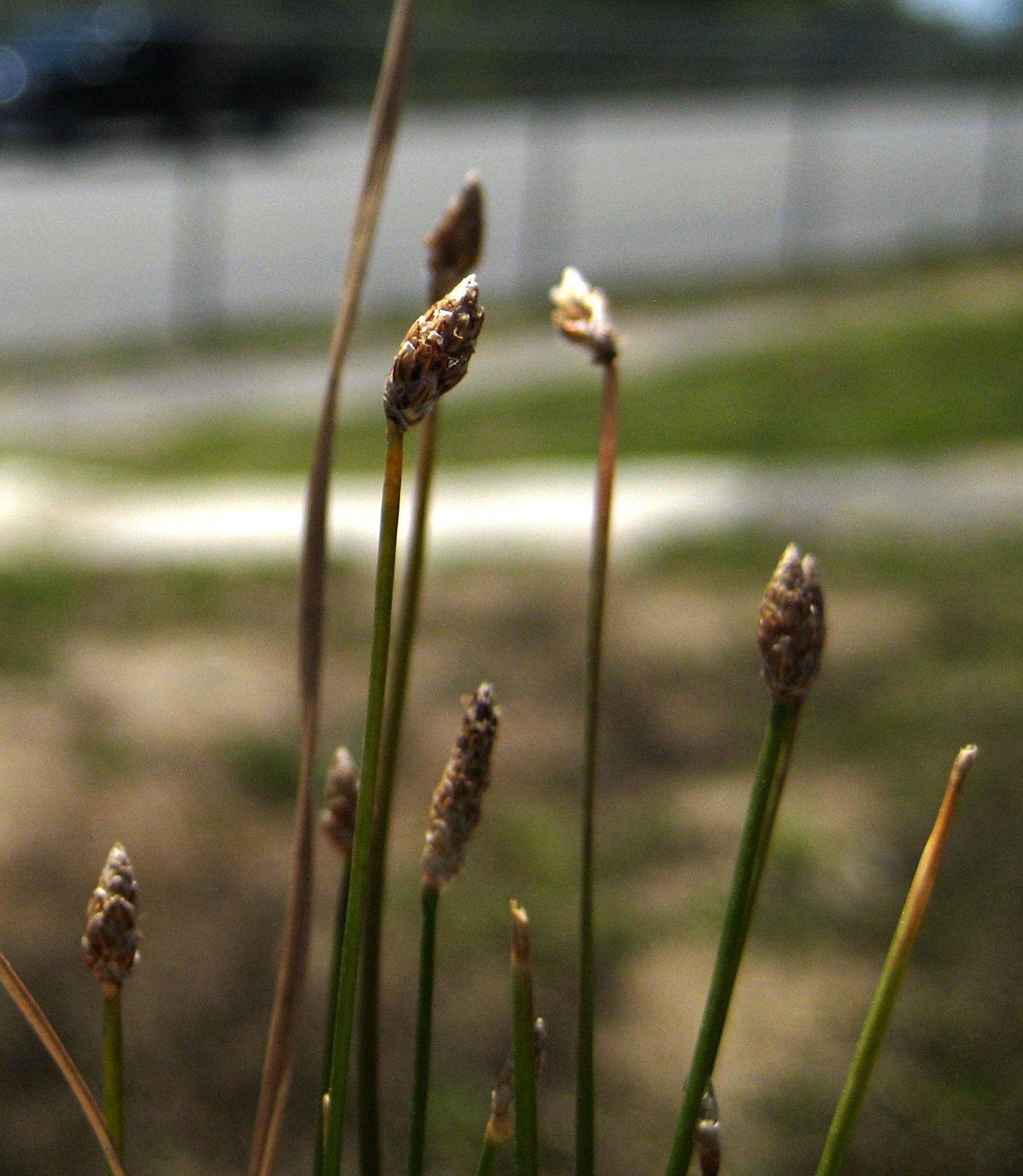
Photo by Chez Brungraber
Family: Cyperaceae · Type: Grass · Native
Eleocharis montevidensis (Montevideo spike rush) is a native California grass in the Cyperaceae family, recognized by 26 co-occurring species; tooth-like projections and wrinkled recurved bracts.
Montevideo spike rush is a California native perennial found in the northern Coast Ranges, Cascade Range, northern Sierra Nevada, Sacramento Valley, Central Coast, southern Coast Ranges, southwestern California, and Sonoran Desert in fresh wet places like riparian zones, foothill woodlands, and pine forests at elevations below 2,000 meters. Flowering from spring to summer, this plant produces small clusters of pale flowers in spikes 4 to 12 millimeters long with wide-rounded flower bracts. Growing 25 to 50 centimeters tall with tough, subcylindric stems 0.5 to 1.2 millimeters in diameter, it spreads via a slender rhizome. Its leaf sheaths are firm and persistent, with some showing a subtle tooth-like projection up to 1 millimeter long. The fruit is tiny, fine-wrinkled, and three-sided, accompanied by 5 to 6 short perianth bristles.
Identification and appearance
Key characters: 26 co-occurring species; tooth-like projections and wrinkled recurved bracts are diagnostic
Habitat and range
Habitat: Locally common. Fresh wet places in riparian and foothill woodland, pine forest, streams
Elevation: < 2000 m
California counties: San Diego, Los Angeles, San Bernardino, Riverside, Orange, San Luis Obispo, San Mateo, Ventura, Santa Barbara, Plumas, Santa Clara, Santa Cruz, Siskiyou, Sonoma, Napa, Kern, Imperial, Lake, Nevada, Monterey, Tulare, Humboldt, Butte, Yuba, Tehama, Glenn, Trinity, Lassen, Sacramento, Colusa
Outside California: to Florida, Mexico, South America
Bloom period
Eleocharis montevidensis blooms Spring-summer.
How to tell it apart
vs Carex: Eleocharis has single spikelet with no bracts below, Carex has leafy bracts and multiple spikes.; vs Isolepis: Eleocharis has no bracts below spikelet, Isolepis has conspicuous leaf-like bracts extending beyond flowers.; vs Schoenoplectus: Eleocharis has single terminal spikelet, Schoenoplectus has multiple spikelets in clusters.; vs Juncus: Eleocharis spikelets are flattened oval, Juncus flowers are round with visible petals in clusters.; vs Equisetum: Eleocharis has grass-like stems with flower spikelets, Equisetum has jointed hollow stems with cone-like structures.
Frequently asked questions
Is Eleocharis montevidensis native to California?
Yes. Eleocharis montevidensis is native to California (recorded as native).
When does Eleocharis montevidensis bloom?
Eleocharis montevidensis blooms Spring-summer.
Where in California does Eleocharis montevidensis grow?
Eleocharis montevidensis occurs in San Diego, Los Angeles, San Bernardino, Riverside, Orange, San Luis Obispo, San Mateo, Ventura and other counties, at elevations of < 2000 m.
What plant family does Eleocharis montevidensis belong to?
Eleocharis montevidensis is in the Cyperaceae family, genus Eleocharis.
What habitat does Eleocharis montevidensis grow in?
Eleocharis montevidensis grows in Locally common. Fresh wet places in riparian and foothill woodland, pine forest, streams.
Related species
Other California species in the same genus, family, or bioregion.
Sources: Jepson eFlora · Index of California Plant Names · CalPhotos
Last updated 2026-10-07
Data from The California Species Project — 14,000+ California species with verified data from CNPS, CDFW, USFWS, Cal-IPC, and more.