Eleocharis parvula
Small spikerush, Small Spikerush
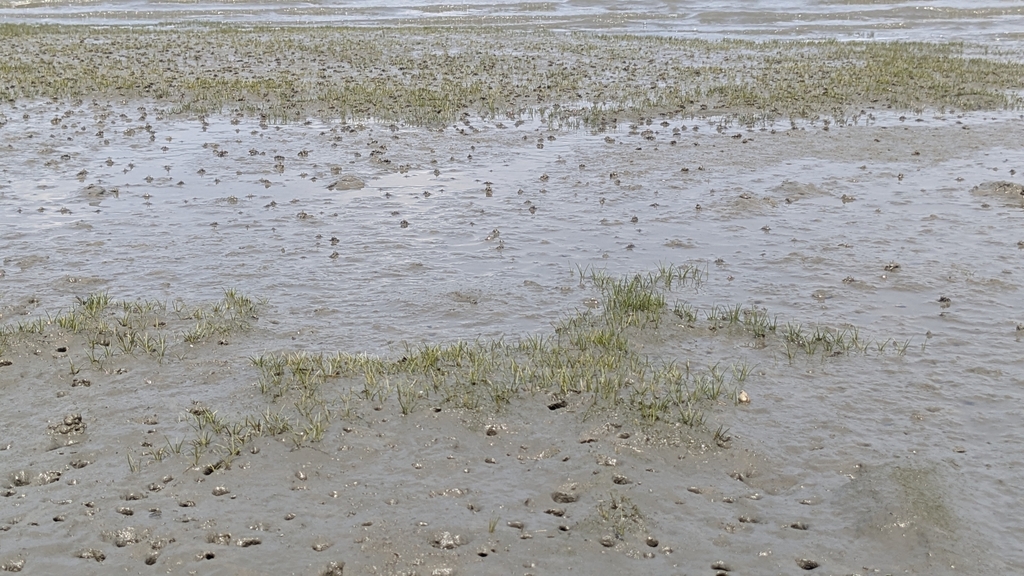
(c) Cheng-Te Hsu, some rights reserved (CC BY) · licence
Family: Cyperaceae · Type: Grass · Native
Conservation status: CNPS 4.3
Eleocharis parvula (Small spikerush) is a native California grass in the Cyperaceae family, recognized by 16 co-occurring species; coastal brackish habitat, tiny size, and curved tubers.
Small spikerush is a native perennial found in coastal bioregions of Northern California Coast, San Francisco Bay, and Southern California in brackish wet soils at elevations below 50 meters. Flowering from late winter through fall, this delicate plant produces tiny inconspicuous flowers in slender spikelets 2 to 4 millimeters long. Growing with extremely thin stems just 2 to 9 centimeters tall, it features weak rhizomes that often develop small curved tubers near their tips. Its distal leaf sheaths are fragile and tend to disintegrate, with rounded tips characterizing the plant's minimalist structure. The fruit is smooth, three-sided, and typically 1 to 1.2 millimeters wide, with six perianth bristles that are about equal to or slightly longer than the fruit.
Identification and appearance
Key characters: 16 co-occurring species; coastal brackish habitat, tiny size, and curved tubers are diagnostic
Habitat and range
Habitat: Brackish wet soil, coastal
Elevation: < 50 m
California counties: Los Angeles, San Diego, San Luis Obispo, San Bernardino, Humboldt, Glenn, Orange, Sonoma, Napa, Sacramento, Alameda, Riverside, Marin, Lassen
Outside California: to British Columbia, Kansas to Newfoundland, Florida, Louisiana, Mexico, Central America, Eurasia
Bloom period
Eleocharis parvula blooms Late winter-fall.
Conservation status
CNPS 4.3
How to tell it apart
vs Carex: Eleocharis has single spikelet with no bracts below, Carex has leafy bracts and multiple spikes.; vs Isolepis: Eleocharis has no bracts below spikelet, Isolepis has conspicuous leaf-like bracts extending beyond flowers.; vs Schoenoplectus: Eleocharis has single terminal spikelet, Schoenoplectus has multiple spikelets in clusters.; vs Juncus: Eleocharis spikelets are flattened oval, Juncus flowers are round with visible petals in clusters.; vs Equisetum: Eleocharis has grass-like stems with flower spikelets, Equisetum has jointed hollow stems with cone-like structures.
Frequently asked questions
Is Eleocharis parvula native to California?
Yes. Eleocharis parvula is native to California (recorded as native).
When does Eleocharis parvula bloom?
Eleocharis parvula blooms Late winter-fall.
Where in California does Eleocharis parvula grow?
Eleocharis parvula occurs in Los Angeles, San Diego, San Luis Obispo, San Bernardino, Humboldt, Glenn, Orange, Sonoma and other counties, at elevations of < 50 m.
What plant family does Eleocharis parvula belong to?
Eleocharis parvula is in the Cyperaceae family, genus Eleocharis.
Is Eleocharis parvula rare or endangered?
Eleocharis parvula carries California Rare Plant Rank 4.3, state rank S3.
Related species
Other California species in the same genus, family, or bioregion.
Sources: Jepson eFlora · CNPS Rare Plant Inventory · Index of California Plant Names · CalPhotos · CDFW CNDDB
Last updated 2026-10-07
Data from The California Species Project — 14,000+ California species with verified data from CNPS, CDFW, USFWS, Cal-IPC, and more.