Eleusine tristachya
Three-spiked goose grass
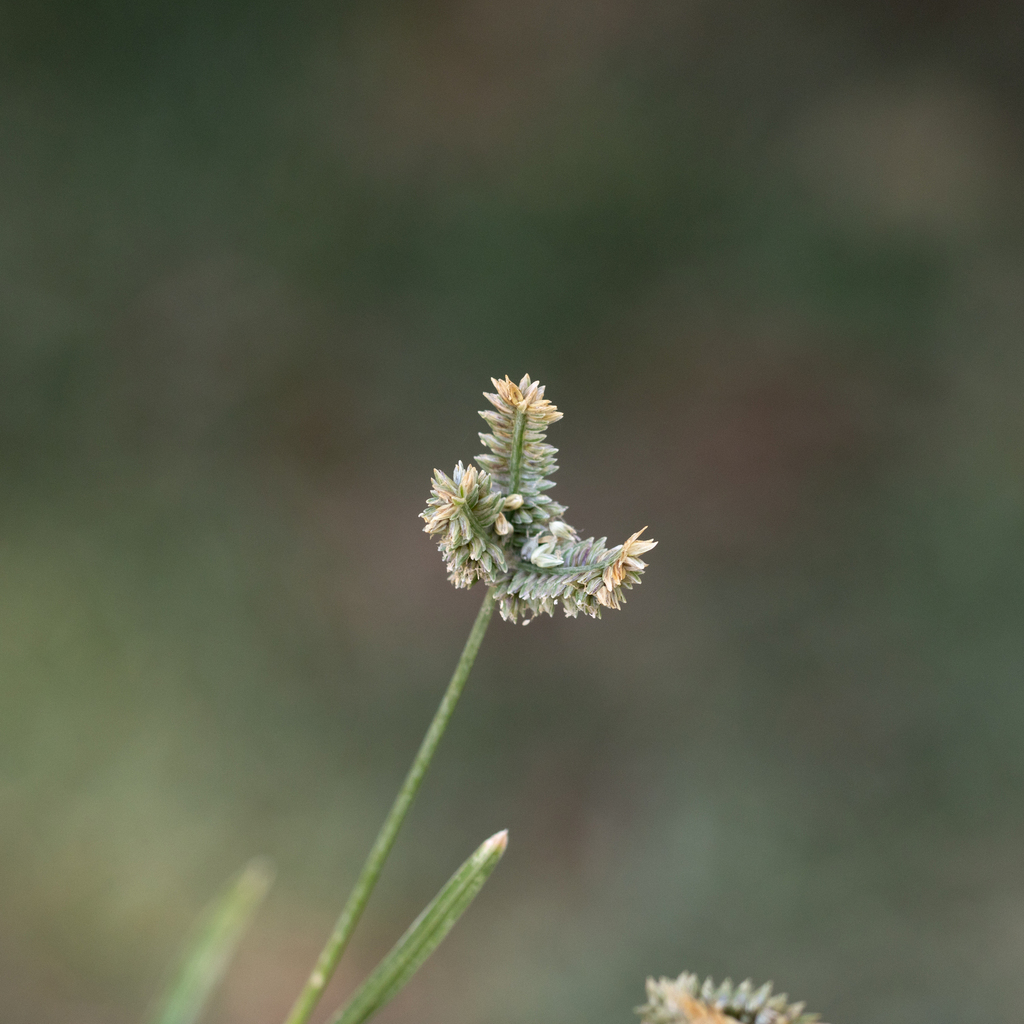
(c) Kym Nicolson, some rights reserved (CC BY) · licence
Family: Poaceae · Type: Grass · Not Native
Eleusine tristachya (Three-spiked goose grass) is a non-native California grass in the Poaceae family, recognized by perennial habit and few inflorescence branches.
Three-spiked goose grass is a naturalized annual grass found in disturbed areas of northern California Sierra Nevada foothills, Sacramento Valley, southern Coast Ranges, and southern California coastal regions at elevations below 650 meters. Flowering from May to October, this plant produces pale green to whitish spikelets clustered in slender, finger-like branches. Growing with ascending stems 10 to 40 centimeters tall, it forms loose, spreading clumps in open ground. Its leaf blades are narrow, measuring 6 to 25 centimeters long and only 1 to 4 millimeters wide, with a delicate, grass-like appearance. Individual spikelets are compact, measuring 8 to 10 millimeters long with overlapping pale green glumes.
Identification and appearance
Key characters: 2 sympatric species; perennial habit and few inflorescence branches are diagnostic
Habitat and range
Habitat: Disturbed areas
Elevation: < 650 m
California counties: Amador, San Joaquin, Riverside, Glenn, Monterey, Solano, San Benito, Sacramento, Stanislaus, Yuba, Merced, Contra Costa, San Luis Obispo, Yolo
Outside California: Oregon, Nevada, Texas, scattered in eastern United States, native to South America
Bloom period
Eleusine tristachya blooms May-Oct.
How to tell it apart
vs Cynodon: Goose grass has flattened stems and multiple florets per spikelet; bermuda grass is round-stemmed with single florets.; vs Digitaria: Goose grass has thick, dense flower rows on flattened stems; crabgrass has delicate rows on round stems.; vs Bromus: Goose grass has finger spikes radiating from one point; brome has elongated branching panicles.; vs Liriope: Eleusine is an annual grass with finger spikes; Liriope is a perennial lily-relative with strap-like leaves.; vs Paspalum: Goose grass has flowers in tight rows on both spike sides; paspalum has rows on one side only.
Frequently asked questions
Is Eleusine tristachya native to California?
No. Eleusine tristachya is not native to California (recorded as not native).
When does Eleusine tristachya bloom?
Eleusine tristachya blooms May-Oct.
Where in California does Eleusine tristachya grow?
Eleusine tristachya occurs in Amador, San Joaquin, Riverside, Glenn, Monterey, Solano, San Benito, Sacramento and other counties, at elevations of < 650 m.
What plant family does Eleusine tristachya belong to?
Eleusine tristachya is in the Poaceae family, genus Eleusine.
What habitat does Eleusine tristachya grow in?
Eleusine tristachya grows in Disturbed areas.
Related species
Other California species in the same genus, family, or bioregion.
Sources: Jepson eFlora · Index of California Plant Names · CalPhotos
Last updated 2026-10-07
Data from The California Species Project — 14,000+ California species with verified data from CNPS, CDFW, USFWS, Cal-IPC, and more.