Elymus caput-medusae
Medusa head
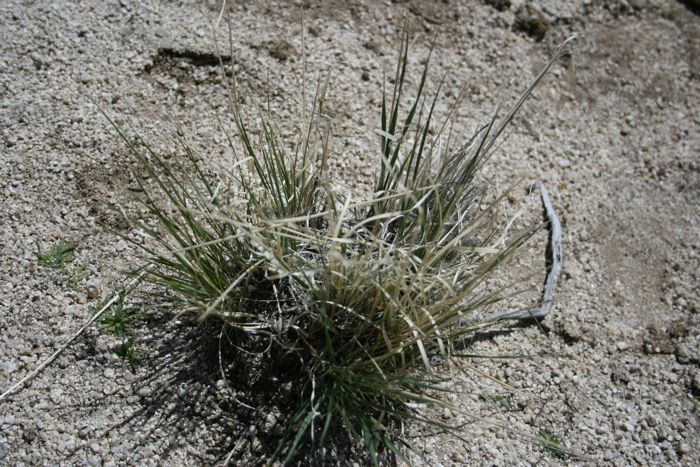
Photo by Chez Brungraber
Family: Poaceae · Type: Grass · Not Native
Conservation status: Cal-IPC Yes
Elymus caput-medusae (Medusa head) is a non-native California grass in the Poaceae family, recognized by only annual in genus, distinctive spreading awns and fused glumes.
Medusa head is a naturalized annual grass found in the Klamath Ranges, North Coast, California Ranges, Sierra Nevada Foothills, Central Valley, Southern Coast Ranges, and Modoc Plateau in disturbed areas at elevations below 2,000 meters. Flowering from April to July, this plant produces pale green to straw-colored spikelets with long, spreading awns that give it a distinctive tangled appearance. Growing with decumbent to ascending slender stems 20 to 70 centimeters tall, it has thin, narrow leaves that are slightly rolled and long-ciliate near the base. Its leaves are narrow, approximately 1 to 3 millimeters wide, with tiny membranous ligules less than one millimeter long. The plant's most distinctive feature is its dramatic seed heads with stiff, erect to spreading awns measuring 30 to 100 millimeters long, creating a medusa-like tangle of bristles.
Identification and appearance
Key characters: 22 sympatric species; only annual in genus, distinctive spreading awns and fused glumes
Habitat and range
Habitat: Disturbed areas
Elevation: < 2000 m
California counties: Tehama, Placer, Siskiyou, Solano, Yuba, Ventura, Nevada, Calaveras, El Dorado, Sacramento, San Luis Obispo, Modoc, Butte, Shasta, Plumas, Merced, Glenn, Sutter, Lake, Lassen, Contra Costa, San Benito, Mendocino, Humboldt, Trinity, Monterey, Santa Barbara, Sonoma, San Diego
Outside California: to British Columbia, Rocky Mountains, eastern United States (rare), native to Eurasia
Bloom period
Elymus caput-medusae blooms Apr-Jul.
Conservation status
Cal-IPC Yes
How to tell it apart
vs Hordeum: Elymus has rounded glume backs; Hordeum has all glumes narrow and bristle-like.; vs Leymus: Elymus has 2-8 spikelets per node; Leymus has just 1-2 spikelets per node.; vs Taeniatherum: Elymus is perennial with robust growth; Taeniatherum is a weedy annual with very long awns.; vs Lolium: Elymus shows multiple spikelets per node; Lolium has single spikelets edgewise to the stem.; vs Thinopyrum: Elymus has prominent auricles; Thinopyrum typically lacks auricles or has very small ones.
Frequently asked questions
Is Elymus caput-medusae native to California?
No. Elymus caput-medusae is not native to California (recorded as not native).
When does Elymus caput-medusae bloom?
Elymus caput-medusae blooms Apr-Jul.
Where in California does Elymus caput-medusae grow?
Elymus caput-medusae occurs in Tehama, Placer, Siskiyou, Solano, Yuba, Ventura, Nevada, Calaveras and other counties, at elevations of < 2000 m.
What plant family does Elymus caput-medusae belong to?
Elymus caput-medusae is in the Poaceae family, genus Elymus.
Is Elymus caput-medusae invasive in California?
Elymus caput-medusae is listed by Cal-IPC with an invasiveness rating of Yes.
Related species
Other California species in the same genus, family, or bioregion.
Sources: Jepson eFlora · Index of California Plant Names · CalPhotos
Last updated 2026-10-07
Data from The California Species Project — 14,000+ California species with verified data from CNPS, CDFW, USFWS, Cal-IPC, and more.