Elymus multisetus
Big squirreltail, Big Squirreltail
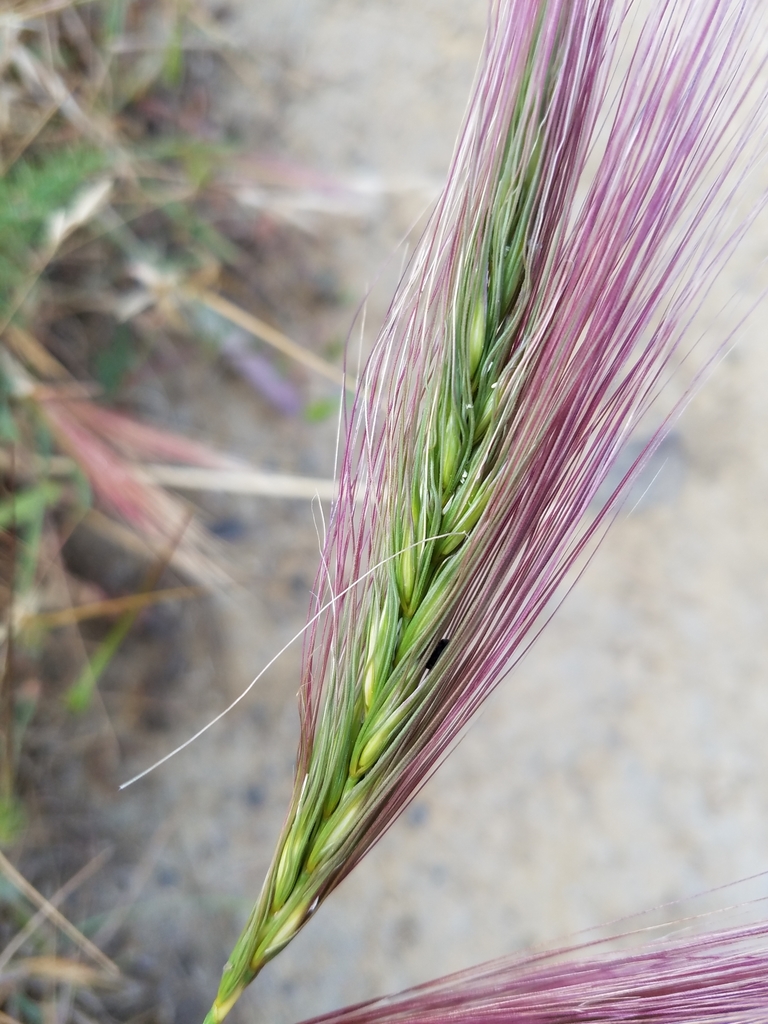
(c) D Defreese, some rights reserved (CC BY), uploaded by D Defreese · licence
Family: Poaceae · Type: Grass · Native
Elymus multisetus (Big squirreltail) is a native California grass in the Poaceae family, recognized by unique multi-divided glumes and lemma tips create distinctive appearance.
Big squirreltail is a California native perennial grass found in open, sandy to rocky areas below 3,800 meters elevation. Flowering from May to July, this plant produces delicate grass inflorescences with distinctive curving awns that can extend 25 to 200 millimeters long. Growing in dense, cespitose clumps with erect to ascending stems 15 to 60 centimeters tall, it forms robust grass clusters in dry landscapes. Its leaves are flat or rolled, 1.5 to 5 millimeters wide, with short ligules and small auricles less than 1.5 millimeters long. The grass develops spikelets with intricate glume divisions that curve outward as they mature, creating a distinctive squirreltail-like appearance.
Identification and appearance
Key characters: 27 sympatric species; unique multi-divided glumes and lemma tips create distinctive appearance
Habitat and range
Habitat: Open, sandy to rocky areas
Elevation: < 3800 m
California counties: Humboldt, Kern, Los Angeles, Colusa, San Luis Obispo, Placer, Riverside, Siskiyou, Ventura, San Bernardino, Stanislaus, Solano, Plumas, San Mateo, Trinity, Santa Clara, Orange, Lake, Monterey, Tulare, San Joaquin, San Diego, Tuolumne, Inyo, Marin, Mendocino, Yolo, Mariposa, Calaveras, Mono, Napa, San Benito, Sutter, Butte, Modoc, Fresno, Amador, Contra Costa, El Dorado, Glenn, Santa Barbara, Santa Cruz, Shasta, Lassen, Nevada, San Francisco, Sonoma, Tehama, Alameda, Del Norte, Alpine, Madera, Yuba, Sacramento
Outside California: to Washington, Rocky Mountains
Bloom period
Elymus multisetus blooms May-Jul.
How to tell it apart
vs Hordeum: Elymus has rounded glume backs; Hordeum has all glumes narrow and bristle-like.; vs Leymus: Elymus has 2-8 spikelets per node; Leymus has just 1-2 spikelets per node.; vs Taeniatherum: Elymus is perennial with robust growth; Taeniatherum is a weedy annual with very long awns.; vs Lolium: Elymus shows multiple spikelets per node; Lolium has single spikelets edgewise to the stem.; vs Thinopyrum: Elymus has prominent auricles; Thinopyrum typically lacks auricles or has very small ones.
Frequently asked questions
Is Elymus multisetus native to California?
Yes. Elymus multisetus is native to California (recorded as native).
When does Elymus multisetus bloom?
Elymus multisetus blooms May-Jul.
Where in California does Elymus multisetus grow?
Elymus multisetus occurs in Humboldt, Kern, Los Angeles, Colusa, San Luis Obispo, Placer, Riverside, Siskiyou and other counties, at elevations of < 3800 m.
What plant family does Elymus multisetus belong to?
Elymus multisetus is in the Poaceae family, genus Elymus.
What habitat does Elymus multisetus grow in?
Elymus multisetus grows in Open, sandy to rocky areas.
Related species
Other California species in the same genus, family, or bioregion.
Sources: Jepson eFlora · Index of California Plant Names · CalPhotos
Last updated 2026-10-07
Data from The California Species Project — 14,000+ California species with verified data from CNPS, CDFW, USFWS, Cal-IPC, and more.