Elymus repens
Quack grass
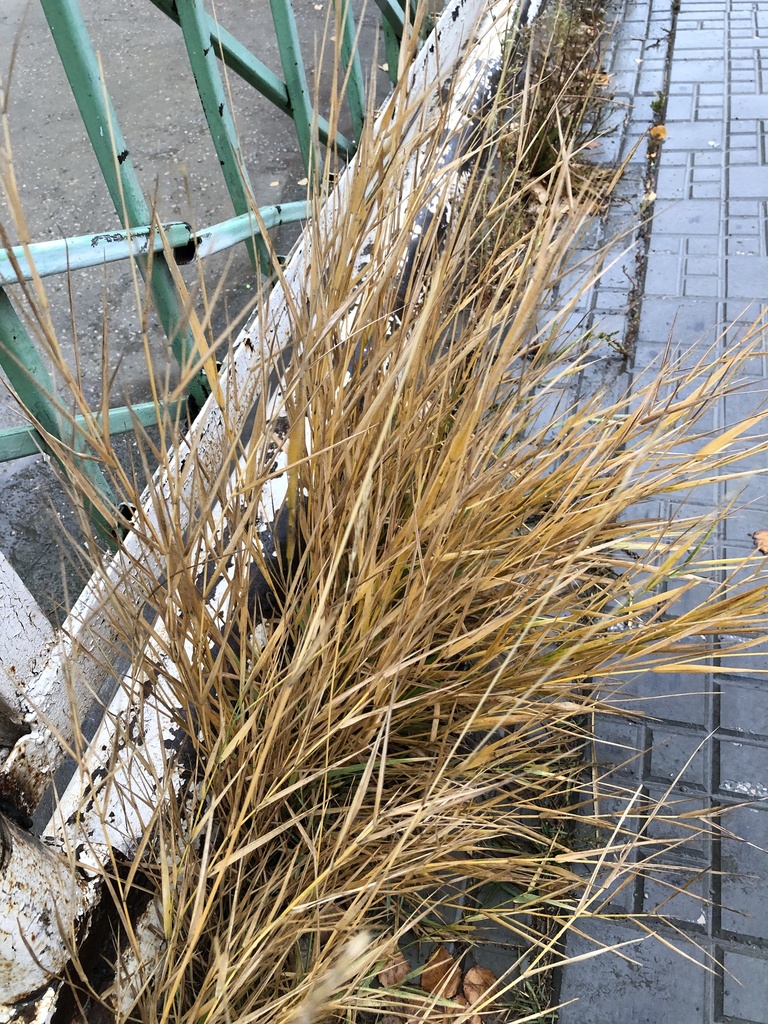
(c) Roman A. Lagazyuk (Роман А. Лагазюк), some rights reserved (CC BY) · licence
Family: Poaceae · Type: Grass · Not Native
Elymus repens (Quack grass) is a non-native California grass in the Poaceae family, recognized by distinctive vein pattern in leaves plus aggressive rhizomatous habit.
Quack grass is a naturalized perennial grass found in the California Floristic Province and Great Basin in disturbed areas and cultivated fields at elevations below 2,150 meters. Flowering from April to August, this aggressive weed produces pale green to whitish flower spikes with sharp-tipped spikelets 10 to 27 millimeters long. Growing with robust rhizomatous stems 50 to 100 centimeters tall, it spreads rapidly through underground root systems. Its leaf blades are 6 to 14 millimeters wide, with distinctive strongly ribbed veins and small ear-like auricles less than 1 millimeter long. The grass produces 4 to 7 florets per spikelet, with lemmas tapering to sharp points or short awns.
Identification and appearance
Key characters: 26 sympatric species; distinctive vein pattern in leaves plus aggressive rhizomatous habit
Habitat and range
Habitat: Weed of disturbed areas, cultivated fields
Elevation: < 2150 m
California counties: Humboldt, Plumas, Lassen, San Francisco, San Mateo, Orange, Tulare, Yolo, Riverside, Alpine, Butte, Calaveras, Del Norte, Kern, Napa, Nevada, San Diego, Santa Barbara, Sierra, Siskiyou, Modoc, Trinity, San Luis Obispo, Mono, Shasta, Amador, San Joaquin, Alameda, Marin, Placer, El Dorado
Outside California: to eastern United States, Canada, native to Eurasia
Bloom period
Elymus repens blooms Apr-Aug.
How to tell it apart
vs Hordeum: Elymus has rounded glume backs; Hordeum has all glumes narrow and bristle-like.; vs Leymus: Elymus has 2-8 spikelets per node; Leymus has just 1-2 spikelets per node.; vs Taeniatherum: Elymus is perennial with robust growth; Taeniatherum is a weedy annual with very long awns.; vs Lolium: Elymus shows multiple spikelets per node; Lolium has single spikelets edgewise to the stem.; vs Thinopyrum: Elymus has prominent auricles; Thinopyrum typically lacks auricles or has very small ones.
Frequently asked questions
Is Elymus repens native to California?
No. Elymus repens is not native to California (recorded as not native).
When does Elymus repens bloom?
Elymus repens blooms Apr-Aug.
Where in California does Elymus repens grow?
Elymus repens occurs in Humboldt, Plumas, Lassen, San Francisco, San Mateo, Orange, Tulare, Yolo and other counties, at elevations of < 2150 m.
What plant family does Elymus repens belong to?
Elymus repens is in the Poaceae family, genus Elymus.
What habitat does Elymus repens grow in?
Elymus repens grows in Weed of disturbed areas, cultivated fields.
Related species
Other California species in the same genus, family, or bioregion.
Sources: Jepson eFlora · Index of California Plant Names · CalPhotos
Last updated 2026-10-07
Data from The California Species Project — 14,000+ California species with verified data from CNPS, CDFW, USFWS, Cal-IPC, and more.