Emex spinosa
Devil's thorn
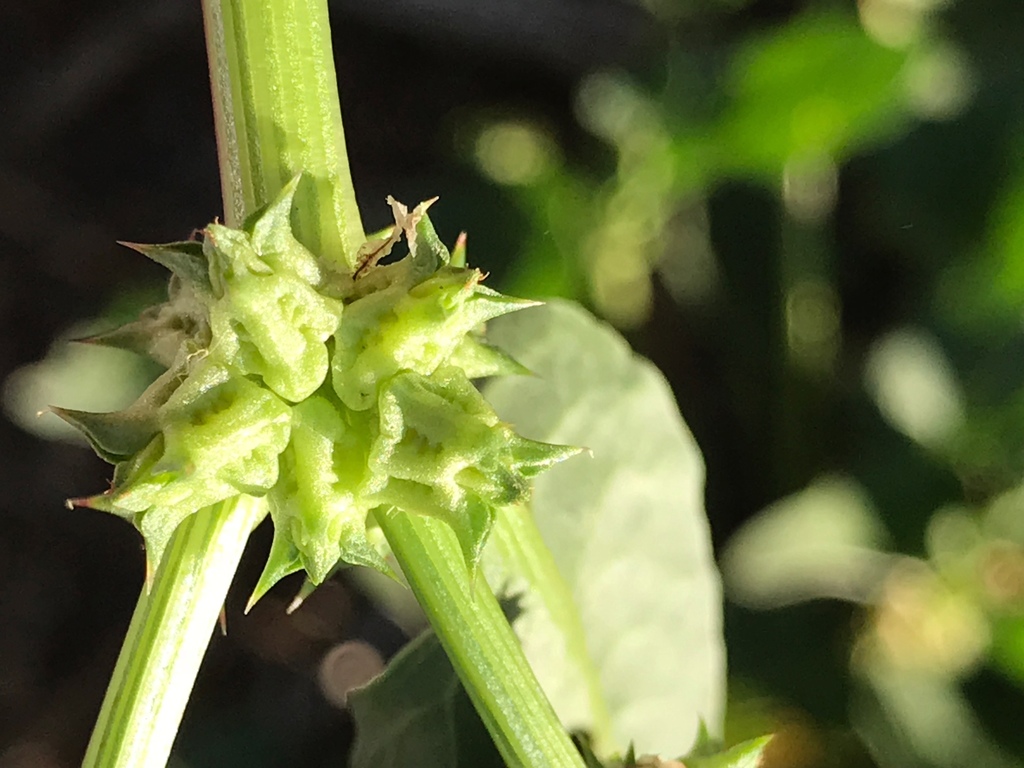
(c) Amy Huie, some rights reserved (CC BY), uploaded by Amy Huie · licence
Family: Polygonaceae · Type: Herb · Not Native
Conservation status: Cal-IPC Yes
Emex spinosa (Devil's thorn) is a non-native California herb in the Polygonaceae family.
Devil's thorn is a naturalized annual found in coastal California regions including the central and southern coastal areas in dry, sandy, disturbed places at elevations below 500 meters. Flowering from May to December, this plant produces small, inconspicuous green flowers. Growing with stems 30 to 80 centimeters tall, it spreads across disturbed ground with a sprawling habit. Its leaves have broad blades 3 to 13 centimeters long and 1 to 12 centimeters wide, supported by petioles 1.5 to 4 centimeters in length. The distinctive fruit features three-angled perianths with 8 to 12 pit-like depressions and short spines 1.5 to 3 millimeters long, giving the plant its memorable "devil's thorn" nickname.
Identification and appearance
Key characters: 1 sympatric species; key differentiators are plant size, fruit depression patterns, and spine length
Habitat and range
Habitat: Dry, sandy, disturbed places
Elevation: < 500 m
Outside California: Massachusetts, New Jersey, Florida, Texas, also Hawaii, South America, Eurasia, Africa, Australia, native to Mediterranean
Bloom period
Emex spinosa blooms May-Dec.
Conservation status
Cal-IPC Yes
How to tell it apart
vs Rumex: Emex has fierce three-pronged spines on fruits; Rumex fruits have smooth papery wings.
Frequently asked questions
Is Emex spinosa native to California?
No. Emex spinosa is not native to California (recorded as not native).
When does Emex spinosa bloom?
Emex spinosa blooms May-Dec.
What plant family does Emex spinosa belong to?
Emex spinosa is in the Polygonaceae family, genus Emex.
Is Emex spinosa invasive in California?
Emex spinosa is listed by Cal-IPC with an invasiveness rating of Yes.
What habitat does Emex spinosa grow in?
Emex spinosa grows in Dry, sandy, disturbed places.
Related species
Other California species in the same genus, family, or bioregion.
Sources: Jepson eFlora · CalPhotos
Last updated 2026-10-07
Data from The California Species Project — 14,000+ California species with verified data from CNPS, CDFW, USFWS, Cal-IPC, and more.