Emmenanthe penduliflora
Whispering bells
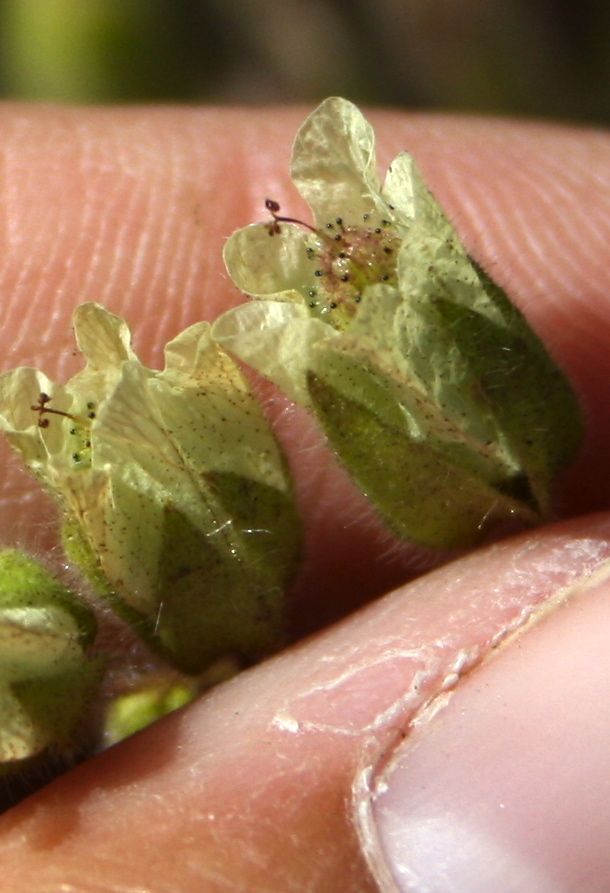
Photo by Chez Brungraber
Family: Hydrophyllaceae · Type: Herb · Native
Emmenanthe penduliflora (Whispering bells) is a native California herb in the Hydrophyllaceae family, recognized by . Distinguished by desert/inland distribution and cream-yellow flowers.
Whispering bells is a California native annual found in chaparral and creosote-bush scrub habitats, growing in rocky, sandy, and serpentine soils at elevations up to 2,200 meters. Flowering from April to July, this plant produces delicate cream to yellow flowers that fade to pale white, with blossoms 8 to 11 millimeters long and a limb 6 to 10 millimeters in diameter. Growing 5 to 85 centimeters tall with green to yellow-green stems that are few to many-branched, it develops an open, spreading form. Its leaves are green to yellow-green, measuring 1 to 8 centimeters long and 1 to 3 centimeters wide, with an elegant, somewhat elongated shape. The fruit is an oblong capsule 7 to 10 millimeters long, containing 8 to 16 seeds and often developing on reddish-green pedicels.
Identification and appearance
Key characters: Geographically isolated with 0 sympatric species. Distinguished by desert/inland distribution and cream-yellow flowers.
Habitat and range
Habitat: Chaparral to creosote-bush scrub, rocky, sandy, decomposed granite, serpentine soils, generally after fire, disturbance
Elevation: < 2200 m
California counties: Riverside, San Bernardino, Inyo, Los Angeles, Ventura, Imperial, Kern, Orange, San Diego, Lake, Santa Barbara, Tuolumne, Santa Cruz, Contra Costa, San Luis Obispo, Calaveras, Santa Clara, Tulare, Fresno, Mono, Monterey, Colusa, Stanislaus, Mendocino, Mariposa, San Benito, Alameda, Napa, Tehama, Amador, Merced, Sonoma, Glenn, Solano, San Joaquin, Yolo
Outside California: to Utah, Arizona
Bloom period
Emmenanthe penduliflora blooms Apr-Jul.
How to tell it apart
vs Mentzelia: Emmenanthe has drooping bell flowers; Mentzelia has upward-facing star-shaped flowers with many stamens and sandpapery leaves.; vs Phacelia: Emmenanthe flowers droop downward and become papery; Phacelia flowers spread outward in coiled clusters and fall off cleanly.; vs Eucrypta: Emmenanthe has pendulous bell flowers that become papery; Eucrypta has spreading small flowers and very sticky foliage.; vs Mirabilis: Emmenanthe has small 5-petaled bells on delicate stems; Mirabilis has larger tubular flowers with no petals and opposite leaves.; vs Fritillaria: Emmenanthe is a soft annual herb; Fritillaria is a bulb plant with stiff upright stems and checkerboard-patterned bell flowers.
Frequently asked questions
Is Emmenanthe penduliflora native to California?
Yes. Emmenanthe penduliflora is native to California (recorded as native).
When does Emmenanthe penduliflora bloom?
Emmenanthe penduliflora blooms Apr-Jul.
Where in California does Emmenanthe penduliflora grow?
Emmenanthe penduliflora occurs in Riverside, San Bernardino, Inyo, Los Angeles, Ventura, Imperial, Kern, Orange and other counties, at elevations of < 2200 m.
What plant family does Emmenanthe penduliflora belong to?
Emmenanthe penduliflora is in the Hydrophyllaceae family, genus Emmenanthe.
What habitat does Emmenanthe penduliflora grow in?
Emmenanthe penduliflora grows in Chaparral to creosote-bush scrub, rocky, sandy, decomposed granite, serpentine soils, generally after fire, disturbance.
Related species
Other California species in the same genus, family, or bioregion.
Sources: Jepson eFlora · Index of California Plant Names · CalPhotos
Last updated 2026-10-07
Data from The California Species Project — 14,000+ California species with verified data from CNPS, CDFW, USFWS, Cal-IPC, and more.