Enneapogon desvauxii
Nine-awned pappus grass
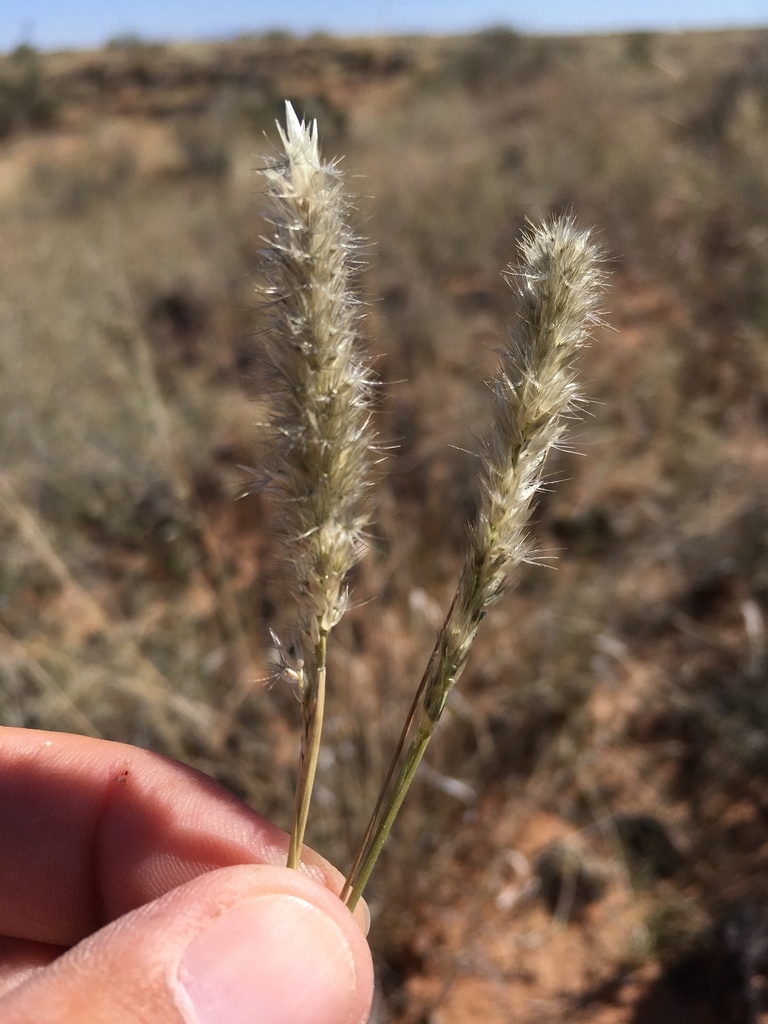
no rights reserved, uploaded by Cecelia Alexander · CC0
Family: Poaceae · Type: Grass · Native
Conservation status: CNPS 2B.2
Enneapogon desvauxii (Nine-awned pappus grass) is a native California grass in the Poaceae family, recognized by Small genus adapted to arid conditions; nine-awn character is taxonomically distinctive within grass family.
Nine-awned pappus grass is a rare (CNPS 2B.2) California native perennial found in the eastern Mojave Desert in rocky slopes, crevices, and calcareous desert woodland at elevations of 1,275 to 1,825 meters. Flowering from August to September, this grass produces grayish spike-like inflorescences 3 to 6 centimeters long with delicate spikelets. Growing with stems 10 to 40 centimeters tall that have dense, short-hairy nodes, it develops soft, narrow leaves less than 2 millimeters wide that are slightly rolled. Its leaves are soft-hairy with ciliate sheaths and very short ligule hairs less than 1 millimeter long. Each spikelet features distinctive lemmas with 2 to 5 millimeter awns that extend beyond the surrounding structures.
Identification and appearance
Key characters: Small genus adapted to arid conditions; nine-awn character is taxonomically distinctive within grass family
Habitat and range
Habitat: Rocky slopes, crevices, calcareous soils, desert woodland
Elevation: 1275-1825 m
California counties: San Bernardino
Outside California: to Colorado, western Texas, northern Mexico, South America
Bloom period
Enneapogon desvauxii blooms Aug-Sep.
Conservation status
CNPS 2B.2
How to tell it apart
vs Aristida: Enneapogon lemmas bear a ring of about 9 short feathery (plumose) awns; Aristida (three-awn) has just 3 rigid, non-plumose awns per floret.; vs Stipa: Enneapogon has short florets crowned by 9 feathery awns; needlegrasses have a single long, twisted awn on a hard needle-like floret.; vs Bouteloua: Enneapogon has a contracted, gray, spike-like cylindrical head of feathery-awned florets; Bouteloua bears one-sided, comb-like spikes.; vs Muhlenbergia: Enneapogon florets carry a crown of nine plumose awns; Muhlenbergia has a lemma with a single awn or no awn.; vs Blepharidachne: Enneapogon has a soft gray spike-like panicle with 9-awned lemmas; Blepharidachne has 3-lobed, ciliate lemmas in a low tuft.
Frequently asked questions
Is Enneapogon desvauxii native to California?
Yes. Enneapogon desvauxii is native to California (recorded as native).
When does Enneapogon desvauxii bloom?
Enneapogon desvauxii blooms Aug-Sep.
Where in California does Enneapogon desvauxii grow?
Enneapogon desvauxii occurs in San Bernardino, at elevations of 1275-1825 m.
What plant family does Enneapogon desvauxii belong to?
Enneapogon desvauxii is in the Poaceae family, genus Enneapogon.
Is Enneapogon desvauxii rare or endangered?
Enneapogon desvauxii carries California Rare Plant Rank 2B.2, state rank S3.
Related species
Other California species in the same genus, family, or bioregion.
Sources: Jepson eFlora · CNPS Rare Plant Inventory · Index of California Plant Names · CalPhotos · CDFW CNDDB
Last updated 2026-10-07
Data from The California Species Project — 14,000+ California species with verified data from CNPS, CDFW, USFWS, Cal-IPC, and more.