Ephedra viridis
Green ephedra
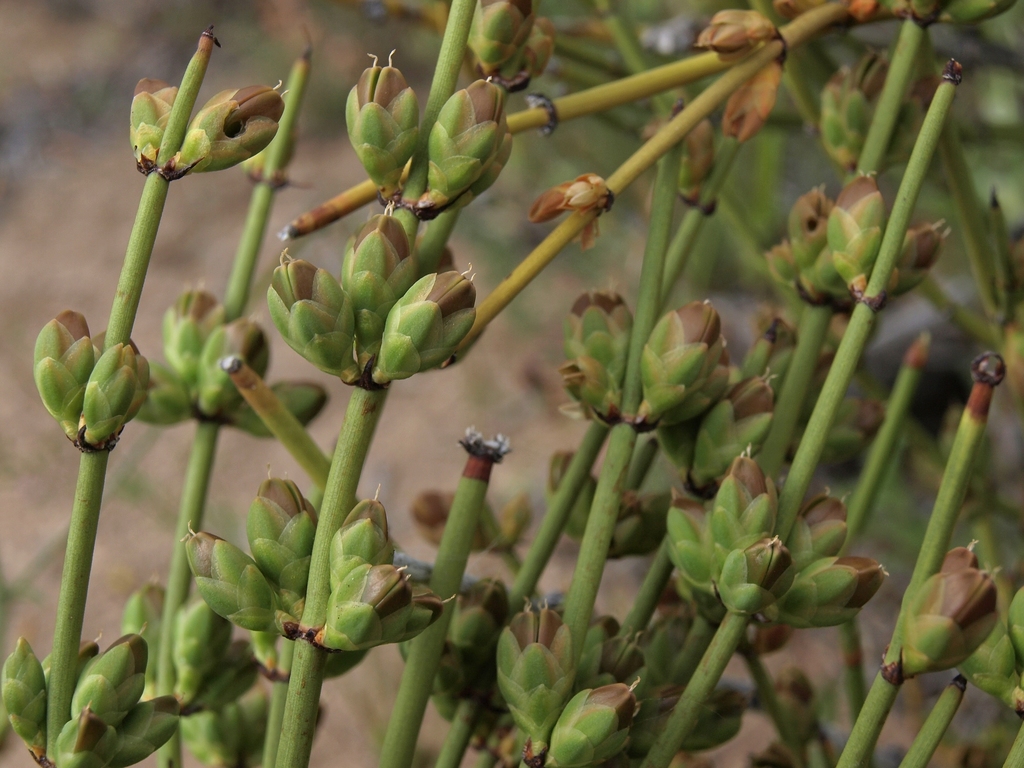
(c) Jim Morefield, some rights reserved (CC BY) · licence
Family: Ephedraceae · Type: Shrub · Native
Ephedra viridis (Green ephedra) is a native California shrub in the Ephedraceae family, recognized by . Key features: higher elevation, broom-like habit, bright green twigs, 2 seeds per cone.
Green ephedra is a California native shrub found in the southern Sierra Nevada Mountains, Tehachapi, San Joaquin Valley, southern Coast Ranges, Transverse Ranges, San Jacinto Mountains, Peninsular Ranges, Great Basin, and Mojave and Sonoran Deserts in sagebrush scrub, creosote-bush scrub, and pinyon-juniper woodland at elevations of 900 to 2,300 meters. With its distinctive broom-like structure, the plant features bright to yellow-green branches that age to a golden yellow, creating an eye-catching form in arid landscapes. Growing 0.5 to 1 meter tall, this shrub develops erect, branching stems with a dark brown pith and a striking architectural silhouette. Its small leaves, typically two per node and 1.5 to 6 millimeters long, have persistent brown bases that become swollen with age. The plant produces both pollen and seed cones, with seed cones measuring 6 to 10 millimeters long and featuring scarious bracts with yellow-translucent margins.
Identification and appearance
Key characters: 5 sympatric species. Key features: higher elevation, broom-like habit, bright green twigs, 2 seeds per cone
Habitat and range
Habitat: Sagebrush scrub, creosote-bush scrub, pinyon/juniper woodland
Elevation: 900-2300 m
California counties: Mono, Los Angeles, San Bernardino, Kern, Riverside, Inyo, Lassen, Ventura, San Diego, Tulare, Santa Barbara, San Luis Obispo, Plumas, Modoc, Alpine, Sierra
Outside California: to Oregon, Colorado, Utah, New Mexico
How to tell it apart
vs Thamnosma: Ephedra has obvious joints on green stems; Thamnosma stems are smooth without joints.; vs Senna: Ephedra has tiny scale leaves that fall off; Senna has compound leaves with paired leaflets.; vs Lepidospartum: Ephedra stems have distinct joints at regular intervals; Lepidospartum stems are smooth and rush-like.; vs Spartium: Ephedra has jointed stems with nodes; Spartium has smooth, ridged stems and pea flowers.; vs Ericameria: Ephedra has obvious stem joints and scale leaves; Ericameria has narrow but normal leaves and daisy flowers.
Frequently asked questions
Is Ephedra viridis native to California?
Yes. Ephedra viridis is native to California (recorded as native).
Where in California does Ephedra viridis grow?
Ephedra viridis occurs in Mono, Los Angeles, San Bernardino, Kern, Riverside, Inyo, Lassen, Ventura and other counties, at elevations of 900-2300 m.
What plant family does Ephedra viridis belong to?
Ephedra viridis is in the Ephedraceae family, genus Ephedra.
What habitat does Ephedra viridis grow in?
Ephedra viridis grows in Sagebrush scrub, creosote-bush scrub, pinyon/juniper woodland.
Related species
Other California species in the same genus, family, or bioregion.
Sources: Jepson eFlora · Index of California Plant Names · CalPhotos
Last updated 2026-10-07
Data from The California Species Project — 14,000+ California species with verified data from CNPS, CDFW, USFWS, Cal-IPC, and more.