Epilobium brachycarpum
Annual fireweed
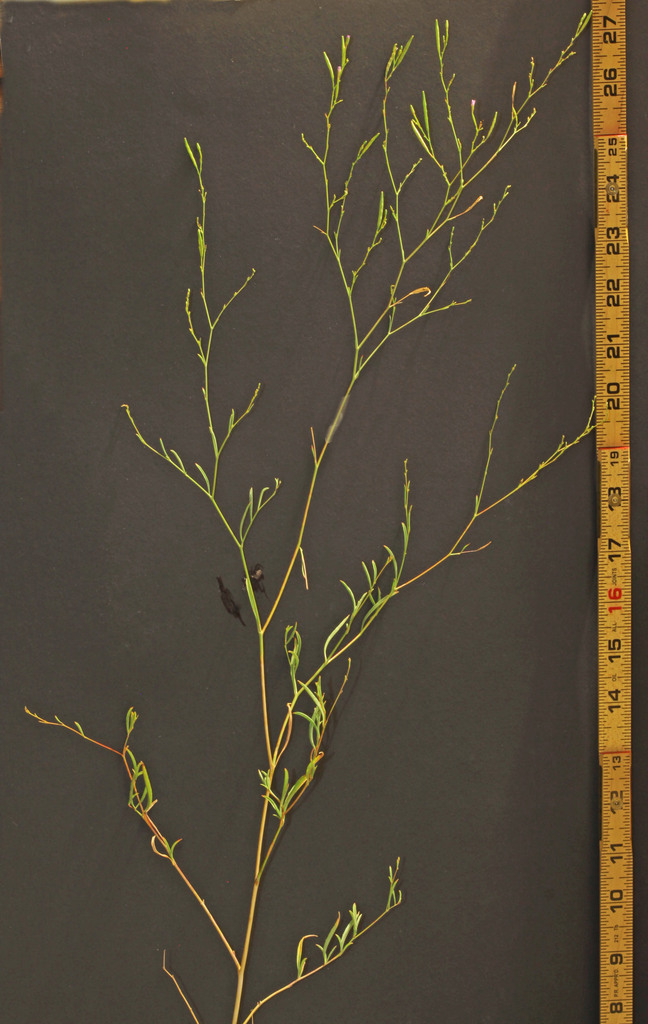
(c) Andrey Zharkikh, some rights reserved (CC BY) · licence
Family: Onagraceae · Type: Herb · Native
Epilobium brachycarpum (Annual fireweed) is a native California herb in the Onagraceae family, recognized by but extreme height and peeling bark diagnostic.
Annual fireweed is a California native annual found in the California Floristic Province (excluding the Channel Islands), the Modoc Plateau, and the White and Inyo Mountains in dry or seasonally moist open woods, meadows, and prairies, especially along roadsides and streambanks at elevations up to 3,300 meters. Flowering from June to September, this plant produces white to rose-purple flowers 2 to 15 millimeters long in panicle or raceme formations. Growing with slender stems 20 to 200 centimeters tall, it is glabrous and peeling at the base while becoming strigose and glandular-hairy toward the top. Its leaves are early-deciduous, linear to narrowly elliptic, 10 to 55 millimeters long, often folded along the midrib and nearly glabrous. The fruit is 15 to 32 millimeters long, with a hair-tuft that readily detaches from the seed.
Identification and appearance
Key characters: 31 sympatric species but extreme height and peeling bark diagnostic
Habitat and range
Habitat: Common. Dry or seasonally moist, often disturbed ground in open woods, meadows, prairies, esp on roadsides, streambanks
Elevation: < 3300 m
California counties: Alpine, Amador, Mono, Santa Barbara, Los Angeles, Lake, San Bernardino, Santa Clara, Napa, San Diego, Siskiyou, Fresno, Mendocino, San Mateo, Butte, Marin, Nevada, San Francisco, Tulare, Kern, Santa Cruz, Sonoma, Humboldt, Alameda, Plumas, San Benito, Trinity, Modoc, Lassen, San Luis Obispo, Mariposa, Tuolumne, Ventura, Merced, San Joaquin, Madera, Solano, Tehama, Del Norte, Stanislaus, Sutter, Riverside, El Dorado, Orange, Colusa, Sacramento, Inyo, Shasta, Monterey, Glenn, Yuba, Calaveras, Placer, Yolo, Sierra, Contra Costa, Kings
Outside California: to British Columbia, Minnesota, New Mexico, also eastern Canada, introduced in southern South America, Europe
Bloom period
Epilobium brachycarpum blooms Jun-Sep.
How to tell it apart
vs Penstemon: Epilobium has 4 notched petals and opposite leaves; Penstemon has 5-lobed tubular flowers (snapdragon family).; vs Gambelia: Epilobium has 4 notched petals; Gambelia has 5-lobed tubular snapdragon-like flowers.; vs Fuchsia: Epilobium has notched petals spreading flat; Fuchsia has dangling tubular flowers with protruding stamens.; vs Keckiella: Epilobium has 4 notched petals; Keckiella has 5-lobed tubular snapdragon-like flowers.; vs Diplacus: Epilobium has 4 notched petals; Diplacus has 5-lobed tubular monkey flowers.
Frequently asked questions
Is Epilobium brachycarpum native to California?
Yes. Epilobium brachycarpum is native to California (recorded as native).
When does Epilobium brachycarpum bloom?
Epilobium brachycarpum blooms Jun-Sep.
Where in California does Epilobium brachycarpum grow?
Epilobium brachycarpum occurs in Alpine, Amador, Mono, Santa Barbara, Los Angeles, Lake, San Bernardino, Santa Clara and other counties, at elevations of < 3300 m.
What plant family does Epilobium brachycarpum belong to?
Epilobium brachycarpum is in the Onagraceae family, genus Epilobium.
What habitat does Epilobium brachycarpum grow in?
Epilobium brachycarpum grows in Common. Dry or seasonally moist, often disturbed ground in open woods, meadows, prairies, esp on roadsides, streambanks.
Related species
Other California species in the same genus, family, or bioregion.
Sources: Jepson eFlora · Index of California Plant Names · CalPhotos
Last updated 2026-10-07
Data from The California Species Project — 14,000+ California species with verified data from CNPS, CDFW, USFWS, Cal-IPC, and more.