Epilobium canum
California fuchsia, zauschneria, Zauschneria
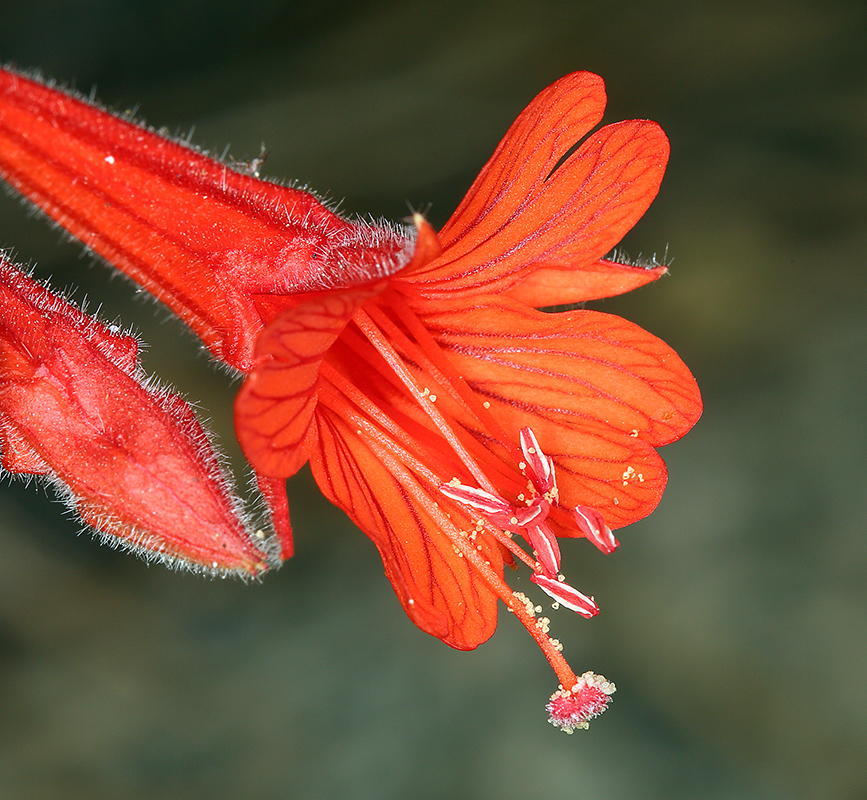
(c) Steve Matson, some rights reserved (CC BY), uploaded by Steve Matson · licence
Family: Onagraceae · Type: Subshrub · Native
Epilobium canum (California fuchsia) is a native California subshrub in the Onagraceae family, recognized by but red-orange color and large flower size completely diagnostic.
California fuchsia is a California native perennial found in diverse bioregions in rocky, sunny habitats from low to mid-elevation areas. Flowering from July to September, this plant produces brilliant red-orange tubular flowers 7 to 15 millimeters long that attract hummingbirds and pollinators. Growing in clumped formations with erect to spreading stems 30 to 60 centimeters tall, it develops woody bases and spreads through basal scaly shoots. Its leaves are linear to widely ovate, ranging 8 to 70 millimeters long, with margins that can be nearly entire or strongly toothed, presenting a variable green to grayish appearance. The fruit is a slender, hairy capsule 15 to 30 millimeters long, which develops after the vibrant flowering period.
Identification and appearance
Key characters: 31 sympatric species but red-orange color and large flower size completely diagnostic
Habitat and range
California counties: San Bernardino, Los Angeles, Riverside, Sonoma, Orange, San Diego, Monterey, Ventura, Kern, Imperial, Santa Barbara, Santa Clara, Tulare, Inyo, Placer, El Dorado, San Mateo, Alameda, Marin, Contra Costa, Nevada, Yolo, Mendocino, Napa, San Benito, Sierra, Del Norte, Tuolumne, San Luis Obispo, Plumas, Mariposa, Shasta, Kings, Solano, Colusa, Sacramento, Santa Cruz
How to tell it apart
vs Penstemon: Epilobium has 4 notched petals and opposite leaves; Penstemon has 5-lobed tubular flowers (snapdragon family).; vs Gambelia: Epilobium has 4 notched petals; Gambelia has 5-lobed tubular snapdragon-like flowers.; vs Fuchsia: Epilobium has notched petals spreading flat; Fuchsia has dangling tubular flowers with protruding stamens.; vs Keckiella: Epilobium has 4 notched petals; Keckiella has 5-lobed tubular snapdragon-like flowers.; vs Diplacus: Epilobium has 4 notched petals; Diplacus has 5-lobed tubular monkey flowers.
Frequently asked questions
Is Epilobium canum native to California?
Yes. Epilobium canum is native to California (recorded as native).
Where in California does Epilobium canum grow?
Epilobium canum occurs in San Bernardino, Los Angeles, Riverside, Sonoma, Orange, San Diego, Monterey, Ventura and other counties.
What plant family does Epilobium canum belong to?
Epilobium canum is in the Onagraceae family, genus Epilobium.
Related species
Other California species in the same genus, family, or bioregion.
Sources: Jepson eFlora · Index of California Plant Names · CalPhotos
Last updated 2026-10-07
Data from The California Species Project — 14,000+ California species with verified data from CNPS, CDFW, USFWS, Cal-IPC, and more.