Epilobium cleistogamum
Cleistogamous boisduvalia
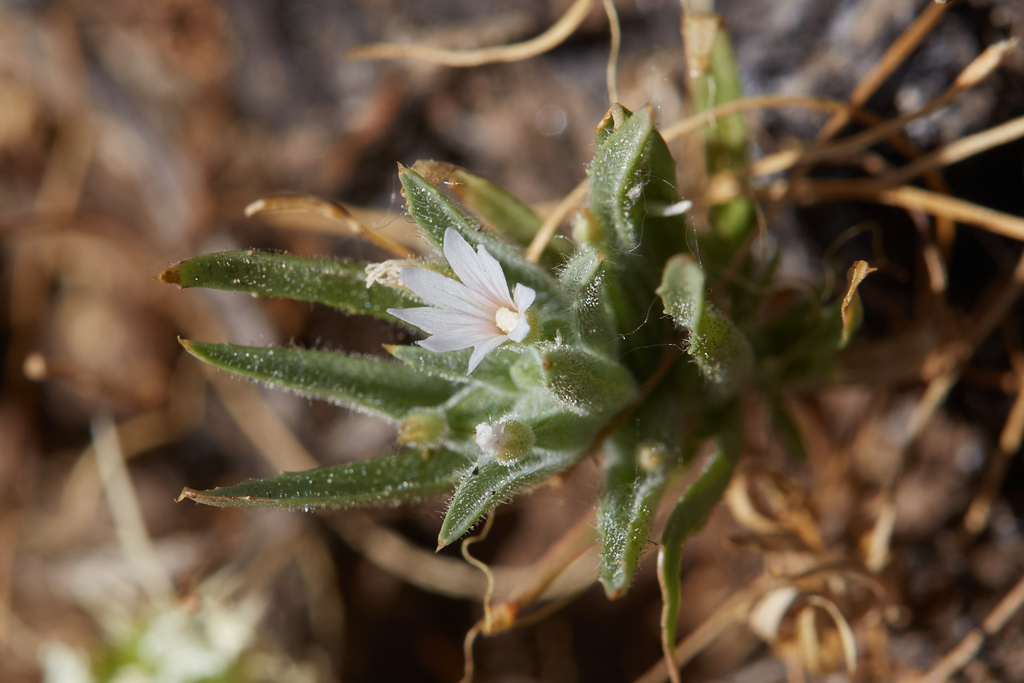
(c) Ken-ichi Ueda, some rights reserved (CC BY), uploaded by Ken-ichi Ueda · licence
Family: Onagraceae · Type: Herb · Native
Epilobium cleistogamum (Cleistogamous boisduvalia) is a native California herb in the Onagraceae family, recognized by but vernal pool habitat and cleistogamous flowers diagnostic.
Cleistogamous boisduvalia is a California native annual found in the Sierra Nevada Foothills, Central Valley, and southern Coast Ranges in vernal pools and clay flats at elevations below 300 meters. Flowering from May to July, this plant produces white to pale pink flowers in small, delicate clusters with cleistogamous (self-pollinating) characteristics. Growing 15 to 32 centimeters tall with occasionally prostrate basal branches, it has a slender form with stems that may be nearly hairless or have spreading hairs. Its leaves are primarily linear to narrowly elliptic, opposite near the base and becoming alternate upward, often folded along the midrib with hairy surfaces. The fruit is distinctive, forming a tough, sharply 4-sided capsule that splits only on its distal third, containing rows of netted, glabrous seeds.
Identification and appearance
Key characters: 10 sympatric species but vernal pool habitat and cleistogamous flowers diagnostic
Habitat and range
Habitat: Vernal pools, clay flats
Elevation: < 300 m
California counties: Butte, Madera, Yolo, Sacramento, Calaveras, Solano, Tehama, Contra Costa, Sutter, Merced, Colusa, Glenn, Stanislaus, San Luis Obispo, Tulare, San Joaquin, Fresno, Tuolumne, Plumas, Napa, Placer
Bloom period
Epilobium cleistogamum blooms May-Jul.
How to tell it apart
vs Penstemon: Epilobium has 4 notched petals and opposite leaves; Penstemon has 5-lobed tubular flowers (snapdragon family).; vs Gambelia: Epilobium has 4 notched petals; Gambelia has 5-lobed tubular snapdragon-like flowers.; vs Fuchsia: Epilobium has notched petals spreading flat; Fuchsia has dangling tubular flowers with protruding stamens.; vs Keckiella: Epilobium has 4 notched petals; Keckiella has 5-lobed tubular snapdragon-like flowers.; vs Diplacus: Epilobium has 4 notched petals; Diplacus has 5-lobed tubular monkey flowers.
Frequently asked questions
Is Epilobium cleistogamum native to California?
Yes. Epilobium cleistogamum is native to California (recorded as native).
When does Epilobium cleistogamum bloom?
Epilobium cleistogamum blooms May-Jul.
Where in California does Epilobium cleistogamum grow?
Epilobium cleistogamum occurs in Butte, Madera, Yolo, Sacramento, Calaveras, Solano, Tehama, Contra Costa and other counties, at elevations of < 300 m.
What plant family does Epilobium cleistogamum belong to?
Epilobium cleistogamum is in the Onagraceae family, genus Epilobium.
What habitat does Epilobium cleistogamum grow in?
Epilobium cleistogamum grows in Vernal pools, clay flats.
Related species
Other California species in the same genus, family, or bioregion.
Sources: Jepson eFlora · Index of California Plant Names · CalPhotos
Last updated 2026-10-07
Data from The California Species Project — 14,000+ California species with verified data from CNPS, CDFW, USFWS, Cal-IPC, and more.