Epilobium obcordatum
Heart willowweed
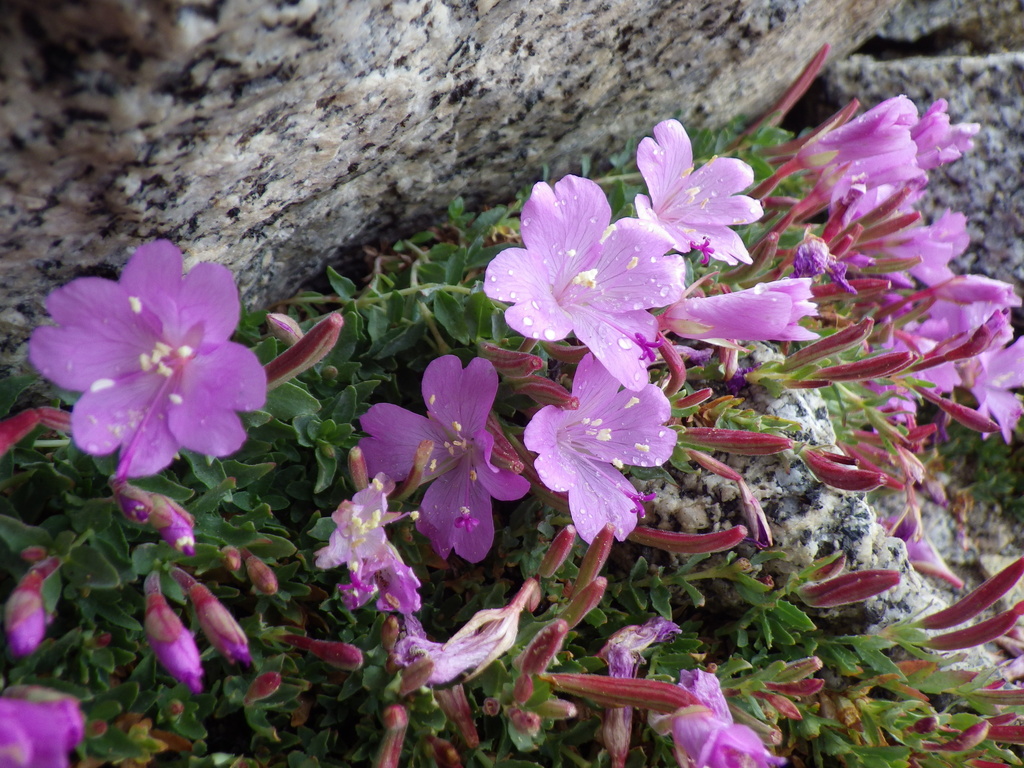
(c) Matt Lavin, some rights reserved (CC BY-SA) · licence
Family: Onagraceae · Type: Subshrub · Native
Epilobium obcordatum (Heart willowweed) is a native California subshrub in the Onagraceae family, recognized by distinctive rounded leaves and large flowers.
Heart willowweed is a California native perennial found in the high Sierra Nevada, Modoc Plateau, and high Cascade Range Mountains on rocky ridges and dry talus at elevations of 1,700 to 4,000 meters. Flowering from July to September, this plant produces pink to rose-purple flowers 11 to 24 millimeters long with distinctive rounded petals. Growing as a compact clump less than 15 centimeters tall with many wiry basal shoots, it emerges from a woody caudex and appears somewhat glaucous and nearly hairless. Its leaves are broadly lance-elliptic to nearly round, 6 to 20 millimeters long with rounded or obtuse tips and minimal to no petiole. The fruit is a widely club-like capsule 20 to 45 millimeters long, densely covered with glandular hairs.
Identification and appearance
Key characters: 25 sympatric species; distinctive rounded leaves and large flowers are diagnostic
Habitat and range
Habitat: Rocky ridges, dry talus
Elevation: 1700-4000 m
California counties: Alpine, Modoc, Nevada, Tulare, Fresno, Inyo, Tuolumne, Mono, Madera, Butte, Mariposa, Siskiyou, Del Norte, Placer, Plumas, Tehama, Shasta, Sierra, El Dorado
Outside California: to eastern Oregon, central Idaho, northeastern Nevada
Bloom period
Epilobium obcordatum blooms Jul-Sep.
How to tell it apart
vs Penstemon: Epilobium has 4 notched petals and opposite leaves; Penstemon has 5-lobed tubular flowers (snapdragon family).; vs Gambelia: Epilobium has 4 notched petals; Gambelia has 5-lobed tubular snapdragon-like flowers.; vs Fuchsia: Epilobium has notched petals spreading flat; Fuchsia has dangling tubular flowers with protruding stamens.; vs Keckiella: Epilobium has 4 notched petals; Keckiella has 5-lobed tubular snapdragon-like flowers.; vs Diplacus: Epilobium has 4 notched petals; Diplacus has 5-lobed tubular monkey flowers.
Frequently asked questions
Is Epilobium obcordatum native to California?
Yes. Epilobium obcordatum is native to California (recorded as native).
When does Epilobium obcordatum bloom?
Epilobium obcordatum blooms Jul-Sep.
Where in California does Epilobium obcordatum grow?
Epilobium obcordatum occurs in Alpine, Modoc, Nevada, Tulare, Fresno, Inyo, Tuolumne, Mono and other counties, at elevations of 1700-4000 m.
What plant family does Epilobium obcordatum belong to?
Epilobium obcordatum is in the Onagraceae family, genus Epilobium.
What habitat does Epilobium obcordatum grow in?
Epilobium obcordatum grows in Rocky ridges, dry talus.
Related species
Other California species in the same genus, family, or bioregion.
Sources: Jepson eFlora · Index of California Plant Names · CalPhotos
Last updated 2026-10-07
Data from The California Species Project — 14,000+ California species with verified data from CNPS, CDFW, USFWS, Cal-IPC, and more.