Epilobium oregonense
Oregon willowherb
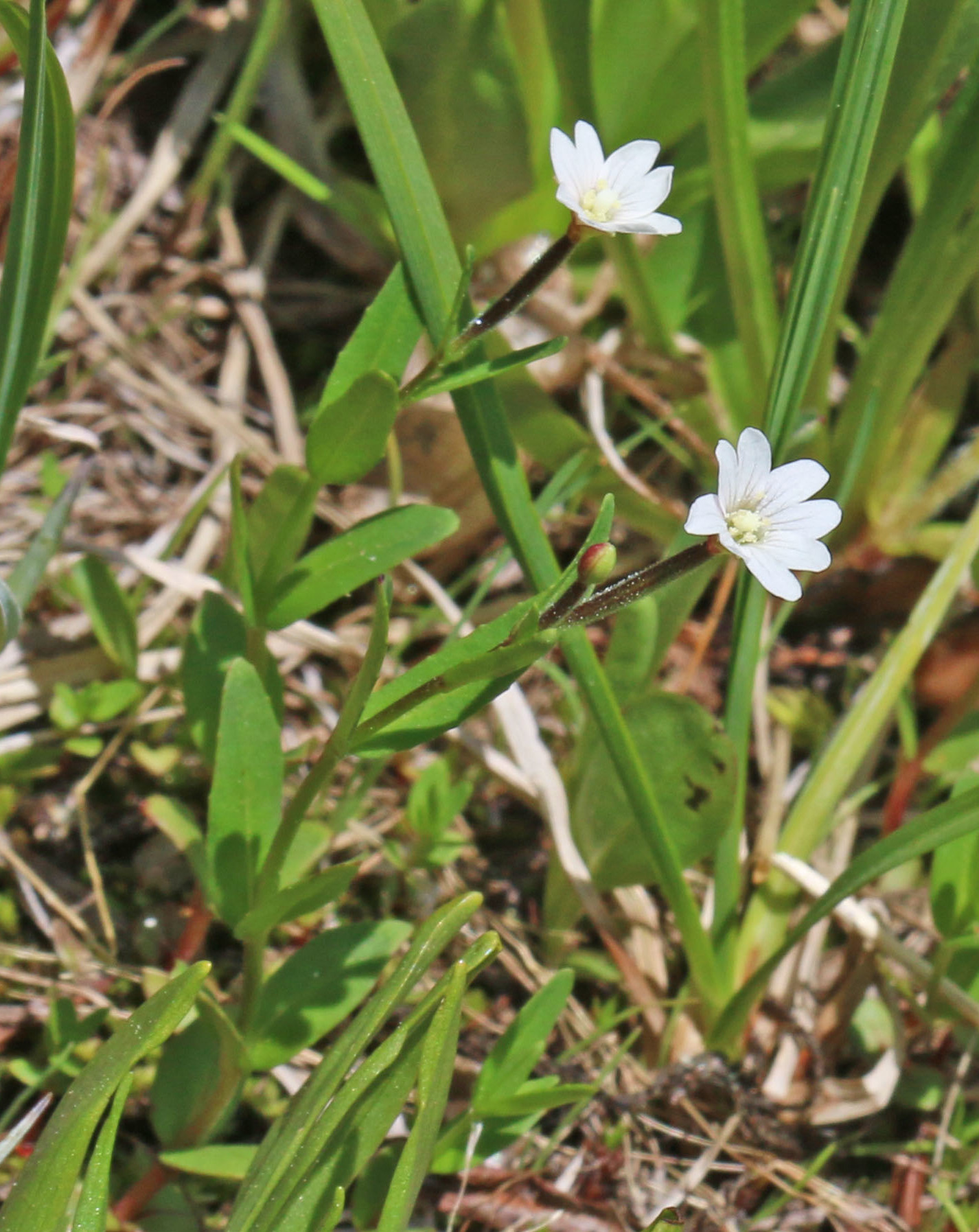
Andrey Zharkikh (via Wikimedia Commons) · CC BY
Family: Onagraceae · Type: Herb · Native
Epilobium oregonense (Oregon willowherb) is a native California herb in the Onagraceae family, recognized by thread-like stolons with bulblets and long pedicels.
Oregon willowherb is a California native perennial found in the Klamath Ranges, Cascade Range foothills, Sierra Nevada, southern California mountains, and eastern Sierra Nevada in boggy areas and shaded streambanks at elevations of 1,200 to 3,500 meters. Flowering from July to August, this delicate plant produces white to pink flowers 5 to 8 millimeters long with a broadly club-like stigma. Growing with sprawling, thread-like stems 8 to 30 centimeters tall and a matted habit, it has a purple-tinged appearance in its upper portions. Its sessile leaves are broadly elliptic near the base, becoming linear and widely spaced towards the stem tips, measuring 5 to 25 millimeters long with obtuse tips. The plant produces slender fruits 20 to 50 millimeters long, with pedicels typically longer than the fruit itself.
Identification and appearance
Key characters: 28 sympatric species; thread-like stolons with bulblets and long pedicels are diagnostic
Habitat and range
Habitat: +- boggy areas, shaded streambanks
Elevation: 1200-3500 m
California counties: Riverside, Inyo, Fresno, Nevada, Plumas, Lassen, San Bernardino, Tulare, El Dorado, Kern, Siskiyou, Ventura, Mono, Butte, Placer, Modoc, Amador, Shasta, Tuolumne, Humboldt, Mariposa, Madera, Lake, Tehama, Calaveras, Alpine, Sierra
Outside California: to British Columbia, western Montana, Wyoming
Bloom period
Epilobium oregonense blooms Jul-Aug.
How to tell it apart
vs Penstemon: Epilobium has 4 notched petals and opposite leaves; Penstemon has 5-lobed tubular flowers (snapdragon family).; vs Gambelia: Epilobium has 4 notched petals; Gambelia has 5-lobed tubular snapdragon-like flowers.; vs Fuchsia: Epilobium has notched petals spreading flat; Fuchsia has dangling tubular flowers with protruding stamens.; vs Keckiella: Epilobium has 4 notched petals; Keckiella has 5-lobed tubular snapdragon-like flowers.; vs Diplacus: Epilobium has 4 notched petals; Diplacus has 5-lobed tubular monkey flowers.
Frequently asked questions
Is Epilobium oregonense native to California?
Yes. Epilobium oregonense is native to California (recorded as native).
When does Epilobium oregonense bloom?
Epilobium oregonense blooms Jul-Aug.
Where in California does Epilobium oregonense grow?
Epilobium oregonense occurs in Riverside, Inyo, Fresno, Nevada, Plumas, Lassen, San Bernardino, Tulare and other counties, at elevations of 1200-3500 m.
What plant family does Epilobium oregonense belong to?
Epilobium oregonense is in the Onagraceae family, genus Epilobium.
What habitat does Epilobium oregonense grow in?
Epilobium oregonense grows in +- boggy areas, shaded streambanks.
Related species
Other California species in the same genus, family, or bioregion.
Sources: Jepson eFlora · Index of California Plant Names · CalPhotos
Last updated 2026-10-07
Data from The California Species Project — 14,000+ California species with verified data from CNPS, CDFW, USFWS, Cal-IPC, and more.