Epilobium palustre
Marsh willowherb
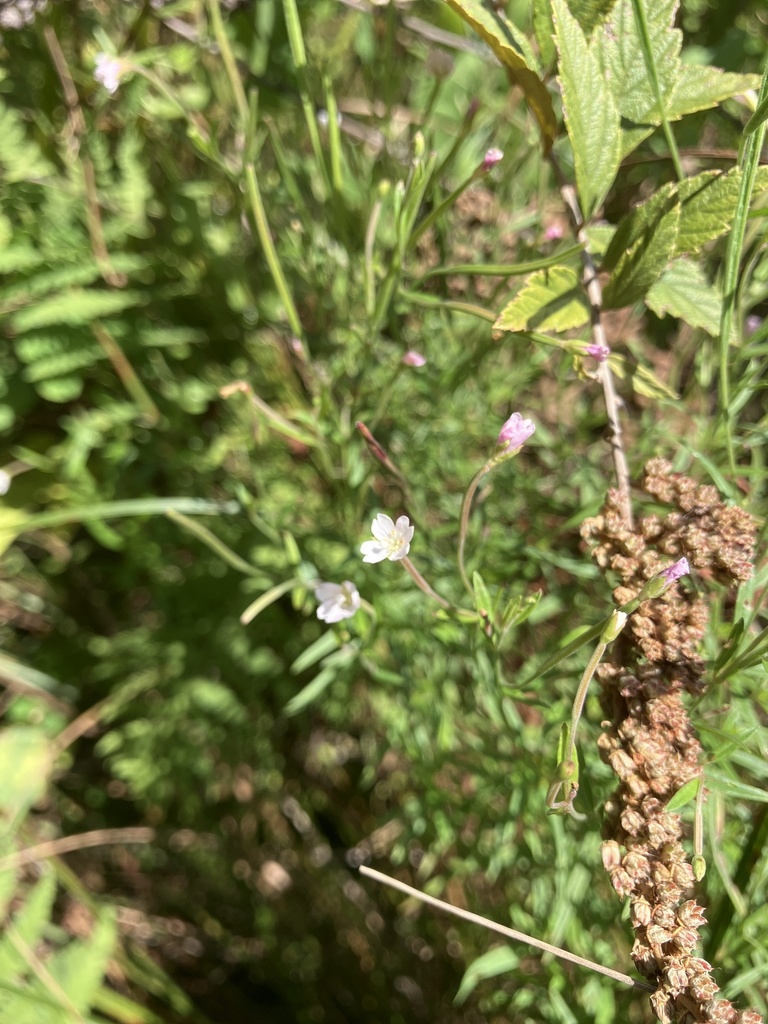
(c) Bryan Connolly, some rights reserved (CC BY) · licence
Family: Onagraceae · Type: Herb · Native
Conservation status: CNPS 2B.3
Epilobium palustre (Marsh willowherb) is a native California herb in the Onagraceae family, recognized by bulblet-tipped stolons and extremely long fruits.
Marsh willowherb is a rare (CNPS 2B.3) California native perennial found in northern Sierra Nevada Mountains, including Grass Lake in El Dorado County and Warner Range, in wet meadows, seeps, and bogs at elevations of 1,950 to 2,400 meters. Flowering from July to September, this plant produces white to pink flowers small and delicate. Growing with thread-like stems 10 to 80 centimeters tall, it forms compact stolons tipped with fleshy bulblets and has a fine, strigose texture especially along leaf bases. Its leaves are nearly sessile, 15 to 70 millimeters long, ranging from narrow linear to elliptic in shape. The fruit is elongated, 30 to 90 millimeters long with fine hairs, and the seeds have persistent hair-tufts.
Identification and appearance
Key characters: 24 sympatric species; bulblet-tipped stolons and extremely long fruits are diagnostic
Habitat and range
Habitat: Wet meadows, seeps, bogs, disturbed wet areas
Elevation: 1950-2400 m
Outside California: circumboreal
Bloom period
Epilobium palustre blooms Jul-Sep.
Conservation status
CNPS 2B.3
How to tell it apart
vs Penstemon: Epilobium has 4 notched petals and opposite leaves; Penstemon has 5-lobed tubular flowers (snapdragon family).; vs Gambelia: Epilobium has 4 notched petals; Gambelia has 5-lobed tubular snapdragon-like flowers.; vs Fuchsia: Epilobium has notched petals spreading flat; Fuchsia has dangling tubular flowers with protruding stamens.; vs Keckiella: Epilobium has 4 notched petals; Keckiella has 5-lobed tubular snapdragon-like flowers.; vs Diplacus: Epilobium has 4 notched petals; Diplacus has 5-lobed tubular monkey flowers.
Frequently asked questions
Is Epilobium palustre native to California?
Yes. Epilobium palustre is native to California (recorded as native).
When does Epilobium palustre bloom?
Epilobium palustre blooms Jul-Sep.
What plant family does Epilobium palustre belong to?
Epilobium palustre is in the Onagraceae family, genus Epilobium.
Is Epilobium palustre rare or endangered?
Epilobium palustre carries California Rare Plant Rank 2B.3, state rank S2.
What habitat does Epilobium palustre grow in?
Epilobium palustre grows in Wet meadows, seeps, bogs, disturbed wet areas.
Related species
Other California species in the same genus, family, or bioregion.
Sources: Jepson eFlora · CNPS Rare Plant Inventory · Index of California Plant Names · CalPhotos · CDFW CNDDB
Last updated 2026-10-07
Data from The California Species Project — 14,000+ California species with verified data from CNPS, CDFW, USFWS, Cal-IPC, and more.