Epilobium rigidum
Siskiyou mountains willowherb, Siskiyou Mountains Willowherb
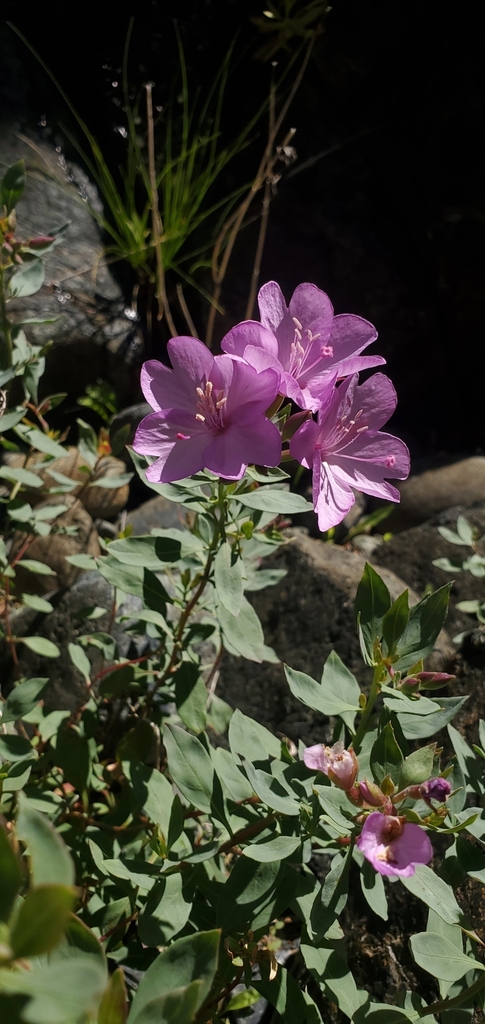
(c) Asher Budnik, some rights reserved (CC BY) · licence
Family: Onagraceae · Type: Subshrub · Native
Conservation status: CNPS 4.3
Epilobium rigidum (Siskiyou mountains willowherb) is a native California subshrub in the Onagraceae family.
Siskiyou mountains willowherb is a California native perennial found in the northwestern Klamath Ranges of Del Norte County in dry, open places and streambeds at elevations of 100 to 1,200 meters. Flowering from July to September, this plant produces delicate pink to rose-purple flowers with petals 16 to 20 millimeters long. Growing with ascending wiry shoots 10 to 40 centimeters tall, it forms clumps from a woody caudex with stems that peel proximally and become finely hairy toward the tips. Its leaves are approximately obovate, 20 to 45 millimeters long, nearly glabrous with short 2 to 6 millimeter petioles and nearly entire margins. The slender fruit is club-like, 20 to 35 millimeters long and covered in fine strigose hairs.
Identification and appearance
Key characters: Geographically isolated in Del Norte County with no sympatric species
Habitat and range
Habitat: Dry, open places, dry streambeds, sometimes on serpentine-like soils
Elevation: 100-1200 m
California counties: Del Norte
Outside California: southwestern Oregon
Bloom period
Epilobium rigidum blooms Jul-Sep.
Conservation status
CNPS 4.3
How to tell it apart
vs Penstemon: Epilobium has 4 notched petals and opposite leaves; Penstemon has 5-lobed tubular flowers (snapdragon family).; vs Gambelia: Epilobium has 4 notched petals; Gambelia has 5-lobed tubular snapdragon-like flowers.; vs Fuchsia: Epilobium has notched petals spreading flat; Fuchsia has dangling tubular flowers with protruding stamens.; vs Keckiella: Epilobium has 4 notched petals; Keckiella has 5-lobed tubular snapdragon-like flowers.; vs Diplacus: Epilobium has 4 notched petals; Diplacus has 5-lobed tubular monkey flowers.
Frequently asked questions
Is Epilobium rigidum native to California?
Yes. Epilobium rigidum is native to California (recorded as native).
When does Epilobium rigidum bloom?
Epilobium rigidum blooms Jul-Sep.
Where in California does Epilobium rigidum grow?
Epilobium rigidum occurs in Del Norte, at elevations of 100-1200 m.
What plant family does Epilobium rigidum belong to?
Epilobium rigidum is in the Onagraceae family, genus Epilobium.
Is Epilobium rigidum rare or endangered?
Epilobium rigidum carries California Rare Plant Rank 4.3, state rank S3.
Related species
Other California species in the same genus, family, or bioregion.
Sources: Jepson eFlora · CNPS Rare Plant Inventory · Index of California Plant Names · CalPhotos · CDFW CNDDB
Last updated 2026-10-07
Data from The California Species Project — 14,000+ California species with verified data from CNPS, CDFW, USFWS, Cal-IPC, and more.