Epilobium septentrionale
Humboldt county fuchsia, Humboldt County Fuchsia
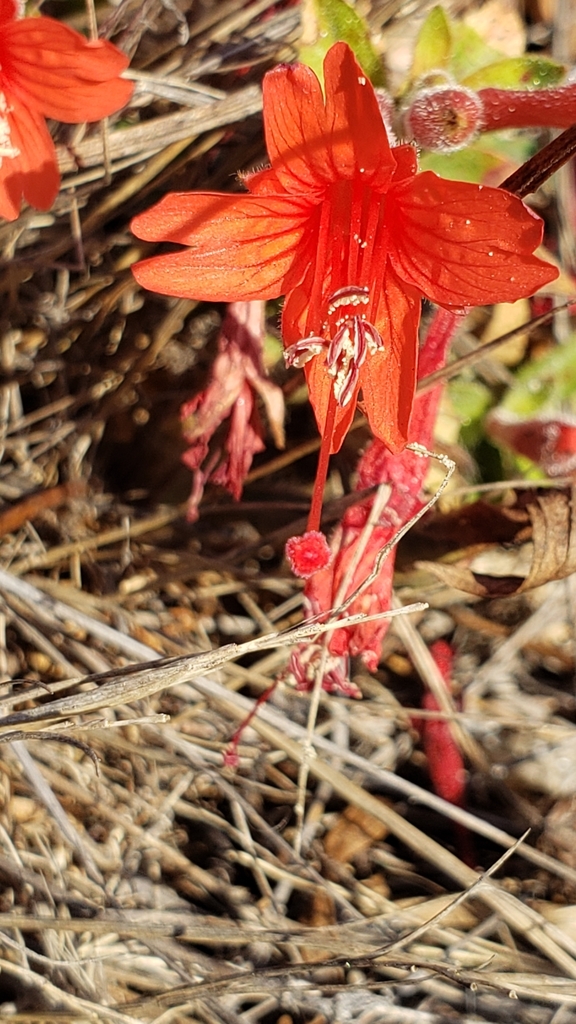
(c) Rupert Clayton, some rights reserved (CC BY) · licence
Family: Onagraceae · Type: Herb · Native
Conservation status: CNPS 4.3
Epilobium septentrionale (Humboldt county fuchsia) is a native California herb in the Onagraceae family, recognized by red-orange flowers and white-canescent habit are unique.
Humboldt county fuchsia is a California native perennial ranked 4.3 by CNPS, found in northern coastal California bioregions including North Coast and North Coast Ranges on dry, sandy or rocky serpentine slopes at elevations of 20 to 1,900 meters. Flowering from July to September, this plant produces distinctive red-orange flowers 8 to 14 millimeters long with a white-canescent appearance. Growing as a low, matted herb 5 to 20 centimeters tall with a wiry, somewhat woody base, it spreads in dense clusters with scaly lower stems. Its leaves are generally opposite, lanceolate to ovate, 10 to 25 millimeters long, covered in white-canescent hair and appearing soft and pale green. The fruit is 20 to 26 millimeters long with a short beak and hairy surface.
Identification and appearance
Key characters: 14 sympatric species; red-orange flowers and white-canescent habit are unique
Habitat and range
Habitat: Dry, sandy or rocky ledges (serpentine slopes)
Elevation: 20-1900 m
California counties: Humboldt, Trinity, Mendocino, Yuba, Siskiyou
Bloom period
Epilobium septentrionale blooms Jul-Sep.
Conservation status
CNPS 4.3
How to tell it apart
vs Penstemon: Epilobium has 4 notched petals and opposite leaves; Penstemon has 5-lobed tubular flowers (snapdragon family).; vs Gambelia: Epilobium has 4 notched petals; Gambelia has 5-lobed tubular snapdragon-like flowers.; vs Fuchsia: Epilobium has notched petals spreading flat; Fuchsia has dangling tubular flowers with protruding stamens.; vs Keckiella: Epilobium has 4 notched petals; Keckiella has 5-lobed tubular snapdragon-like flowers.; vs Diplacus: Epilobium has 4 notched petals; Diplacus has 5-lobed tubular monkey flowers.
Frequently asked questions
Is Epilobium septentrionale native to California?
Yes. Epilobium septentrionale is native to California (recorded as native).
When does Epilobium septentrionale bloom?
Epilobium septentrionale blooms Jul-Sep.
Where in California does Epilobium septentrionale grow?
Epilobium septentrionale occurs in Humboldt, Trinity, Mendocino, Yuba, Siskiyou, at elevations of 20-1900 m.
What plant family does Epilobium septentrionale belong to?
Epilobium septentrionale is in the Onagraceae family, genus Epilobium.
Is Epilobium septentrionale rare or endangered?
Epilobium septentrionale carries California Rare Plant Rank 4.3, state rank S4.
Related species
Other California species in the same genus, family, or bioregion.
Sources: Jepson eFlora · CNPS Rare Plant Inventory · Index of California Plant Names · CalPhotos · CDFW CNDDB
Last updated 2026-10-07
Data from The California Species Project — 14,000+ California species with verified data from CNPS, CDFW, USFWS, Cal-IPC, and more.