Epipactis helleborine
Broad-leaved helleborine, Broad-Leaved Helleborine
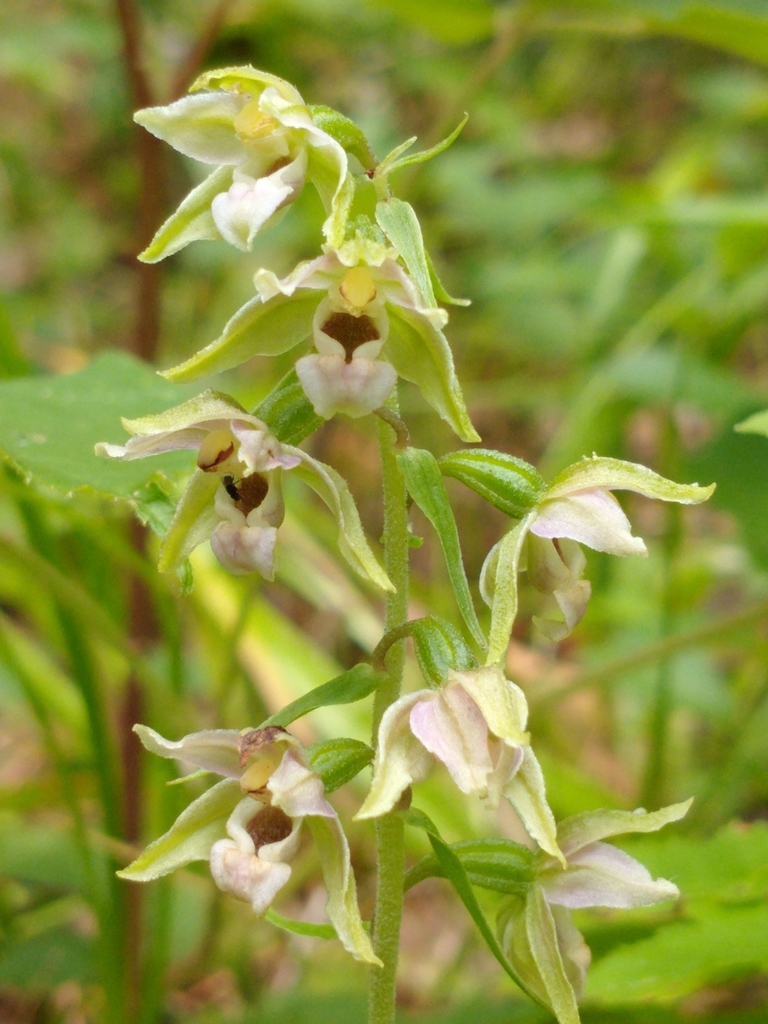
(c) Tom Norton, some rights reserved (CC BY) · licence
Family: Orchidaceae · Type: Herb · Not Native
Epipactis helleborine (Broad-leaved helleborine) is a non-native California herb in the Orchidaceae family, recognized by non-native status, dry habitat preference, and smaller petal size.
Broad-leaved helleborine is a naturalized perennial orchid found in southern North Coast Ranges, southern North Coast Interiors, central Sierra Nevada, Central Coast, San Francisco Bay Area, and expected in other regions, typically occurring on dry slopes, roadcuts, and mixed-conifer forest at elevations below 1,300 meters. Flowering from April to December, this plant produces green to pink flowers with sepals often purple-tinged, featuring lateral petals 8 to 11 millimeters long and a distinctive lip that transitions from white to pink on the outside and brown to purple on the inside. Growing with robust stems 40 to 100 centimeters tall, it develops an elegant vertical structure characteristic of woodland orchids. Its leaves are 6 to 10 centimeters long, ranging from lanceolate to ovate, and displaying varied coloration including green, white, and pink tones. The fruit develops 1 to 1.5 centimeters long, completing the plant's seasonal cycle.
Identification and appearance
Key characters: 1 sympatric species; distinguished by non-native status, dry habitat preference, and smaller petal size
Habitat and range
Habitat: Generally dry slopes, roadcuts, mixed-conifer forest
Elevation: < 1300 m
California counties: Los Angeles, Contra Costa, Santa Cruz, Marin, Monterey, Santa Clara, San Mateo, Alameda, Napa, Sonoma, Tuolumne
Outside California: to eastern Canada, central and northeastern United States, native to Europe
Bloom period
Epipactis helleborine blooms Apr-Dec.
How to tell it apart
vs Maianthemum: Epipactis has pleated leaves and orchid flowers with a distinct lip petal, while Maianthemum has smooth leaves and tiny 4-parted flowers.; vs Veratrum: Epipactis leaves have 3-5 pleats and orchid flowers, while Veratrum has heavily pleated fan-like leaves and small 6-parted flowers in large clusters.; vs Platanthera: Epipactis leaves have multiple pleats and flowers lack spurs, while Platanthera leaves have one central fold and flowers have spurs.; vs Cymbidium: Epipactis has pleated leaves arranged up the stem, while cultivated Cymbidium has smooth strap-like leaves in clusters.; vs Iris: Epipactis has pleated leaves arranged alternately up the stem, while Iris has smooth sword-shaped leaves in fans from the base.
Frequently asked questions
Is Epipactis helleborine native to California?
No. Epipactis helleborine is not native to California (recorded as not native).
When does Epipactis helleborine bloom?
Epipactis helleborine blooms Apr-Dec.
Where in California does Epipactis helleborine grow?
Epipactis helleborine occurs in Los Angeles, Contra Costa, Santa Cruz, Marin, Monterey, Santa Clara, San Mateo, Alameda and other counties, at elevations of < 1300 m.
What plant family does Epipactis helleborine belong to?
Epipactis helleborine is in the Orchidaceae family, genus Epipactis.
What habitat does Epipactis helleborine grow in?
Epipactis helleborine grows in Generally dry slopes, roadcuts, mixed-conifer forest.
Related species
Other California species in the same genus, family, or bioregion.
Sources: Jepson eFlora · Index of California Plant Names · CalPhotos
Last updated 2026-10-07
Data from The California Species Project — 14,000+ California species with verified data from CNPS, CDFW, USFWS, Cal-IPC, and more.