Equisetum arvense
Common horsetail, Common Horsetail
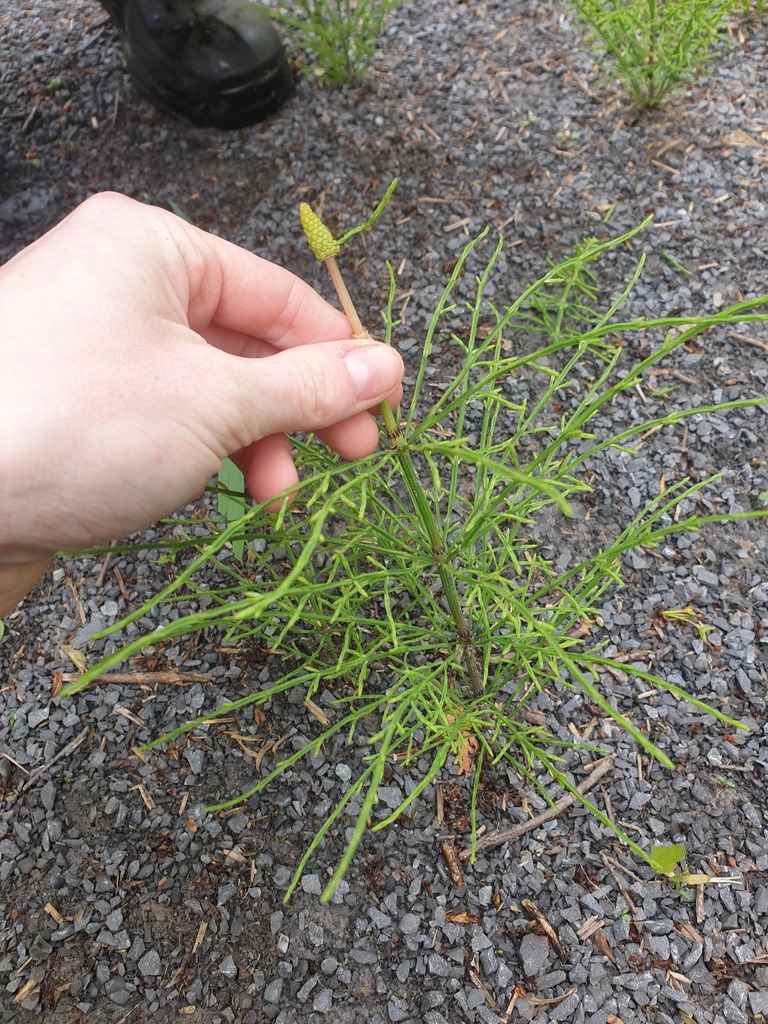
no rights reserved · CC0
Family: Equisetaceae · Type: Herb · Native
Equisetum arvense (Common horsetail) is a native California herb in the Equisetaceae family, recognized by clearly distinguished by dimorphic stems and solid branched structure.
Common horsetail is a native perennial found in northwestern California, Cascade Range, Sierra Nevada, Central Valley, Central Coast, San Francisco Bay Area, southern Coast Ranges, southwestern California, Modoc Plateau, eastern Sierra Nevada, and Mojave Desert in streambanks, wet meadows, springs, and other wet, shaded places at elevations up to 3,050 meters. This distinctive plant produces two types of stems: green sterile stems 10 to 60 centimeters tall with multiple branches, and ephemeral brown fertile stems 11 to 32 centimeters long. Growing with jointed, hollow stems that have distinctive ridged branches, it features dark-tipped sheaths with 6 to 14 teeth. Its branches have 3 to 4 rounded ridges and emerge from basal internodes that are longer than the surrounding sheaths. In wet habitats, this horsetail forms dense, distinctive clusters with its segmented, green stems that give it a distinctive, prehistoric appearance.
Identification and appearance
Key characters: 5 sympatric species; clearly distinguished by dimorphic stems and solid branched structure
Habitat and range
Habitat: Streambanks, wet meadows, springs, other wet, shaded places
Elevation: < 3050 m
California counties: San Mateo, San Bernardino, Santa Cruz, San Joaquin, San Diego, Tuolumne, Trinity, Plumas, Shasta, Sonoma, Tulare, Butte, Mono, Los Angeles, Riverside, Fresno, Orange, El Dorado, Humboldt, Inyo, Kern, Lake, Madera, Marin, Mariposa, Mendocino, Modoc, San Francisco, San Luis Obispo, Santa Barbara, Alameda, Placer, Amador, Nevada, Calaveras, Alpine, Santa Clara, Lassen, Del Norte, Napa, Monterey, Sierra, Yolo, Siskiyou, Tehama, Yuba, Colusa, Sacramento, Contra Costa, Ventura, Stanislaus, Solano
Outside California: North America, Europe, Asia
How to tell it apart
vs Foeniculum: Equisetum has scale-like leaves in whorls; Fennel has feathery, thread-like leaf divisions.; vs Hippuris: Equisetum has fused scale-like leaves at joints; Hippuris has separate linear leaves in whorls.; vs Juncus: Equisetum stems have distinct joints with leaf whorls; Juncus stems are smooth without joints.; vs Elegia: Equisetum stems are rough and hollow with whorled scales; Elegia has smooth stems with overlapping leaf sheaths.; vs Pinus: Equisetum is an herbaceous plant with jointed stems; Pine is a woody tree with needle clusters.
Frequently asked questions
Is Equisetum arvense native to California?
Yes. Equisetum arvense is native to California (recorded as native).
Where in California does Equisetum arvense grow?
Equisetum arvense occurs in San Mateo, San Bernardino, Santa Cruz, San Joaquin, San Diego, Tuolumne, Trinity, Plumas and other counties, at elevations of < 3050 m.
What plant family does Equisetum arvense belong to?
Equisetum arvense is in the Equisetaceae family, genus Equisetum.
What habitat does Equisetum arvense grow in?
Equisetum arvense grows in Streambanks, wet meadows, springs, other wet, shaded places.
Related species
Other California species in the same genus, family, or bioregion.
Sources: Jepson eFlora · Index of California Plant Names · CalPhotos
Last updated 2026-10-07
Data from The California Species Project — 14,000+ California species with verified data from CNPS, CDFW, USFWS, Cal-IPC, and more.