Eragrostis barrelieri
Mediterranean love grass
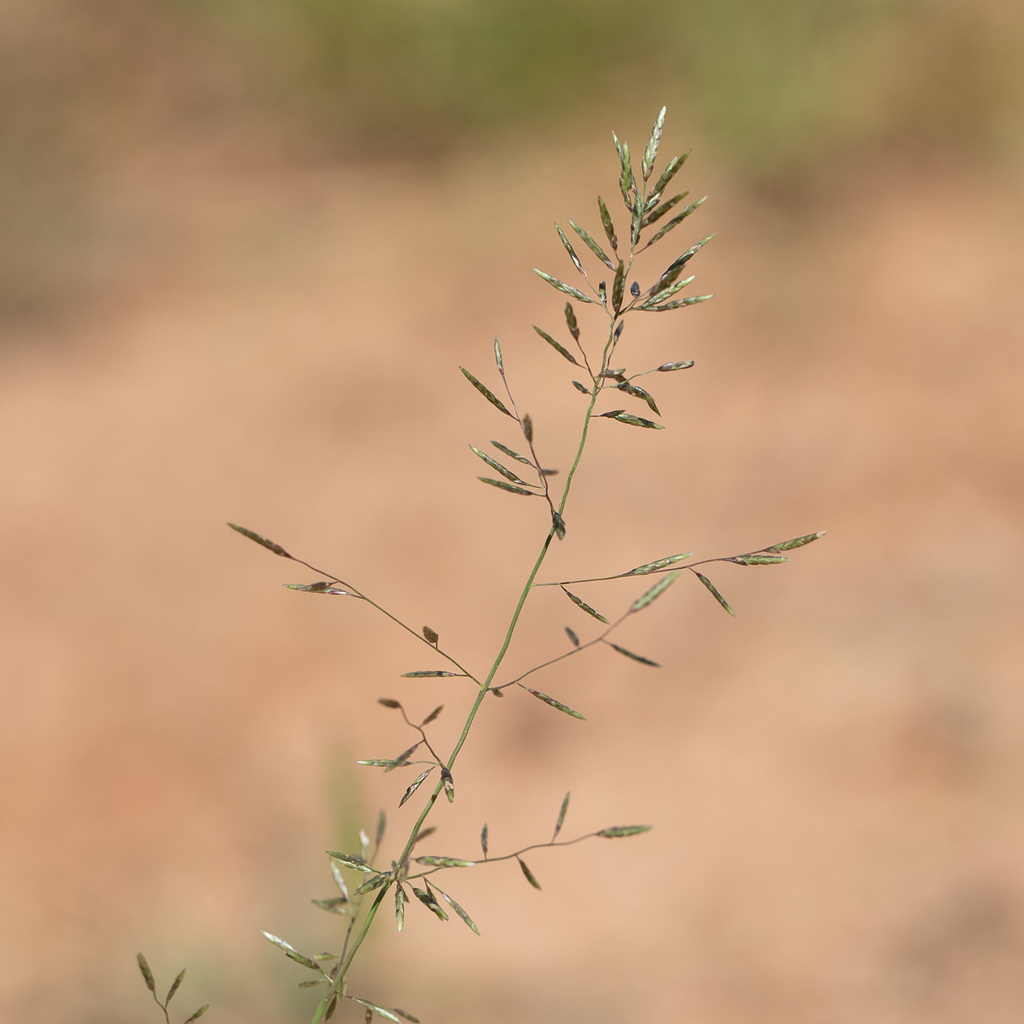
(c) Kym Nicolson, some rights reserved (CC BY), uploaded by Kym Nicolson · licence
Family: Poaceae · Type: Grass · Not Native
Eragrostis barrelieri (Mediterranean love grass) is a non-native California grass in the Poaceae family, recognized by glandular bands on inflorescence axis and glands below nodes.
Mediterranean love grass is a naturalized annual grass found in the Central Valley, southern Coast Ranges, southern California, western Transverse Ranges, San Bernardino Mountains, and Peninsular Ranges in disturbed soils at elevations below 1,200 meters. Flowering from June to July, this grass produces small, densely clustered spikelets with gray-green to reddish lemmas in open, spreading inflorescences. Growing 25 to 60 centimeters tall, it forms tufted or occasionally prostrate-spreading clumps with branching stems that are glandular near the nodes. Its leaf blades are 2 to 10 centimeters long, 2 to 5 millimeters wide, and generally glabrous, with flat to slightly inrolled tips. The tiny fruits are elliptic-ovoid, approximately 0.8 millimeters long, creating delicate, loose panicles across disturbed landscapes.
Identification and appearance
Key characters: 11 sympatric species; key features are glandular bands on inflorescence axis and glands below nodes
Habitat and range
Habitat: Disturbed soils
Elevation: < 1200 m
California counties: Santa Barbara, San Bernardino, Fresno, Ventura, Los Angeles, Orange, San Diego, Riverside, Solano, Tuolumne, Yolo, San Luis Obispo
Outside California: to Kansas, Texas, native to southern Europe
Bloom period
Eragrostis barrelieri blooms Jun-Jul.
How to tell it apart
vs Poa: Eragrostis spikelets are many-flowered and laterally flattened with 3-veined lemmas and no cobwebby tuft at the floret base; Poa lemmas are 5-veined, keeled and boat-tipped, often with webby hairs at the base.; vs Bromus: Eragrostis lemmas are small and awnless with 3 prominent veins; Bromus lemmas are larger, many-veined, and usually bear an awn from a notched tip.; vs Sporobolus: Eragrostis spikelets carry several florets each; Sporobolus spikelets hold a single floret and the ripe seed often falls free or swells with mucilage.; vs Muhlenbergia: Eragrostis spikelets are many-flowered and awnless in an open panicle; Muhlenbergia spikelets are 1-flowered and the lemma is commonly awn-tipped.; vs Leptochloa: Eragrostis carries spikelets in an open, spreading panicle; Leptochloa arranges them along slender, one-sided spike-like branches.
Frequently asked questions
Is Eragrostis barrelieri native to California?
No. Eragrostis barrelieri is not native to California (recorded as not native).
When does Eragrostis barrelieri bloom?
Eragrostis barrelieri blooms Jun-Jul.
Where in California does Eragrostis barrelieri grow?
Eragrostis barrelieri occurs in Santa Barbara, San Bernardino, Fresno, Ventura, Los Angeles, Orange, San Diego, Riverside and other counties, at elevations of < 1200 m.
What plant family does Eragrostis barrelieri belong to?
Eragrostis barrelieri is in the Poaceae family, genus Eragrostis.
What habitat does Eragrostis barrelieri grow in?
Eragrostis barrelieri grows in Disturbed soils.
Related species
Other California species in the same genus, family, or bioregion.
Sources: Jepson eFlora · Index of California Plant Names · CalPhotos
Last updated 2026-10-07
Data from The California Species Project — 14,000+ California species with verified data from CNPS, CDFW, USFWS, Cal-IPC, and more.