Eremocarya micrantha var. micrantha
Desert red-root
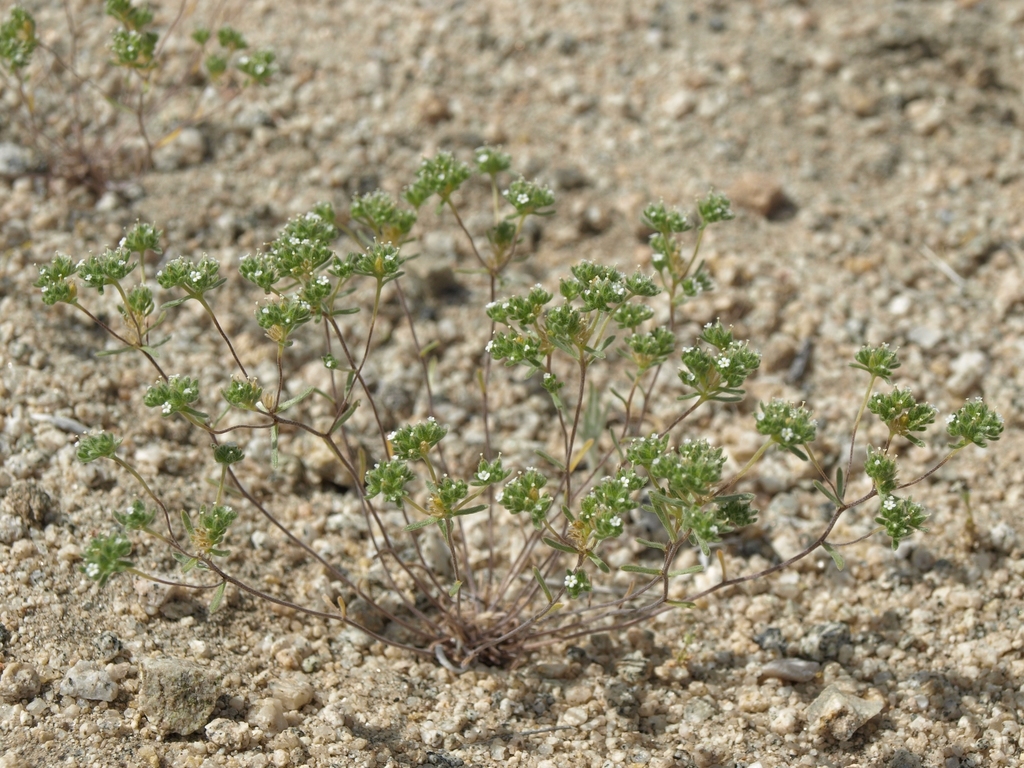
(c) Jim Morefield, some rights reserved (CC BY) · licence
Family: Boraginaceae · Type: Herb · Native
Eremocarya micrantha var. micrantha (Desert red-root) is a native California herb in the Boraginaceae family, recognized by growth form (wider than tall vs taller than wide), habitat (desert vs mountain), and flower appendage size/color.
Desert red-root is a California native annual found in southwestern California (excluding Channel Islands), southeastern Sierra Nevada, and desert regions in sandy washes and fine-gravelly soils at elevations below 1,900 meters. Flowering from February to June, this plant produces white flowers with delicate, minute appendages in small clusters. Growing as a low, spreading plant 2.5 to 10 centimeters tall, with branches emerging from the base and extending wider than its height. Its leaves are small and compact, adapting to the sparse desert environment. The fruit consists of tiny nutlets less than 1.2 millimeters long with a sharp, acute tip.
Identification and appearance
Key characters: 1 sympatric species; distinguished by growth form (wider than tall vs taller than wide), habitat (desert vs mountain), and flower appendage size/color
Habitat and range
Habitat: Desert flats, washes, sandy to fine-gravelly soils
Elevation: < 1900 m
California counties: San Bernardino, Riverside, Inyo, Los Angeles, Ventura, San Diego, Kern, Mono, Imperial
Outside California: to Utah, Texas, northern Mexico
Bloom period
Eremocarya micrantha var. micrantha blooms Feb-Jun.
How to tell it apart
vs Cryptantha: Eremocarya has a small corolla with a conspicuous yellow center and prominent yellow throat appendages; Cryptantha typically shows a white throat with less prominent appendages.; vs Johnstonella: Eremocarya has a distinctly yellow-eyed flower and acuminate nutlets; Johnstonella has white flowers and differently ornamented nutlets.; vs Greeneocharis: Eremocarya is erect and taller than wide with acuminate nutlets; Greeneocharis is a low, rounded, cushion-like plant.; vs Plagiobothrys: Eremocarya is a dry-desert annual with tiny yellow-centered flowers and non-staining herbage; Plagiobothrys (popcornflowers) often stain purple and grow in moist ground.; vs Amsinckia: Eremocarya has tiny white flowers with a yellow eye in short coils; Amsinckia (fiddleneck) has orange-yellow tubular flowers in a strongly coiled cyme.
Frequently asked questions
Is Eremocarya micrantha var. micrantha native to California?
Yes. Eremocarya micrantha var. micrantha is native to California (recorded as native).
When does Eremocarya micrantha var. micrantha bloom?
Eremocarya micrantha var. micrantha blooms Feb-Jun.
Where in California does Eremocarya micrantha var. micrantha grow?
Eremocarya micrantha var. micrantha occurs in San Bernardino, Riverside, Inyo, Los Angeles, Ventura, San Diego, Kern, Mono and other counties, at elevations of < 1900 m.
What plant family does Eremocarya micrantha var. micrantha belong to?
Eremocarya micrantha var. micrantha is in the Boraginaceae family, genus Eremocarya.
What habitat does Eremocarya micrantha var. micrantha grow in?
Eremocarya micrantha var. micrantha grows in Desert flats, washes, sandy to fine-gravelly soils.
Related species
Other California species in the same genus, family, or bioregion.
Sources: Jepson eFlora · Index of California Plant Names · CalPhotos
Last updated 2026-10-07
Data from The California Species Project — 14,000+ California species with verified data from CNPS, CDFW, USFWS, Cal-IPC, and more.